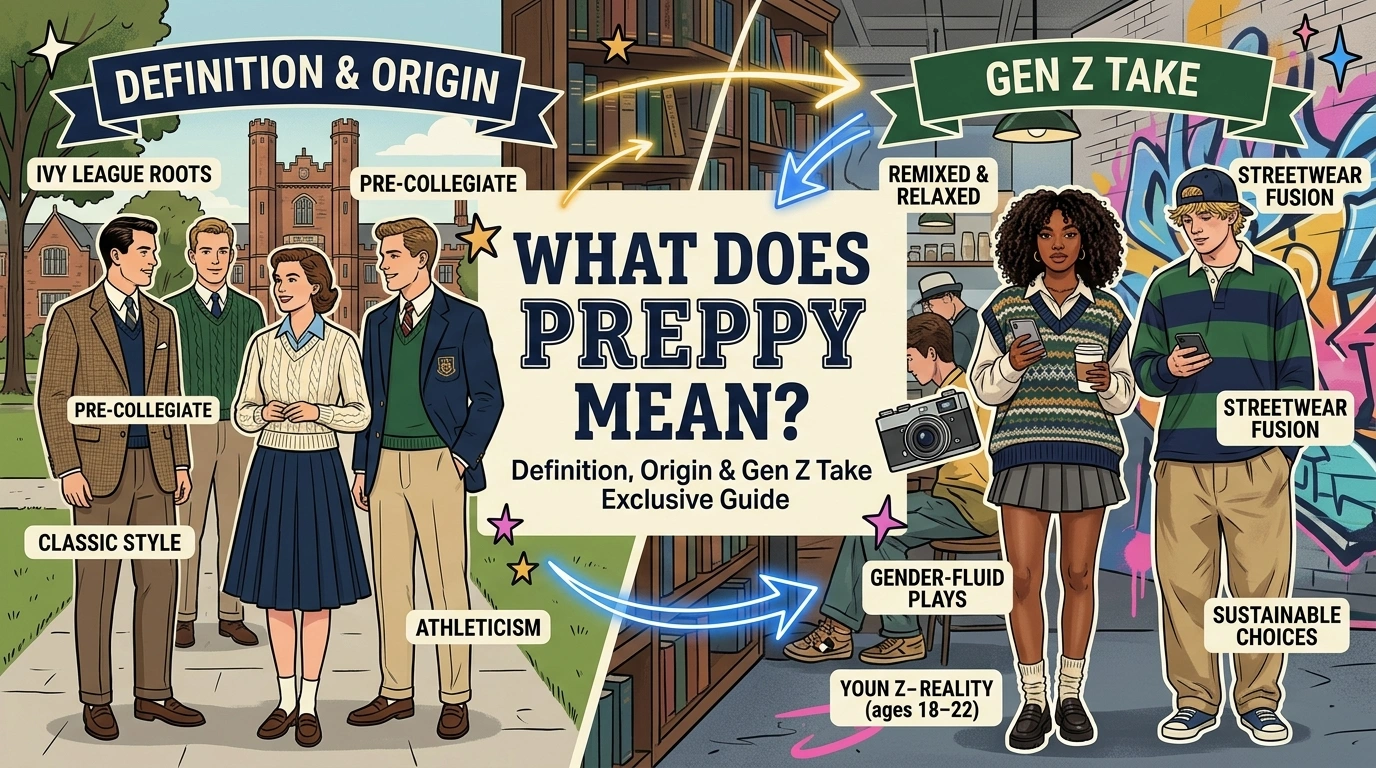
What Does Preppy Mean? Definition, Origin & Gen Z Take Exclusive Guide
What Does Preppy Mean?
There’s something almost paradoxical about the word preppy. It started as a descriptor for a very specific type of person – someone who attended elite prep schools, wore navy blazers without thinking twice, and lived a life that felt like a Ralph Lauren catalog. Decades later, it has morphed into a mood, a TikTok aesthetic, and a Gen Alpha personality quiz answer. The word has outgrown its origins so thoroughly that two people using it in the same sentence might mean completely different things – and both would be right.
Understanding what preppy actually means in 2026 requires untangling its past from its present, and separating the old-money roots from the bright, girly-and-colorful reinterpretation that preteen girls on Roblox now claim as their own identity.
The Real Definition of Preppy: More Than Just a Dress Code
At its most literal, preppy (sometimes spelled preppie) is an adjective and occasionally a noun used to describe a style, attitude, or person associated with the culture of preparatory schools, commonly called “prep schools.” These are private academic institutions, historically elite and expensive, that prepared students for Ivy League universities. The youth of wealthy prep schools in the northeastern United States developed a very recognizable look: clean cuts, collared shirts, structured clothing, and an overall academic, professional look that communicated both wealth and taste without being flashy about it.
The word carries a double meaning even in its original form. Yes, it referred to fashion. But it also implied a whole worldview organized, ambitious, socially polished, and comfortably privileged.
By the 1980s, preppy had become mainstream cultural shorthand for a particular brand of casual but upscale fashion that was simultaneously conservative and aspirational. Think polo shirts tucked into pleated miniskirts, argyle sweaters draped over shoulders, white button-downs under navy blazers, and Mary Janes finishing the look. The aesthetic was unmistakable.
What makes the term genuinely interesting is how it has never fully belonged to one era. It keeps returning slightly shifted, slightly updated because the underlying idea of looking “put-together without trying too hard” never really goes out of style.
Where Did Preppy Actually Come From? The True Origin Story
The Prep School Roots (Pre-1970s)
The etymological trail leads directly to American preparatory schools boarding schools like Phillips Exeter Academy and Choate Rosemary Hall that served as pipelines to Harvard, Yale, and Princeton. Students at these institutions, mostly from affluent East Coast families, developed a shared wardrobe that was practical for campus life but subtly signaled social class.
Oxfords, loafers, cable-knit sweaters, and chinos were the staples. Nothing was loud or overdone. The clothing was meant to look effortless, which, ironically, required a great deal of deliberate choice. This is a key tension that has defined preppy fashion ever since.
The 1980s Mainstream Explosion
The term entered popular American culture aggressively in the 1980s, helped in large part by The Official Preppy Handbook (1980), a satirical guide that somehow functioned both as parody and aspirational manual simultaneously. Around the same time, Ralph Lauren was transforming what had been a niche East Coast aesthetic into a global lifestyle brand. Polo shirts now practically synonymous with preppy style became cultural currency.
The 1980s version of preppy leaned heavily into pastel colors, monogrammed accessories, and a kind of cheerful conformity. It was polished, it was privileged, and it was everywhere.
The 90s Preppy Twist and the Clueless Effect
By the late 1990s, preppy got a shrunken, self-aware twist. Cher Horowitz from Clueless (1995) became one of the most iconic preppy characters in pop culture but her version of the aesthetic was deliberately heightened, almost satirical, mixing plaid skirts with coordinated blazers in hot pink and yellow. It was school-uniform-chic turned maximalist.
Blair Waldorf from Gossip Girl (which premiered in 2007 but defined a generation’s understanding of elite preppy culture through reruns and Netflix) pushed it further into luxury territory headbands, structured coats, monogrammed everything. Blair’s look drew from Chanel, Dior, and Vivienne Westwood as much as from any American prep tradition.
These pop culture figures didn’t just reflect preppy they actively shaped what the word meant for Millennials and early Gen Z.
How Preppy Is Used Today: From Slang to Aesthetic Identity
The Gen Z and TikTok Redefinition
Something shifted around the early 2020s. On TikTok, preppy stopped being primarily a fashion descriptor and became what the fast-paced world of fashion aesthetics calls a vibe a complete identity package. It merged with concepts like the old money aesthetic, absorbed elements of Lululemon-era athleisure, and began appearing alongside Stanley cups and skincare products as markers of a specific kind of aspirational, feminine lifestyle.
Gen Z and Gen Alpha users on TikTok started using “preppy” as a social media micro-label one of those neatly packaged identities you could claim in a bio or use to filter content. The term’s range expanded dramatically. It now lives comfortably alongside office-siren aesthetics and vintage trends without contradiction.
One of the more fascinating developments is how deeply the word has embedded itself into gaming culture. On Roblox, specifically in the game Dress to Impress, “preppy” is one of the most-used style themes. For Generation Alpha kids born after 2013 this is often their first encounter with the concept. They’re building preppy avatars before they fully understand the historical context of prep schools. The aesthetic has genuinely decoupled from its origins.
For a deeper dive into how this style is being interpreted today, Preppyglow is one of the most thoughtful resources capturing the current conversation around preppy fashion and its evolving identity.
How the Word Is Actually Used in Sentences
Context matters enormously here. “Preppy” functions differently depending on who is saying it:
- As a compliment: “She has such a preppy vibe love the bow and the blazer.”
- As a neutral descriptor: “The dress code is pretty preppy think polo shirts and khakis.”
- As a slang identifier: “I’m going full preppy for the Roblox competition.”
- As a cultural shorthand: “That neighborhood has very preppy energy lots of Lululemon and lattes.”
The word has largely shed its negative connotations (it used to carry a slight air of snobbery) and functions now mostly as affectionate shorthand for a clean, elite look that signals effort-through-effortlessness.
The Visual Language of Preppy: What It Actually Looks Like
Preppy fashion has a very specific visual vocabulary, and while it has evolved across decades, certain elements remain constant. Here’s how the core look breaks down:
Classic Preppy Wardrobe Staples
- Polo shirts the cornerstone piece, especially in solid colors or subtle stripes
- Argyle sweaters diamond-patterned knitwear in muted or pastel tones
- Navy blazers structured, slightly formal, worn casually over almost anything
- White button-downs clean, crisp, tucked or half-tucked
- Plaid skirts / pleated miniskirts particularly the tartan or Burberry-adjacent patterns
- Mary Janes the shoe of choice for the feminine preppy look
- Hair bows and headbands Blair Waldorf’s most enduring legacy
- Uggs and Doc Martens absorbed into the modern preppy rotation via Gen Z
The Color Palette
Traditional preppy leaned on navy, white, hunter green, and burgundy. The modern version, especially as interpreted by Gen Alpha on platforms like TikTok and Threads, has embraced pastel pinks and blues, hot pink statements, and smiley faces and lightning bolt patterns on accessories. Bright colors and playful patterns now sit comfortably within the preppy umbrella in a way they wouldn’t have in 1985.
Preppy vs. Similar Aesthetics: What’s the Actual Difference?
This is where a lot of people get confused. Preppy overlaps with several adjacent aesthetics but maintains distinct characteristics. Here’s a clear breakdown:
| Aesthetic | Core Vibe | Key Markers | Origins |
|---|---|---|---|
| Preppy | Clean, elite, academic | Polo shirts, blazers, plaid skirts, headbands | East Coast prep schools |
| Old Money | Quiet luxury, inherited wealth | Neutral tones, quality fabrics, no logos | European aristocracy + WASP culture |
| Cottagecore | Whimsical, nature-adjacent | Floral prints, linen, aprons | Rural romanticism |
| Office Siren | Powerful femininity | Tailored suits, heels, structured bags | Corporate culture reinterpreted |
| Clean Girl | Effortless minimalism | Slicked-back bun, gold jewelry, dewy skin | Social media aesthetics c. 2022 |
| Dark Academia | Intellectual, moody | Tweed, browns, vintage books | Gothic literature + campus life |
The most common confusion is between preppy and old money aesthetic. While they share DNA both prize polish over flash, both draw from elite institutions old money deliberately avoids visible branding and leans into understated neutrals. Preppy, by contrast, has always been more comfortable with logos, color, and a certain cheerful visibility. Ralph Lauren is quintessentially preppy; a nameless cashmere sweater in oatmeal is old money.
Why Preppy Keeps Coming Back: The Psychology Behind the Aesthetic
There’s a reason preppy fashion is cyclical rather than permanently trendy or permanently dated. It taps into something durable: the desire to look competent, put-together, and socially legible without appearing to have tried too hard. In an era of micro-trends and social media micro-labels, that reliability is genuinely appealing.
For Generation Z and Millennials who grew up watching Blair Waldorf or rewatching Clueless, there’s also a powerful nostalgia component. The late 90s shrunken twist on preppy Cher’s coordinated sets, the plaid and knee socks reads as vintage now, which gives it a new layer of cool that the original wearers never intended.
For Generation Alpha, who encountered preppy first through Roblox games, YouTube hauls, and TikTok aesthetics, it carries no historical baggage at all. It’s just a vibe they chose. That democratization is both an evolution and a kind of flattening the cultural context gets lost, but the aesthetic lives on.
Britney Spears’ schoolgirl look in the “…Baby One More Time” video (1999) is often cited as one of the most culturally influential moments in preppy-adjacent fashion for that generation proof that the aesthetic’s reach has always extended far beyond actual prep schools.
Preppy in Digital Culture: TikTok, Roblox, and Beyond
The digital amplification of preppy deserves its own examination because it’s fundamentally changed how the word functions as a cultural concept.
On TikTok, preppy exists as both a fashion hashtag and a personality type. The “preppy girl” archetype organized, put-together, carrying a Stanley cup, doing a skincare routine, wearing a hair bow to school has become a recognizable content category. Brands like Lululemon have benefited enormously from this association without necessarily engineering it.
On Roblox, and specifically in Dress to Impress, preppy is one of the most-requested style categories. Users predominantly preteen girls and middle school girls treat it as a fully codified aesthetic with specific rules: plaid skirts, blazers, Mary Janes, pastel accessories. It’s essentially a digitized uniform.
On Threads and YouTube, preppy content tends to skew slightly older, with Millennials and older Gen Z engaging with it through a more nostalgic, fashion-historical lens discussing 90s fashion, the evolution of brands like Ralph Lauren, and whether specific items qualify as “actually preppy.”
Stores like Aritzia and Dear Hannah Prep have carved out space in the modern preppy market, while legacy retailers like Justice and PINK continue to serve the younger demographic that has enthusiastically claimed the aesthetic on digital platforms. The Children’s Place has also capitalized on Gen Alpha’s preppy moment with school-appropriate pieces that hit the aesthetic’s key visual notes.
Lesser-Known Facts About Preppy Culture Most People Miss
A few things about preppy that rarely make it into the mainstream conversation:
It was originally gender-neutral and somewhat subversive. The original prep school look wasn’t exclusively feminine. Boys in blazers and girls in knee socks were drawing from the same wardrobe tradition. The hyperfeminization of preppy is largely a product of 1990s and 2000s pop culture.
Preppy has always had a complicated relationship with exclusivity. The original version was about authentic membership in a social class. The mass-market version available at any mall was technically the same clothes but stripped of the social context. Ralph Lauren understood this tension better than anyone and used it to build an empire.
The aesthetic survives micro-trends precisely because it’s not a micro-trend. In the fast-paced world of fashion aesthetics where styles emerge and collapse within months, preppy persists because it predates the internet entirely. It has institutional weight. That longevity is rare.
Gen Alpha’s version is arguably the most creative. By removing the class context entirely and mixing plaid skirts with smiley face accessories and hot pink details, younger users have produced something genuinely new a playful, colorful, girly-and-colorful reinterpretation that has very little to do with Phillips Exeter Academy and everything to do with what looks good in a Roblox avatar screenshot.
For anyone building a preppy wardrobe or looking to understand how the aesthetic translates into real outfits in 2026, Preppyglow offers some of the most current and practical style guidance available grounded in both the fashion history and today’s aesthetic landscape.
Frequently Asked Questions About Preppy
What does preppy mean in simple terms?
Preppy refers to a fashion style and attitude originally associated with students at elite American prep schools. It emphasizes clean, polished, put-together clothing think polo shirts, blazers, plaid skirts, and structured accessories. Today, the term also functions as a broader aesthetic identity, particularly popular on TikTok and Roblox, that values a “casual but upscale” look.
Is preppy the same as old money aesthetic?
Not exactly. Both aesthetics prize polish and a certain understated elegance, but they differ in tone and execution. Old money aesthetic leans into quiet luxury neutral colors, quality fabrics, no visible branding. Preppy is more cheerful, colorful, and brand-comfortable. Blair Waldorf is preppy; a character in a nameless cashmere coat is old money.
How is preppy used as slang in 2026?
In current slang usage, “preppy” functions as both an adjective and an identity label. Someone might describe an outfit, a vibe, or even a personality type as “preppy.” On platforms like TikTok and Roblox, it’s used to signal a specific aesthetic category organized, feminine, colorful, and polished that has expanded well beyond its original class-based meaning.
What brands are most associated with the preppy aesthetic?
Ralph Lauren is the most historically significant preppy brand. In the current landscape, Lululemon is strongly associated with the modern preppy aesthetic, particularly through its athleisure crossover appeal. Aritzia and Dear Hannah Prep serve the contemporary market. For younger Gen Alpha consumers, stores like Justice, PINK, and The Children’s Place carry preppy-coded pieces at accessible price points.
Why is preppy so popular with Gen Alpha and Gen Z?
Multiple factors are at play. Nostalgia for 90s fashion Cher Horowitz, Blair Waldorf, the plaid-and-bow era drives Gen Z interest. For Gen Alpha, exposure through Roblox games like Dress to Impress made “preppy” a familiar aesthetic category before it was a historical concept. TikTok accelerated both groups’ engagement with it by packaging preppy as a shareable aesthetic identity complete with specific products, colors, and lifestyle markers.
What is the difference between preppy and school-uniform-chic?
School-uniform-chic is a sub-expression of preppy that specifically references the structured, institutional look of actual uniforms plaid skirts, white shirts, blazers with crests. Preppy is the broader parent aesthetic from which school-uniform-chic draws. You can be preppy without looking like you’re in a uniform, but school-uniform-chic is almost always read as preppy.
Did preppy originate in America or the UK?
The specific term “preppy” and its cultural context are distinctly American, rooted in northeastern U.S. preparatory school culture. However, the underlying aesthetic draws from British traditions boarding school dress codes, Savile Row tailoring influences, and aristocratic casualwear. British institutions like Vivienne Westwood later reinterpreted prep-school imagery through a more subversive, punk-adjacent lens, producing something quite different from the American original.
