What is Preppy Where It Came From & How to Dress It Amazing Guide 2026
What Is Preppy? Meaning, Style & Aesthetic Guide
There’s a particular kind of person who walks into a room and looks like they just stepped off a New England campus in October — collar up, chinos pressed, a Shetland sweater thrown over a crisp Oxford shirt. They’re not overdressed. They’re not underdressed. They look exactly right. That is preppy.
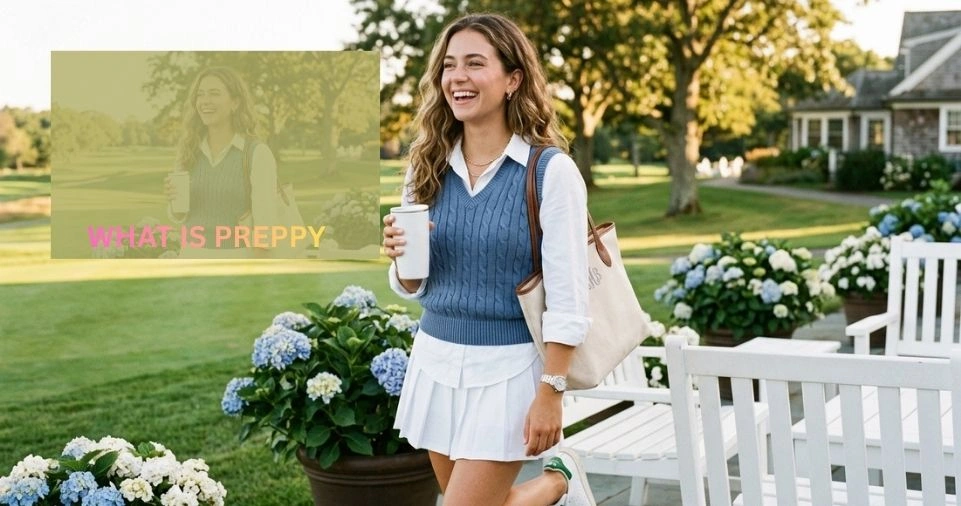
The word “preppy” is not merely a style label. It is a cultural shorthand — a single word that carries inside it an entire world of assumptions about education, geography, leisure, and a particular kind of American self-presentation. To understand preppy properly, you have to start with what the word actually means and where it came from, not just what it looks like on a person.
The Literal Meaning of Preppy
Preppy derives directly from “preparatory school” — the elite private secondary schools, predominantly on the American East Coast, that served as feeder institutions for Ivy League universities such as Harvard, Yale, Princeton, and Dartmouth. Schools like Phillips Exeter, Andover, Choate, and Groton were the original breeding grounds for the preppy sensibility. Students at these institutions developed a shared dress code: formal enough to signal seriousness, relaxed enough to signal ease. The result was a uniform that was, above all, comfortable in itself — neither straining for status nor indifferent to appearance.
The word “preppy” entered common usage as an adjective and noun in the mid-20th century, but its cultural meaning accelerated dramatically after 1980, when Lisa Birnbach’s The Official Preppy Handbook codified the entire subculture in print. What had been an insider vocabulary became a national reference point almost overnight.
What Does Preppy Mean Today?
Today, “preppy” means something broader than its literal origin. It describes an approach to dressing — and to a certain extent, an approach to living — rooted in quality, restraint, and a relaxed kind of elegance. In the current fashion moment, preppy resonates because it stands for something enduring rather than something seasonal. It is not a micro-trend or a runway moment. It is a wardrobe philosophy that has outlasted every trend that has tried to displace it since the 1950s.
When someone describes a shirt, a shoe, or a look as “preppy,” they mean it reads as collegiate, East Coast, heritage-inflected, and polished without being formal. The word carries associations of sailing, campus life, autumn weather, quality wool, and a certain ease of movement through the world. It is a word that implies both background and taste — and the most interesting thing about preppy dressing in the modern era is that the background is now entirely optional. The taste is what remains.
“Preppy stopped being a trend decades ago and became something closer to a timeless wardrobe system – a philosophy of dressing so deeply embedded in American cultural identity that it simply endures.”
What Is Preppy Style?

Preppy style is the visual language of the preppy world — a menswear and womenswear tradition built on heritage fabrics, classic silhouettes, collegiate layering, and a color palette that is simultaneously bold and restrained. It is American fashion at its most coherent and most copied.
The Defining Principles of Preppy Style
Preppy style is not an outfit – it is a system. The individual pieces only make full sense in relation to each other, and the system is governed by four principles that have remained constant since the look first emerged on Ivy League campuses in the 1950s.
- Relaxed tailoring: Preppy style sits in the territory between casual and formal, occupying it permanently. Nothing is too stiff. Nothing is too loose. Clothes are worn with a certain ease — the ease of someone who has worn these things all their life.
- Heritage fabrics: Cotton Oxford weave, Shetland wool, tweed, corduroy, madras, chino twill — these are materials with histories. They age well, they develop character, and they signal a preference for durability over trend.
- Classic silhouettes: The preppy wardrobe is built on shapes that have proven themselves: the straight-leg chino, the unstructured blazer, the crew-neck sweater, the slip-on loafer. These are not fashion silhouettes. They are clothing architecture.
- Detail-oriented dressing: A braided belt instead of a plain one. A button-down collar instead of a spread. A cuffed trouser instead of a plain hem. These details signal that the wearer knows exactly what they’re doing.
The Preppy Aesthetic Defined
The preppy aesthetic is, at its core, about understated elegance. It is the opposite of logomania and the opposite of minimalism. It occupies a middle ground that is harder to achieve than either extreme: wearing things of genuine quality, assembled with real intention, in a way that looks entirely effortless.
The preppy aesthetic draws on a very specific visual vocabulary: madras plaid, repp-stripe ties, Fair Isle patterns, argyle knitwear, houndstooth tweed, Breton stripes on rugby shirts. These patterns carry specific cultural associations, and wearing them fluently means understanding what those associations are and how they work together.
Color in the preppy aesthetic follows particular rules. Navy, khaki, forest green, burgundy, and cream are the anchors. Mustard, coral, and red appear as accents. The palette is simultaneously warm and cool, and the discipline is in limiting each outfit to two or three of these colors — enough to create visual interest, not so many as to create noise.
The Preppy Aesthetic vs. The Preppy Style
These two terms are often used interchangeably, but they describe slightly different things. Preppy style refers to the specific garments and how they are worn. The preppy aesthetic refers to the broader sensibility — the values of quality, heritage, and understated elegance — that those garments express. You can have the aesthetic without wearing every classic piece. You cannot truly dress in the style without understanding the aesthetic behind it.
Ivy League Style History

To understand preppy style fully, you need to understand where it came from — and it came from the most specific of places: the campuses of a handful of elite American universities in the years immediately following the Second World War.
The 1950s: The Original Campus Uniform
The roots of preppy fashion run directly to the 1950s menswear scene on East Coast Ivy League campuses. At schools like Princeton, Yale, and Harvard, students developed what has since been described as the “campus uniform” — a dress code that was formal enough for academic contexts and relaxed enough for everything else. This was not a self-conscious fashion movement. It was simply what well-dressed young men at these institutions wore, informed by both their social class and the practical demands of campus life.
The key pieces of this original campus uniform were few and specific. The Brooks Brothers OCBD (Oxford Cloth Button-Down) shirt, originally designed for polo players to keep their collars from flapping, became the foundational piece. Chinos, repurposed from military surplus, offered a trouser that was neither formal nor casual. Norwegian-inspired penny loafers — the Weejun, introduced by G.H. Bass in 1936 — became the definitive shoe. Repp-stripe ties, drawing from British regimental tradition, provided the standard neckwear. These pieces combined into a look that was distinctly American while drawing freely on British and European sartorial traditions.
The Role of WASP Culture
The Ivy League campus uniform was inseparable from the WASP (White Anglo-Saxon Protestant) establishment that dominated American institutional life in the postwar era. The preppy look was, in its origins, the look of American privilege — specifically, East Coast Protestant privilege. The clothes expressed a set of values: restraint, quality, a certain studied indifference to fashion, and a preference for things that lasted over things that impressed.
From Campus to Culture: The 1960s and 1970s
By the 1960s, the Ivy League campus uniform had begun its spread beyond the campuses where it originated. J. Press, Brooks Brothers, and later Ralph Lauren brought the aesthetic to a wider American audience. By the 1970s, the look had escaped its geographic and class origins entirely — it was available to anyone who could buy the clothes, regardless of whether they had any connection to the institutions that gave rise to it.
This democratization of the preppy look was gradual and contested. The heritage brands that catered to the original Ivy League market maintained their identity by emphasizing quality and tradition rather than accessibility. But the look itself — the chino, the Oxford shirt, the blazer, the loafer — spread into mass-market retail and became a broadly recognizable American visual language.
1980: The Preppy Handbook and the Cultural Moment

The single most important document in the history of preppy fashion is Lisa Birnbach’s The Official Preppy Handbook, published in 1980. The book was conceived as satire — a field guide to the preppy world that gently mocked its subjects even as it documented them with precise detail. It named the brands (Brooks Brothers, L.L. Bean, Lacoste, Lilly Pulitzer), the garments (the Shaggy Dog sweater, the Nantucket Reds, the polo shirt with the popped collar), and the behavioral codes of the preppy world.
The Handbook became a bestseller because it arrived at exactly the moment when American culture was ready to codify and celebrate this particular form of aspiration. Readers — many of whom had no prep school background whatsoever — treated the satirical rulebook as a genuine how-to guide. The result was the mainstream adoption of preppy style as a self-conscious fashion choice rather than an unconscious expression of background.
Preppy Style for Women

Preppy dressing is not, and never has been, exclusively masculine. The female preppy tradition is equally rich, equally codified, and in many ways equally influential on contemporary fashion. Understanding it requires its own vocabulary.
The Female Preppy Wardrobe
Women’s preppy style draws on the same core principles as men’s — heritage fabrics, classic silhouettes, layering, detail-orientation — but expresses them through a distinct set of garments. The polo shirt, the pleated skirt, the Fair Isle sweater, the quilted vest, the ballet flat, the headband, the grosgrain ribbon: these are the building blocks of the female preppy wardrobe.
- Pleated skirts: In tartan, plaid, or solid colors — the definitive preppy bottom for women.
- Polo shirts: In pique cotton, ideally in navy, white, or a classic stripe.
- Fair Isle and cable-knit sweaters: The women’s knitwear tradition is as rich as the men’s.
- Quilted vests and gilets: A distinctly preppy outer layer — practical, heritage-coded, and layerable.
- Ballet flats and loafers: The female preppy shoe vocabulary, used in the same contexts as men’s loafers.
- Headbands and grosgrain accessories: The detail layer — small choices that signal genuine preppy fluency.
Women’s Preppy Style in the Modern Era
Women’s preppy style has undergone the same evolution as men’s in the 2020s, with silhouettes opening up and the relationship between formal and casual becoming more fluid. The oversized blazer worn over a polo shirt and mini skirt is a contemporary preppy outfit that respects the heritage while acknowledging the present. Wide-leg trousers in classic chino fabrics have replaced slim cuts for many wearers.
The most significant shift in women’s preppy dressing has been the crossing of traditional gender lines. The men’s wardrobe — Oxford shirts, chinos, blazers, loafers — has been fully incorporated into women’s preppy dressing, creating a fluid, borrowing relationship between the two traditions that feels entirely natural given the shared underlying philosophy.
Preppy Outfits for Fall & Winter
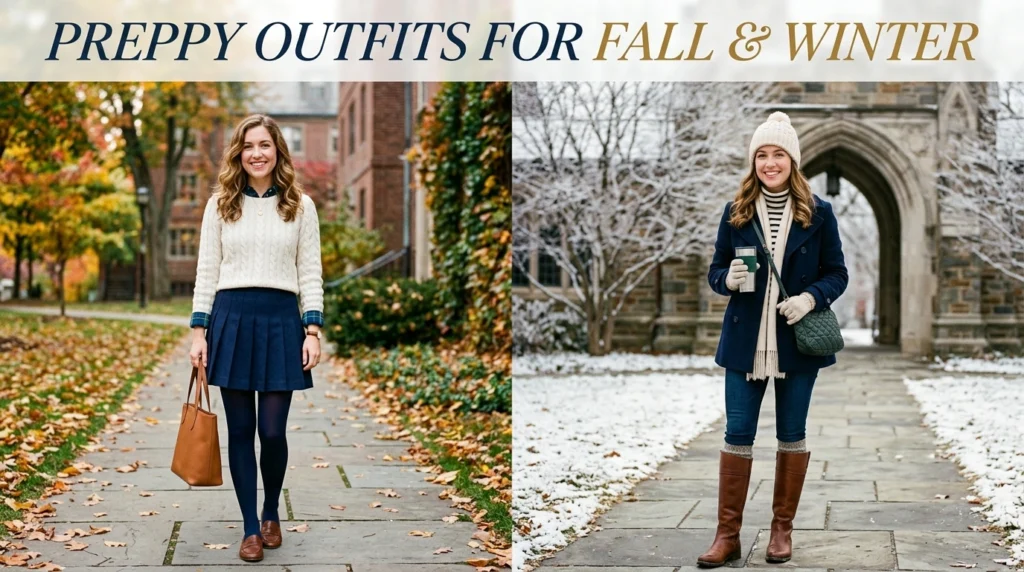
Fall is the native season of preppy style. The cooling air, the return to structure, the excuse to layer — it all aligns perfectly with the Ivy-inspired layering system and the heritage fabrics that define the look at its best.
The Fall Preppy Outfit Formula
The fundamental fall preppy outfit follows a layering logic that has remained constant for seventy years. It begins with an Oxford shirt — white or blue, button-down collar — and builds upward. A Shetland crew-neck sweater goes over the shirt, with the collar and cuffs visible. An unstructured tweed or herringbone blazer goes over the sweater. Khaki chinos, cuffed at the hem, finish the bottom. Penny loafers or leather boat shoes complete the outfit.
This formula is not a costume. It is a system — every element is in conversation with every other element. The collar of the shirt frames the face. The cuffs of the shirt break at the wrist below the sweater sleeve. The blazer sits naturally over the added bulk of the sweater. Nothing is accidental; everything has a reason.
Fall Preppy Outfits: Specific Combinations
- The Classic Campus Look: White OCBD + navy Shetland crew-neck + herringbone blazer + khaki chinos (cuffed) + brown suede penny loafers + burgundy braided belt.
- The Relaxed Weekend Read: Rugby shirt (navy/white stripe) + wide-leg khaki chinos + leather boat shoes. Optional: unstructured corduroy jacket on top.
- The Sweater Vest Outfit: Blue Oxford shirt + Fair Isle sweater vest + straight-leg chinos + black loafers + repp-stripe tie if the occasion demands.
- The Tweedy Statement: Cream cable-knit sweater + herringbone tweed blazer + pleated chinos + suede boots. The two textures — knit and tweed — are the entire point.
- The Modern Preppy Fall Look: Oversized Oxford shirt (half-tucked) + wide-leg chinos + chunky loafers. Same DNA, broader silhouette.
Winter Preppy Dressing
Winter preppy dressing extends the fall system with heavier fabrics and an additional outer layer. A wool overcoat — in camel, navy, or charcoal herringbone — goes over the blazer. Shetland is replaced by heavier cable-knit or Aran wool. Boat shoes are replaced by leather lace-ups or suede chukkas. The color palette shifts toward warmer tones — camel, rust, deep forest green — while maintaining the navy and khaki anchors.
Preppy Wardrobe Essentials
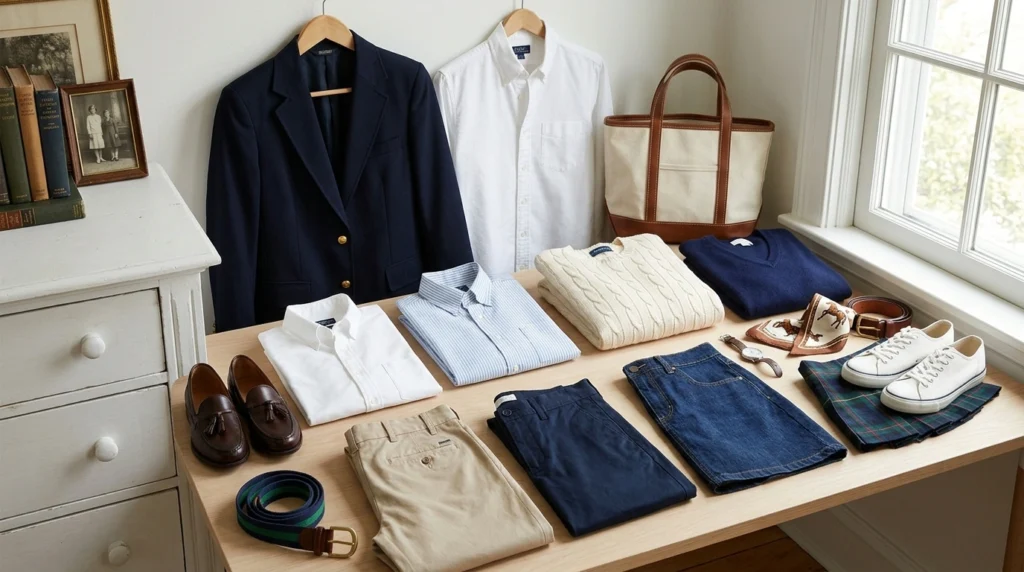
The preppy wardrobe is not built from dozens of pieces. It is built from five foundational items, done exceptionally well, and then expanded from that base with purpose. Every additional piece should multiply outfit options — not replace existing ones.
The Five Non-Negotiable Pieces
1. The Oxford Cloth Button-Down Shirt (OCBD)
The OCBD is the single most important piece in the preppy wardrobe. Its basket-weave fabric gives it texture, structure, and longevity that no other shirt fabric can match. The button-down collar is essential — a spread collar or a point collar is a different garment. Own at minimum one white and one blue. The shirt should fit well through the shoulders and chest, with enough room in the body to layer comfortably. Avoid anything too slim or too boxy — the goal is the relaxed, considered fit that defines preppy tailoring.
2. Chinos in Classic Khaki
The chino is the preppy trouser — not jeans, not dress trousers, not joggers. In classic khaki cotton twill, it occupies the exact register that preppy dressing requires: neither casual nor formal, perfectly positioned in between. Look for a mid-rise, straight-leg cut. A slight taper is acceptable; a wide leg is the current modern interpretation. The trouser should break at the ankle, ideally with a slight cuff.
3. A Shetland or Merino Sweater
The sweater is the layering engine of the preppy wardrobe. Shetland wool — rough, durable, deeply textured — is the traditional choice and the most authentically preppy. Merino is softer, lighter, and appropriate for warmer contexts and more formal reads. Own at least one crew-neck in navy or forest green. The sweater should fit over the Oxford shirt without pulling — the shirt collar and cuffs should emerge naturally from beneath.
4. Loafers or Boat Shoes
The penny loafer — with its distinctive strap and coin slot — is the most specifically American expression of the loafer, and the most historically significant in the preppy context. In leather for formal reads, suede for casual ones. The boat shoe occupies a similar space but is more casual and more specifically associated with summer and coastal contexts. Both should be worn without visible socks in most warm-weather contexts.
5. A Quality Braided Belt
The braided belt is a small detail that makes an immediate difference. It communicates an understanding of preppy dressing that a plain leather belt simply does not. In navy, tan, or a multi-color combination. The belt is not a statement piece — it is the finishing piece that confirms the outfit rather than defining it.
The Secondary Wardrobe: Building from the Foundation
- A herringbone or houndstooth tweed blazer: The authority piece. Unstructured, natural shoulder, in brown or grey tones. Wear for twenty years.
- A repp-stripe tie: In silk or wool-silk blend. Navy and green, or navy and burgundy.
- A rugby shirt: In navy or a bold horizontal stripe. Works in every casual preppy context.
- A Fair Isle or cable-knit sweater vest: Adds personality without bulk.
- A second pair of trousers: Corduroy in olive or camel, or pleated chinos in a second color.
Preppy Brands Guide

The preppy brand landscape divides cleanly into three categories: the heritage institutions that created the look, the American mid-market labels that democratized it, and the contemporary labels that are updating it for the current moment.
The Heritage Institutions
- Brooks Brothers: The founding institution of American preppy. The OCBD shirt was invented here. Founded 1818.
- J. Press: The Ivy League’s own tailor — founded in New Haven in 1902, still operating. Makes the most authentic interpretation of Ivy League sartorial tradition available today.
- G.H. Bass: Makers of the original Weejun penny loafer since 1936. The shoe that defines the preppy foot.
- L.L. Bean: The Maine outfitter whose Bean Boot, canvas tote, and flannel shirt became unexpected preppy icons.
- Lacoste: The polo shirt. The crocodile. Adopted by American preppy culture from its French sporting origins.
- Polo Ralph Lauren: The single most successful translation of preppy into mass-market fashion. Ralph Lauren packaged the look for the world.
The Contemporary Preppy Brands
- Drake’s: London-based but Ivy-fluent. Makes exceptional repp-stripe ties, Oxford shirts, and knitwear.
- Sperry: The boat shoe brand. The original and still the most recognizable.
- Rowing Blazers: The contemporary institution most self-consciously working in the preppy tradition.
- Orvis: The sporting heritage brand whose cotton and wool pieces sit naturally in the preppy wardrobe.
What to Look for Regardless of Brand
The most important lesson in the preppy brands guide is that the brand matters less than the garment. A well-constructed Oxford shirt from a lesser-known label beats a poorly-made one from a heritage brand. The criteria to look for: fabric quality (weight, weave, hand feel), construction (finished seams, appropriate interfacing, clean buttonholes), and silhouette (proportions that conform to the relaxed-tailoring standard). The logo, if there is one, should be secondary to all of these.
Old Money vs Preppy Aesthetic

The old money aesthetic and the preppy aesthetic are the two most frequently confused styles in contemporary fashion conversation. They share a great deal of DNA, but they are not the same thing.
What Is the Old Money Aesthetic?
The old money aesthetic is a style sensibility rooted in inherited wealth — or, more precisely, in the visual codes of people who have had money long enough to have forgotten that it matters. The look is characterized by extreme quality, extreme restraint, and an almost aggressive absence of visible branding. Cashmere sweaters in muted earth tones. Perfectly tailored wool trousers in grey or camel. Silk scarves. Leather goods that were expensive when they were new and now simply look right.
The old money aesthetic is a form of sartorial understatement taken to its logical extreme. It is the look that says: I don’t need to tell you anything about myself through my clothes, because my clothes already do it without trying. The irony is that achieving this effect requires considerable knowledge, taste, and usually considerable expenditure.
The Differences That Matter
- Sportswear roots: Preppy style embraces its athletic and collegiate origins — the rugby shirt, the boat shoe, the baseball cap worn with a blazer. Old money style is more purely sartorial, less willing to acknowledge the gym or the boat dock.
- Color and pattern: Preppy style is more playful with color — bold repp stripes, madras plaid, Fair Isle patterns. Old money dressing trends toward solids and subtle patterns in muted tones.
- Accessibility: Preppy style can be achieved across a wide price range. The old money aesthetic, properly executed, is harder to approximate at lower price points.
- Youth and energy: Preppy style has always had a youthful quality — it emerged from campus culture and retains that energy. Old money dressing has the quality of things that have been worn for decades.
“Old money is a social performance. Preppy is a dressing philosophy. The difference is that preppy can be learned by anyone; old money requires the willingness to pretend you never learned it at all.”
Preppy Style vs. Other Aesthetics

Understanding preppy fully means understanding what it isn’t. The table below positions preppy relative to the six styles most commonly confused with it:
| Style | Core Vibe | Key Pieces | vs. Preppy |
| Preppy | Relaxed East Coast elegance | Oxford shirts, chinos, loafers, blazers | Balanced, layered, collegiate |
| Ivy League (Traditional) | Strictly collegiate, conservative | Sack suits, OCBDs, Weejuns | More formal and restrained |
| Old Money Aesthetic | Quiet luxury, understatement | Cashmere, tailored wool, no branding | Higher price point, less sporty |
| Business Casual | Office-appropriate, polished | Dress shirts, slacks, oxfords | Less casual, less heritage-focused |
| Smart Casual | Effortless polish | Trousers, knits, loafers | Less specifically American |
| Workwear/Heritage | Rugged American craft | Denim, duck canvas, work boots | More utilitarian, fewer tailoring elements |
The clearest single distinction: preppy is a layered, collegiate, specifically American dressing tradition rooted in a particular set of garments and fabrics. Smart casual is a register. Business casual is a dress code. Old money is a social performance. Ivy League (traditional) is preppy’s direct ancestor but with less humor and less sport.
Modern Preppy Style 2026

Preppy fashion trends in the 2020s have moved toward broader silhouettes, bolder color choices, and a more fluid relationship between formal and casual elements. The modern Ivy League fashion moment is not a revival of something lost — it is an evolution of something continuous.
The Key Shifts in Contemporary Preppy Dressing
- The silhouette has opened up: Wide-leg chinos, oversized Oxford shirts, roomier blazers — the 2020s preppy silhouette is noticeably broader than the slim cuts that dominated the 2010s. This is not a departure from preppy tradition; the original Ivy League cuts were always generously proportioned.
- Colors have expanded: Emerald green, coral, and burnt orange have entered a palette that was previously restricted to navy, khaki, burgundy, and forest green. The expansion is within the same tonal family — warm, saturated, natural — but the range has grown.
- The formal/casual boundary has blurred further: Rugby shirts under blazers. Baseball caps with tailored trousers. Sneakers with chinos. These combinations were always latent in the preppy tradition — its whole premise is that formal and casual can coexist.
- Gender lines have dissolved: The preppy aesthetic has crossed gender lines more definitively in the 2020s than in any previous decade. Men in pleated skirts, women in oversized OCBDs and chinos: these are the natural evolution of the preppy tradition.
- Heritage brands are being reconsidered: The contemporary preppy dresser is more likely to buy a single exceptional piece from J. Press than to kit themselves out head-to-toe in Ralph Lauren. The emphasis has shifted from brand loyalty to garment quality.
Preppy Aesthetic in the Quiet Luxury Context
The broader quiet luxury trend of the early 2020s — a preference for understated, quality-focused dressing without visible branding — has created an extremely favorable environment for preppy dressing. Preppy has always been about understated elegance; the quiet luxury moment simply provided a cultural frame that made that preference legible to a much wider audience.
The result is that preppy has never been more mainstream — or more misunderstood. The aesthetic is everywhere, but the specific knowledge that makes it coherent rather than costume is not. The difference between a genuinely preppy outfit and a preppy-adjacent one is in the details: the button-down collar instead of the spread collar, the braided belt instead of the plain one, the Shetland sweater instead of the acrylic knit. These details are small. They are also everything.
Modern Preppy vs. Heritage Preppy
Heritage preppy follows the established rules: OCBD, penny loafer, repp tie, herringbone blazer. Modern preppy understands those rules well enough to break them intelligently: oversized Oxford, chunky loafer, no tie, relaxed corduroy jacket. Both are authentic. The difference is in how much of the rulebook you choose to follow.
Heritage preppy follows the established rules: OCBD, penny loafer, repp tie, herringbone blazer. Modern preppy understands those rules well enough to break them intelligently: oversized Oxford, chunky loafer, no tie, relaxed corduroy jacket. Both are authentic. The difference is in how much of the rulebook you choose to follow.

At PreppyGlow.com, we believe that understanding the foundations of this timeless style is just the beginning. We built this platform to be your definitive guide to translating classic, East Coast elegance into your modern, everyday life. Whether you are hunting for the perfect heritage piece, seeking fresh outfit formulas for the current season, or looking to infuse your wardrobe and home with that signature understated polish, Preppy Glow is your dedicated resource. We are here to help you navigate the nuances of the aesthetic and build a lifestyle that truly endures.
How to Build a Preppy Wardrobe

The preppy wardrobe is not expensive to build. It is patient. The logic is simple: buy five things exceptionally well, then add one piece at a time when you find something that genuinely earns its place.
Step One: The Foundation (Five Pieces)
Start here and nowhere else. Until you have these five pieces in genuinely good versions, do not buy anything else.
- Two Oxford shirts (one white, one blue): The non-negotiable foundation. Button-down collar. Oxford weave. Fits through the shoulder; room to layer.
- One pair of khaki chinos: Mid-rise, straight or slightly tapered leg. Cuffs optional but recommended.
- One Shetland or merino crew-neck sweater: Navy or forest green. Must layer cleanly over the Oxford shirt with collar and cuffs visible.
- One pair of loafers: Penny loafers in brown or black leather. Or leather boat shoes if your context skews casual.
- One braided leather belt: In tan, navy, or a two-color combination. The finishing piece that completes any preppy outfit.
The Layering Logic
The preppy layering formula is: shirt → knitwear → optional blazer. At each layer, the layer beneath should be visible — the shirt collar above the sweater neckline, the shirt cuffs below the sweater sleeves, the sweater visible at the lapels of the blazer. The goal is depth, not bulk. Three considered layers achieve more visual interest than one heavy layer.
Texture contrast drives the visual interest in preppy layering more than color contrast. Rough Shetland wool over smooth Oxford cotton is a more interesting combination than three smooth pieces in three different colors. Tweed over knit over broadcloth is the apex of this principle.
Frequently Asked Questions
What is preppy?
Preppy is a cultural and sartorial term derived from “preparatory school” — the elite private secondary schools that fed into Ivy League universities. As a style term, it describes a classic American approach to dressing built on heritage fabrics, relaxed tailoring, collegiate layering, and a specific color palette rooted in navy, khaki, forest green, and burgundy.
What is preppy style, exactly?
Preppy style is the specific wardrobe tradition that emerged from Ivy League campus culture in the 1950s: Oxford shirts, chinos, loafers, Shetland sweaters, tweedy blazers, repp ties, boat shoes, braided belts, rugby shirts, and sweater vests. It is a layering system governed by principles of quality, proportion, and detail. Polished without being formal. Casual without being careless.
What is the preppy aesthetic?
The preppy aesthetic is the broader sensibility behind preppy style — an attitude toward dressing that prizes quality over novelty, heritage over trend, and understated elegance over obvious display. You can embody the preppy aesthetic in pieces that are not technically preppy garments, as long as those pieces express the same values of quality, proportion, and restraint.
Is preppy style still relevant in 2024–25?
Very much so. The current fashion moment — characterized by quiet luxury, heritage fashion, and a preference for quality over trend — is the most favorable environment for preppy dressing in decades. Modern Ivy League fashion has been absorbed into mainstream menswear and womenswear at a significant scale.
What’s the difference between preppy and Ivy League style?
Ivy League style (traditional) is preppy’s direct ancestor and is somewhat more formal and more strictly codified. The classic Ivy League look — sack suit, OCBD, Weejuns, repp tie — is less playful than modern preppy, less willing to mix registers. Preppy, as a broader term, incorporates the Ivy League tradition but allows for more casual reads, more color, and more mixing of the formal and the athletic.
What’s the difference between preppy and old money aesthetic?
Old money aesthetic prioritizes extreme understatement, very high quality, and a complete absence of visible branding. Preppy style is more accessible, more colorful, and more openly rooted in athletic and collegiate culture. Old money is a social performance. Preppy is a dressing philosophy.
How do I dress preppy for fall?
Start with a white or blue Oxford shirt. Add a Shetland crew-neck sweater, making sure the collar and cuffs remain visible. Over that, an unstructured herringbone tweed blazer. Khaki chinos, cuffed at the hem. Shoes: brown suede penny loafers or leather boat shoes with heavy socks. Belt: braided leather. That is a complete, authentic, fall preppy outfit.
What are the preppy wardrobe essentials?
The five non-negotiable pieces: two Oxford shirts (one white, one blue), one pair of khaki chinos, one Shetland or merino sweater, one pair of loafers or boat shoes, and one braided leather belt. Everything else — the blazer, the ties, the rugby shirts, the sweater vests — builds on this foundation.
What are the best preppy brands?
The heritage institutions: Brooks Brothers, J. Press, G.H. Bass, L.L. Bean, Lacoste, and Polo Ralph Lauren. Contemporary labels doing the work well: Drake’s, Rowing Blazers, Sperry, and Orvis. But the most important advice in any preppy brands guide is this: focus on the garment, not the label. A well-made piece from anywhere beats a poorly-made piece from a heritage brand.
