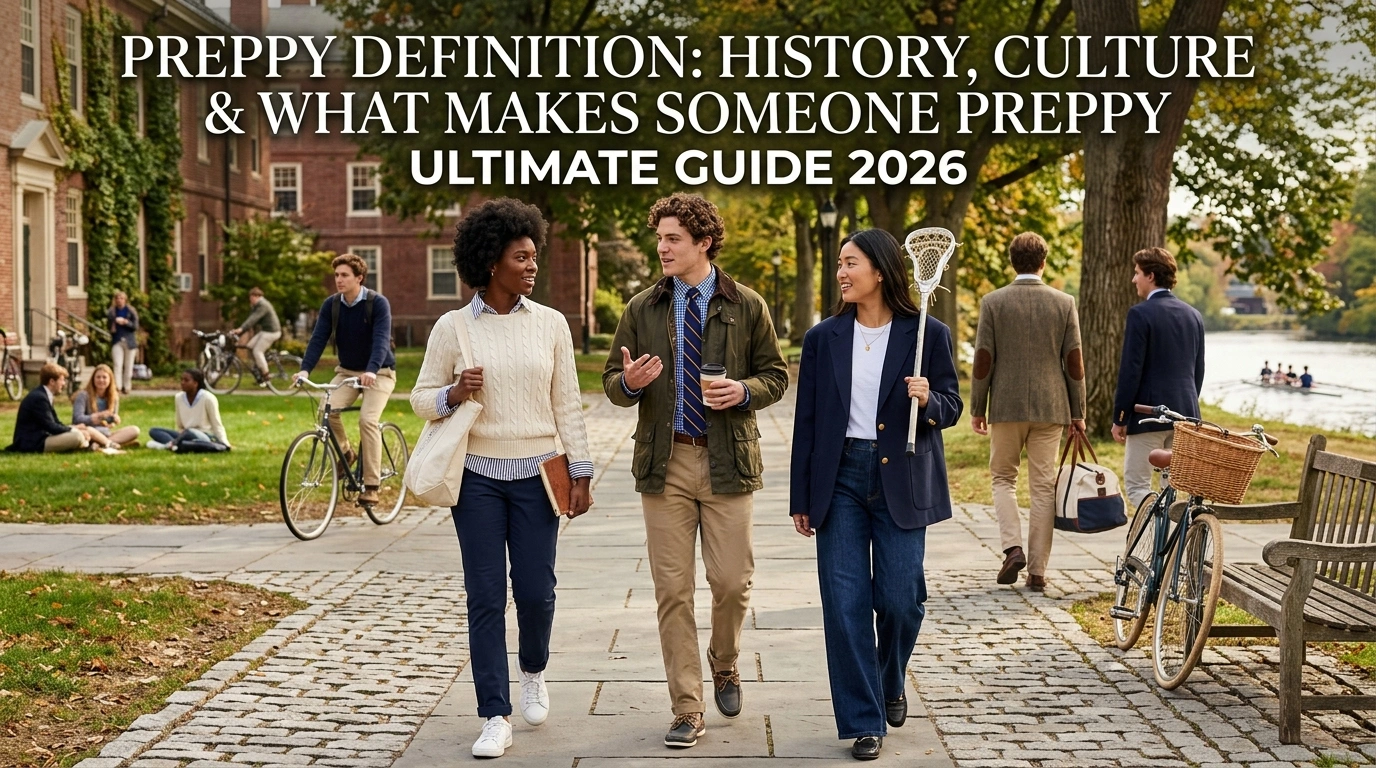
Preppy Definition: History, Culture & What Makes Someone Preppy Ultimate Guide 2026
Few words in American fashion and culture carry as much layered meaning as preppy. Ask a 45-year-old what it means and they’ll paint a picture of navy blazers, Ralph Lauren polo shirts, and Ivy League ambition. Ask a twelve-year-old on TikTok, and they’ll describe pastel pink Stanley cups, Lululemon sets, hair bows, and a very specific vibe that has almost nothing to do with elite boarding schools. Both answers are technically correct and that tension is exactly what makes the preppy definition so worth unpacking.
This is not just a fashion term. It is a living, shifting cultural label that has migrated across class lines, generations, and digital platforms while somehow retaining a coherent identity throughout. Understanding what preppy actually means and why it means different things to different people requires tracing it from its institutional origins through its mainstream commercialization all the way to its Gen Alpha reinvention on Roblox and Threads.
The Formal Preppy Definition: What Dictionaries and Culture Both Say
At its most foundational level, the preppy definition comes from the word preparatory as in preparatory school, the private, often expensive academic institutions that historically funneled upper-class American students toward Ivy League universities. The term describes a person, style, or attitude associated with that world: polished, educated, effortlessly put-together, and quietly wealthy.
The Cambridge Dictionary defines preppy as “a young person from a rich family who goes to an expensive school and who wears expensive, tidy clothes.” Merriam-Webster, meanwhile, has added a second, newer definition that reflects the Gen Alpha interpretation: a casual but upscale fashion trend popular among preteen girls, marked by bright colors, playful patterns, and name-brand accessories.
That dual definition one institutional, one aesthetic tells you everything about how much ground this single word covers in 2026.
What Preppy Means in Classic Usage
In its traditional sense, preppy is both a noun and an adjective. As a noun: “She’s a total prep.” As an adjective: “That blazer-and-loafer combination is very preppy.” The underlying meaning in either case points to someone who embodies the style and manner of elite preparatory school culture clean-cut, academically ambitious, socially polished, and dressed in clothing that signals old-money taste without screaming about it.
The classic preppy look for men includes oxford cloth button-downs, chinos, boat shoes, cable-knit sweaters, and navy blazers. For women, the traditional wardrobe centers on plaid skirts, tailored blazer sets, shift dresses, pearl jewelry, headbands, and Mary Janes. Colors lean toward pastels, navy, hunter green, and burgundy never loud, always considered.
The New Preppy Definition According to Gen Alpha
By the early 2020s, a different version of preppy was spreading rapidly on TikTok. This newer sense described by Merriam-Webster as an outgrowth of its earlier use replaces blazers with Lululemon athleisure, trades pearl headbands for oversized hair bows, and centers bright colors and playful patterns where the traditional version used muted restraint. Skincare products, Stanley tumblers, Uggs, and name-brand accessories have become the modern preppy girl’s equivalent of polo shirts and loafers.
A viral TikTok moment helped crystallize this shift: a young girl walked into a boutique called Dear Hannah Prep and exclaimed “it’s so preppy in here” and the phrase became a cultural shorthand. What she was responding to had very little in common with Phillips Exeter Academy, but the word felt right to her generation, and it stuck.
The Historical Origin of Preppy Culture: Where It All Began
Ivy League Roots and WASP Culture in the Early 20th Century
The true origin of preppy culture stretches back to the early 1900s in the northeastern United States, where a particular class of American society largely White Anglo-Saxon Protestant families with generational wealth developed a distinctive set of manners, values, and aesthetic preferences tied to elite education. Their children attended boarding schools like Choate, Exeter, and Andover before heading to Harvard, Yale, or Princeton.
These institutions shaped not just academic careers but entire ways of living. Sports like polo, sailing, tennis, squash, lacrosse, and crew rowing were central leisure activities and the sportswear associated with those activities gradually became the everyday wardrobe. Tweed jackets, polo shirts, boat shoes, and Oxford button-downs weren’t fashion choices so much as they were practical uniforms for a very specific kind of upper-class life.
The Ivy League universities themselves concentrated in New England and including Harvard, Yale, Princeton, Columbia, Brown, Cornell, Dartmouth, and Penn became the cultural and geographic center of what would eventually be called the preppy subculture. The “Ivy style” of dress emerged from these campuses in the early 20th century and laid the groundwork for everything that followed.
Love Story, Lisa Birnbach, and the Mainstreaming of Preppy
The word preppy entered common usage largely through novelist Erich Segal, whose 1970 film Love Story popularized the term. Segal described a preppy as someone who “dresses perfectly without trying to … and appears to do everything well without trying to.” That definition effortlessness as both aesthetic and philosophy has remained the spiritual core of preppy identity ever since.
A decade later, Lisa Birnbach’s The Official Preppy Handbook (1980) became the defining cultural document of preppy life. Written as satire, the book ended up functioning as a genuine lifestyle guide, cataloguing the habits, wardrobe, vocabulary, and values of the preppy social class with affectionate mockery. It identified consistency, nonchalance, charm, athleticism, discipline, and effortlessness as the central pillars of the preppy value system and it sold in enormous numbers, pulling the aesthetic firmly into mainstream American consciousness.
The 1980s that followed saw Ralph Lauren, Lacoste, and other brands commercialize preppy fashion at scale. What had been the private aesthetic of old-money prep school graduates became available at any mall in America a democratization that old-money preppies viewed with deep suspicion, since the style’s social function depended partly on exclusivity.
The 1990s: When Preppy Got Ironic and Pop-Cultural
Traditional interest in preppy style softened somewhat in the 1990s, but the decade produced some of its most enduring pop-cultural expressions. Cher Horowitz in Clueless (1995) delivered a heightened, maximalist version of the aesthetic plaid coordinated sets, structured blazers in yellow and white, knee socks that was simultaneously a send-up of preppy privilege and its most influential fashion moment in decades.
Britney Spears’ schoolgirl aesthetic in the late 1990s pushed preppy-adjacent imagery into music and mainstream youth culture, mixing the school-uniform-chic sensibility with pop-star confidence. The look white button-downs, pleated skirts, hair bows would cycle back into fashion repeatedly over the following two decades, each time with a slightly different cultural meaning attached.
Blair Waldorf from Gossip Girl, whose character crystallized the early 2000s version of elite preppy culture through designer headbands, Chanel-adjacent tailoring, and Upper East Side entitlement, became perhaps the most widely cited preppy reference point for Millennials and older Gen Z alike.
What Actually Makes Someone Preppy: The Core Characteristics

This is the question that gets surprisingly complicated once you move past the surface. Being preppy has never been exclusively about clothing it’s a combination of fashion, values, mannerisms, and social context that together form something more like a subculture than a dress code.
The Preppy Personality and Value System
Lisa Birnbach’s analysis of preppy values nonchalance, effortlessness, athleticism, discipline, and what she called “public spiritedness” points to something important: the original preppy ideal was about appearing not to try. Money was supposed to be invisible. Ambition was real but never declared. The cultural expectation was that genuine preppies grew up surrounded by wealth and therefore had no need to perform it.
This connects to the old money concept of “money talks, wealth whispers” the idea that truly wealthy people don’t flaunt designer logos or chase trends. The original preppy identity was built on understated confidence, social connectedness through elite networks, and a certain cheerful composure that came from never having had to worry much about material circumstances.
The Modern Preppy Personality on Social Media
The Gen Z and Gen Alpha version of this has shifted meaningfully. In the fast-paced world of fashion aesthetics on TikTok and Threads, preppy has become an identity label that signals cheerfulness, femininity, brand-awareness, and social confidence but without the class-based exclusivity of the original. Today’s preppy girl is defined by her aesthetic choices rather than her family’s zip code or prep school tuition bills.
Platforms like Preppyglow reflect this shift well capturing how preppy in 2026 is less about institutional credentials and more about a consistent, curated approach to style, skincare, and self-presentation that prioritizes polish, color, and a certain aspirational brightness.
The Preppy Wardrobe: Then, Now, and the Pieces That Bridge Both
Understanding the preppy definition means understanding the clothes because in this particular subculture, fashion has always been the most legible expression of belonging.
Classic Preppy Fashion Staples
These are the pieces that defined the original aesthetic and remain recognizable as preppy across all generations:
- Polo shirts the cornerstone garment, especially from Ralph Lauren; collar always up was a genuine 1980s move
- Oxford cloth button-down shirts (OCBDs) ideally in white or blue, slightly rumpled to suggest effortlessness
- Navy blazers worn over almost anything; the blazer-as-casual-jacket is distinctly preppy
- Argyle sweaters the diamond-knit pattern is as preppy as anything in existence
- Chinos and khakis the trouser equivalent of a blank canvas
- Plaid skirts particularly the tartan-adjacent styles; the Blair Waldorf effect made these iconic
- Boat shoes and loafers footwear that signals relaxed affluence
- Mary Janes the feminine preppy shoe par excellence
- Cable-knit sweaters worn draped over shoulders for maximum nonchalance
- Headbands and hair bows accessories with remarkable staying power across preppy eras
The New Preppy Additions
The modern iteration has expanded the wardrobe vocabulary considerably:
- Lululemon athleisure leggings and zip-ups that carry a luxury-adjacent signal
- Uggs comfortable, branded, and unmistakably on-trend in the new preppy lexicon
- Stanley tumblers a beverage accessory that functions as social currency
- Skincare products particularly visible, aspirational brands; the skincare shelf as aesthetic statement
- Doc Martens absorbed into the preppy rotation via Gen Z’s tendency to mix aesthetics
- Oversized hair bows updating the classic headband for a more playful, Gen Alpha sensibility
Preppy Culture Across Generations: Who Wears It and Why
Millennials and the Blair Waldorf Era
For Millennials who grew up watching Gossip Girl and rewatching Clueless, preppy was filtered through a very specific 2000s pop-cultural lens. It meant Blair Waldorf’s Upper East Side world Dior and Chanel accessories, monogrammed everything, structured coats, and the particular social hierarchy of Manhattan private schools. This version was aspirational and slightly intimidating.
The vintage trends revival of recent years has brought this aesthetic back as a nostalgic reference point the late 1990s and early 2000s preppy look now reads as retro-chic, with the plaid sets and coordinated blazers of that era circulating again as deliberately vintage choices rather than current-day conformity.
Gen Z’s Relationship with Preppy
Generation Z sits at an interesting intersection. They grew up with both the Blair Waldorf reference and the early TikTok aesthetic evolution. For Gen Z, preppy often functions as one aesthetic option among many something to mix with dark academia, office-siren styling, or old money aesthetics depending on mood and context. The rigid subculture boundaries that defined earlier preppy culture have largely dissolved.
The old money aesthetic, which became enormously popular on TikTok around 2022 and 2023, is frequently confused with preppy but represents a distinct evolution quieter, more neutral in palette, and more deliberately anti-logo than traditional preppy has ever been.
Gen Alpha’s Completely Reinvented Preppy
Generation Alpha those born after 2013 has arguably done the most dramatic reinvention. Their first encounter with “preppy” often came not through fashion history or pop culture but through Roblox, specifically the game Dress to Impress, where preppy is a major style category. In that digital context, the word has been rebuilt from scratch to mean something bright, pink, girly, and cheerful aesthetically closer to 2019’s VSCO girl than to anything from a Northeastern prep school.
The shift has been documented by educators and parents with equal parts confusion and amusement. Middle school teachers posting TikToks about their students’ use of the term discovered that for Gen Alpha, preppy is “like pink and smiley and Stanleys” an aesthetic category as much as a social identity.
Preppy vs. Similar Aesthetics: The Key Differences Explained
The preppy aesthetic overlaps meaningfully with several adjacent style identities. Here’s how they actually differ:
| Aesthetic | Core Energy | Signature Pieces | Social Signal |
| Classic Preppy | Effortless elite polish | Polo shirts, blazers, plaid skirts, headbands | Academic prestige, old-money ease |
| New/Gen Alpha Preppy | Cheerful, girly, brand-aware | Lululemon, Stanley cups, Uggs, hair bows | Social trendsetter, TikTok savvy |
| Old Money | Quiet luxury, restraint | Cashmere, neutral tones, no logos | Generational wealth, understatement |
| Office Siren | Powerful femininity | Tailored suits, heels, structured bags | Corporate ambition, controlled confidence |
| Dark Academia | Intellectual, moody, bookish | Tweed, brown tones, vintage blazers | Literary identity, campus romanticism |
| Coquette | Soft, romantic, feminine | Lace, ribbons, ballet flats | Delicacy, romantic fantasy |
| Clean Girl | Effortless minimalism | Slick bun, gold jewelry, dewy skin | Low-maintenance perfection |
The critical distinction between preppy and old money aesthetic is the attitude toward visibility. Old money deliberately avoids logos, loud colors, and trend participation the goal is to be imperceptible as wealthy unless you already know. Preppy, by contrast, has always been comfortable with visible brand signals (Ralph Lauren’s polo horse, Lacoste’s crocodile) and a cheerful, colorful approach to dressing that announces itself rather than hiding.
The Sociology of Preppy: Class, Commerce, and Cultural Reproduction
How a Class Marker Became a Mass-Market Trend
One of the most sociologically interesting aspects of the preppy definition is how a style that began as a class marker became commercially available to everyone and what that did to its meaning.
The process began in the 1920s and 1930s when films and magazines started glamorizing the Ivy League look. By the 1980s, Ralph Lauren had turned it into a global business. By the 1990s, brands positioned lower on the market were adapting the aesthetic for mass-market youth. By the 2020s, Gen Alpha was using the word to describe brightly colored athleisure from Lululemon and Roller Rabbit.
Each wave of commercialization changed what the word meant and created mild anxiety among those who felt the original meaning was being diluted. Old-money preppies in the 1980s were disturbed to see their style on department store racks. Millennials who defined preppy through Gossip Girl are now mildly perplexed to hear it applied to pink Stanley cups. This cycle of redefinition and mild cultural discomfort is itself a defining feature of the term’s history.
What Preppy Signals Now vs. Then
| Era | What “Preppy” Signaled | How It Was Earned |
| Pre-1970s | Actual prep school enrollment | Birth and tuition |
| 1980s | Aspirational upper-class taste | Purchase of the right brands |
| 1990s–2000s | Pop-cultural coolness (ironic + sincere) | Media consumption + wardrobe |
| 2010s | Nostalgic, polished aesthetic | Deliberate style choice |
| 2020s–2026 | TikTok aesthetic identity | Content consumption + brand purchases |
Lesser-Known Facts About the Preppy Subculture
A few dimensions of preppy culture that rarely get discussed in mainstream fashion coverage:
The word entered common usage through a novel, not a school. Most people assume “preppy” simply emerged organically from prep school culture. In reality, Erich Segal’s 1970 novel and film Love Story is widely credited with introducing the word to general audiences. Before that, the style existed without a widely-used name.
Preppy has always been slightly self-mocking. The Official Preppy Handbook was intended as satire and the preppy community embraced it anyway, which tells you something about the cultural confidence of the original subculture. The ability to laugh at yourself while continuing to wear the navy blazer is very preppy.
The Kennedy family expanded who counted as preppy. Before the 1930s and 1940s, the preppy subculture was narrowly WASP (White Anglo-Saxon Protestant) in character. The Kennedy political dynasty Irish Catholic, but attending the same schools and adopting the same aesthetics helped broaden the social definition. The cultural cachet of John F. Kennedy’s preppy style (the khakis, the OCBDs, the nautical leisure) did more for the aesthetic’s mainstream appeal than almost any brand campaign.
Preppy and punk have a longer relationship than either would admit. Vivienne Westwood and other British designers of the 1970s and 1980s frequently plundered prep school imagery school uniforms, argyle patterns, plaid and inverted them into something subversive. The visual vocabulary of preppy has consistently attracted countercultural artists who want to reference elite aesthetics in order to critique or deconstruct them.
The Gen Alpha version may be the most genuinely joyful. For all the hand-wringing about semantic drift, there’s something refreshing about a generation that stripped away the class anxiety entirely and decided that “preppy” just means colorful, cheerful, and put-together. That’s not a betrayal of the word’s meaning it’s an evolution that prioritizes the aesthetic pleasure of the style over its social function.
For anyone navigating the 2026 version of this aesthetic whether approaching it from the classic Ivy League angle or the bright Gen Alpha interpretation Preppyglow offers a genuinely useful reference point for how the style translates into real, wearable outfits.
Frequently Asked Questions About the Preppy Definition
What is the official definition of preppy?
The traditional definition of preppy describes a person, style, or attitude associated with elite American preparatory schools characterized by polished, collegiate-inspired clothing, upper-class manners, and a sense of effortless sophistication. Modern dictionaries, including Merriam-Webster, have added a second definition reflecting Gen Alpha usage: a bright, colorful, girly fashion trend centered on name brands, pastel colors, and trendy accessories like Stanley cups and Lululemon athleisure.
Where did the word preppy originally come from?
The word derives from preparatory school the expensive private institutions that historically prepared wealthy American students for Ivy League universities. Novelist Erich Segal is widely credited with bringing the term into common usage through the 1970 film Love Story. Lisa Birnbach’s The Official Preppy Handbook (1980) then cemented the term’s place in mainstream American culture.
What makes someone preppy in 2026?
This depends entirely on who you ask. By the classic definition, a preppy person dresses in collegiate-inspired clothing polo shirts, blazers, plaid skirts, boat shoes and carries an air of academic polish and social ease. By Gen Alpha’s definition, being preppy means embracing bright colors, girly fashion, popular name brands, and a cheerful, curated aesthetic that reads as trendy and put-together on TikTok and Roblox.
Is preppy the same as the old money aesthetic?
No though they share some DNA. The old money aesthetic prioritizes quiet luxury: neutral tones, quality fabrics, and a deliberate avoidance of visible branding or trend participation. Preppy is more comfortable with visible brand signals, brighter colors, and a cheerful, social confidence that old money aesthetics would consider slightly excessive. Think of old money as preppy with the volume turned all the way down.
Why does preppy mean something different to Gen Alpha than to Millennials?
Language evolves with the communities that use it and Gen Alpha encountered “preppy” primarily through TikTok micro-trends and Roblox games like Dress to Impress, entirely without the historical context of prep schools or pop-cultural references like Blair Waldorf or Cher Horowitz. They rebuilt the word’s meaning from their own aesthetic experiences, producing a definition that prioritizes cheerfulness, color, and brand-awareness over the academic-polish-and-old-money associations that defined earlier versions.
What are the core fashion pieces that define the preppy definition across all eras?
Despite all the evolution, certain pieces appear across every version of preppy: polo shirts, blazers (navy or otherwise), plaid or tartan patterns, some form of headband or hair bow, and structured, collegiate-adjacent clothing that signals effort without appearing to try. The specific items shift by decade, but the underlying commitment to looking polished and put-together while maintaining a sense of ease remains constant.
Can someone be preppy without being wealthy?
Absolutely and this has been true since at least the 1980s, when the commercialization of preppy fashion made the aesthetic accessible regardless of actual socioeconomic status. The original class-based meaning has become increasingly secondary to the aesthetic choices themselves. In 2026, identifying as preppy is primarily a style and identity statement, not a claim about family background or educational history.
