
Social Etiquette for College Students: Rules Nobody Teaches You
Nobody hands you a rulebook when you move into your dorm. High school taught you where to sit at lunch, but Social Etiquette for College Students is a different game entirely — one played with professors who grade your participation, roommates who see you at your worst, and classmates who might become your first professional reference. This guide breaks down exactly what good manners in university actually look like, section by section, so you’re not left guessing what’s appropriate in a lecture hall, a group project, or your first career fair.
By the end of this article, you’ll know how to be polite in college in every setting that matters: classroom, dorm, digital communication, and networking. Think of it as the college manners guide your orientation leader forgot to give you.
This matters more than it might seem in the moment. First-year college advice usually focuses on syllabi, meal plans, and roommate assignments, but the social rules underneath all of it — how you email a professor, how you handle a messy group chat, how you introduce yourself at a career fair — quietly shape your reputation for four years. Students who master Social Etiquette for College Students early tend to report more social confidence, stronger relationships with professors, and smoother roommate situations by the time midterms hit. None of it requires a personality change. It just requires knowing the unwritten rules before you accidentally break one.
1. Classroom Etiquette for Students: The Rules That Shape Your Reputation
Classroom Etiquette is the foundation of Social Etiquette for College Students, because it’s the first place professors and classmates form an opinion of you.
Arrive Ready, Not Just On Time
Punctuality in college isn’t just about beating the bell. It’s about walking in with your laptop charged, readings skimmed, and phone silenced. A student who’s chronically late signals disorganization — and professors notice, especially in smaller seminar-style classes where every seat is visible.
Respect the Room Before You Speak
Respectful communication in a lecture hall means raising a hand or using the chat function in hybrid classes rather than talking over a classmate. Active listening — actually tracking what your professor and peers say instead of drafting your rebuttal in your head — makes group discussions sharper and shows classroom respect without you having to say a word.
Group Projects Without the Drama
Teamwork in college often means uneven contributions. The etiquette move isn’t to silently resent your groupmates or publicly call them out — it’s to address gaps early, in a private message, with specific and neutral language (“Can you send your section by Thursday so we have time to review?”). This is conflict resolution in its most practical, everyday form.
Classroom Participation Without Dominating the Room
Classroom participation is one of the trickiest balances in college social skills. Some students stay silent out of fear of being wrong; others answer every question and unintentionally crowd out quieter classmates. Genuine classroom etiquette means reading the room: if you’ve already spoken twice in ten minutes, hold back and let someone else weigh in. Professors and classmates alike tend to respect students who contribute thoughtfully rather than constantly, and this same instinct — knowing when to speak and when to listen — carries directly into networking events and workplace meetings later on.
Handling Disagreement With a Professor or Classmate
Respectful disagreement is an underrated college manners skill. If you think a grade was miscalculated or disagree with a classmate’s point during a discussion, the etiquette approach is to separate the idea from the person: “I see it differently because…” rather than “That’s wrong.” This keeps group discussions productive instead of defensive, and it signals emotional maturity that professors notice when writing recommendation letters later.

2. Communicating With Professors: Professional Etiquette Starts Here
Learning how to talk to professors is often the first real test of professionalism most students face, and a core piece of Social Etiquette for College Students — it’s also a preview of how you’ll eventually email a manager or client.
Email Etiquette for Students
Email etiquette for students isn’t complicated, but it’s frequently ignored. A proper email to a professor includes:
- A clear subject line (e.g., “Question About Thursday’s Assignment — [Your Name], [Course Number]”)
- A greeting that uses their actual title (“Dr.” or “Professor,” not “Hey”)
- A concise body with one clear ask
- A sign-off with your full name and course section
This single habit — treating professors like the professional contacts they are — sets students apart in a way that pays off when it’s time to ask for a recommendation letter.
Office Hours Are a Professional Meeting, Not a Hallway Chat
Show up prepared with a specific question, not a vague “I’m confused about everything.” This demonstrates college professionalism and respects your professor’s time, which is often stretched across dozens of students.
Asking for a Recommendation Letter the Right Way
Eventually, most students need a recommendation letter, and how you ask matters almost as much as your grades. Give at least three weeks’ notice, ask in person or by email rather than casually after class, and provide context: your resume, the opportunity you’re applying for, and a reminder of the work you did in their course. This is professional communication in its clearest form — it makes the professor’s job easier, which is exactly the point of good etiquette.
Time Management as a Form of Respect
Time management might not sound like an etiquette topic, but missing deadlines or requesting extensions at the last minute puts pressure on professors and teaching assistants who are managing dozens of similar requests. Building in buffer time for assignments isn’t just a study habit — it’s a quiet form of respect for everyone whose schedule depends on yours.

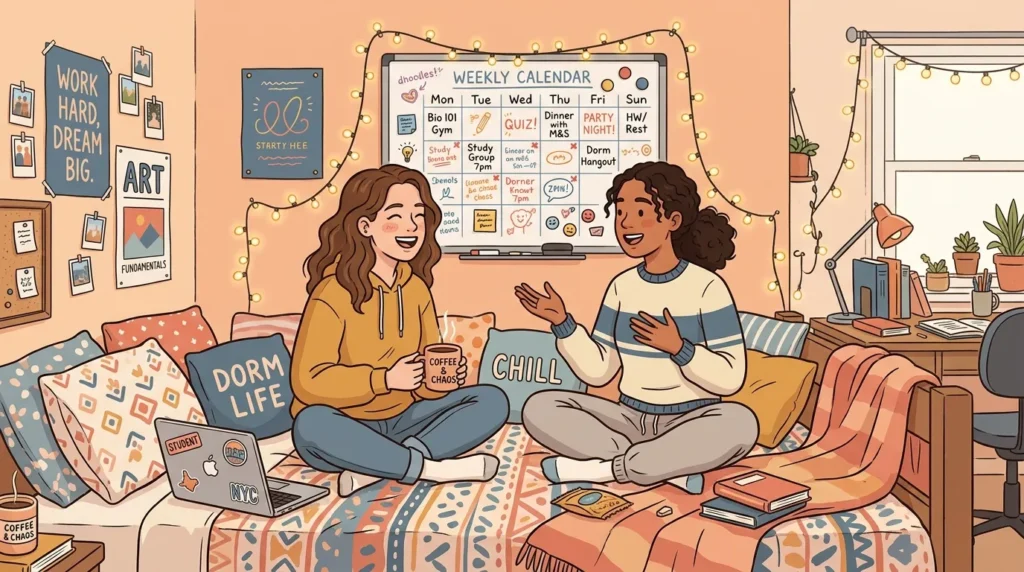
3. Dorm Etiquette: Sharing Space Without Losing Your Mind
Dorm etiquette gets overlooked in most college prep guides, but it’s one of the most lived-in parts of Social Etiquette for College Students — it shapes your daily quality of life more than almost anything else on this list.
Set Boundaries Early, Not After a Blowup
Personal boundaries in a shared 12-by-15-foot room require an upfront conversation: sleep schedules, guests, noise tolerance, and shared supplies. Waiting until resentment builds is the most common dorm mistake first-years make.
Respect Is a Two-Way Street
Empathy in a dorm setting means recognizing that your roommate’s stress during finals week might make them short-tempered — and that this isn’t personal. Mutual respect also means knocking before entering a shared space and asking before borrowing anything, no matter how small.
Handling Roommate Conflict Before It Escalates
Every dorm eventually has a friction point — dishes, noise, guests staying too long. The etiquette response isn’t to vent to everyone else on the floor first; it’s a direct, calm conversation with the roommate involved, ideally framed around a specific behavior rather than a character judgment (“Can we agree on quiet hours after 11?” instead of “You’re so inconsiderate”). If a direct conversation doesn’t resolve it, most colleges have a resident advisor specifically trained in this kind of mediation, and looping them in early is a sign of maturity, not failure.
The Preppy Life Decoded Approach to Dorm Living
If you’re curious how style-conscious students blend tidy, put-together living with genuine warmth toward roommates, the Preppy Life Decoded philosophy is worth a look — it treats a dorm room less like a crash pad and more like a small, shared home, with labeled bins, shared calendars for guests, and a soft rule that everyone tidies the common area before leaving for class. Students in this same corner of campus culture often describe the result as a kind of Preppyglow — that put-together, quietly confident look and attitude that comes less from expensive décor and more from a roommate relationship that actually runs smoothly. It’s less about aesthetics and more about signaling that you respect the space you didn’t choose alone.
4. Digital Etiquette: Group Chats, Social Media, and Online Classes
Digital citizenship is now a core part of Social Etiquette for College Students, since so much of student life happens through a screen.
Group Chat Norms Nobody States Out Loud
Digital etiquette in a class group chat means keeping messages relevant, avoiding 2 a.m. mass-pings for non-urgent questions, and never screenshotting a private conversation into a group thread without consent.
Online Class Etiquette
Camera-on expectations vary by professor, but muting your mic when not speaking, using a neutral background, and avoiding multitasking on camera are near-universal norms for hybrid and online classes.
Social Media and Your Future Self
What you post publicly is increasingly part of your college professionalism. Career fair recruiters and internship coordinators do check public profiles, so digital etiquette extends well past the classroom.
Texting and Messaging Etiquette With New Friends
Making friends in college often happens over text before it happens in person, and the same etiquette applies: don’t double-text within minutes of an unanswered message, keep group plans in one thread instead of splintering conversations, and give people an easy way to say no to invitations without pressure. Respectful communication over text is just as much a part of student social skills as anything said face-to-face, and it often shapes first impressions before you’ve even met in person.
5. Networking Etiquette for Students: Building Relationships That Outlast the Semester
Networking etiquette for students is where Social Etiquette for College Students starts converting into real opportunity — internships, recommendation letters, and job leads.
Career Fairs and Campus Events
Approaching a recruiter at a career fair isn’t about memorizing a script. It’s a short, respectful exchange: a firm handshake, a specific question about the company, and a genuine thank-you before moving on. Overstaying at one table while a line forms behind you is a common and avoidable etiquette misstep.
College Networking Tips for Introverts and Extroverts Alike
- Bring a few open-ended questions prepared in advance
- Follow up within 48 hours with a short, personalized message
- Connect on LinkedIn with a note referencing your actual conversation, not a generic request
Student Clubs and Organizations
Joining a student club is one of the lowest-pressure ways to build interpersonal skills and campus culture familiarity. Showing up consistently — even to unglamorous general meetings — builds a reputation as reliable, which matters more long-term than being the loudest person in the room.
Building Genuine Relationships, Not Just Contacts
Networking etiquette for students works best when it doesn’t feel transactional. Genuinely following up on a classmate’s internship search, celebrating a peer’s acceptance into a competitive program, or simply remembering small details from a past conversation builds the kind of social confidence and goodwill that a rehearsed elevator pitch never will. The strongest professional networks students build in college usually start as ordinary friendships, not calculated connections.

6. Academic Integrity and Inclusive Behavior: The Non-Negotiables
Academic integrity and inclusive behavior sit slightly apart from most guides to Social Etiquette for College Students, but they anchor everything above — because no amount of social confidence makes up for dishonesty or exclusion.
Academic Integrity Basics
Citing sources correctly, never submitting group work as solely your own, and asking professors directly when a citation rule is unclear are baseline expectations, not suggestions.
Inclusive Behavior in a Diverse Campus Culture
Campus culture today spans a wide range of backgrounds, and inclusive behavior means avoiding assumptions about a classmate’s beliefs, background, or family situation, and correcting course quietly and respectfully if you make a mistake.
Body Language Says More Than You Think
Body language is an often-overlooked layer of college social skills. Crossed arms during a group discussion, checking your phone mid-conversation, or avoiding eye contact during a professor’s office hours all send signals independent of what you’re actually saying. Small adjustments — open posture, putting the phone away, nodding to show you’re following along — reinforce respectful communication without adding a single extra word.
Comparison Table: Etiquette Expectations by Setting
A quick-reference snapshot of the etiquette rules covered above, across the settings that matter most:
| Setting | Key Expectation | Common Mistake | Quick Fix |
|---|---|---|---|
| Classroom | Active listening, punctuality | Talking over classmates | Wait for a pause, use hand-raise features |
| Professor Email | Formal tone, clear ask | Overly casual greeting | Use “Dr./Professor” + one clear request |
| Dorm Room | Set boundaries early | Assuming shared norms | Have the roommate conversation in week one |
| Group Chats | Relevant, timed messages | Late-night mass pings | Save non-urgent messages for daytime |
| Career Fair | Brief, respectful exchange | Overstaying at one booth | Ask one question, thank them, move on |
| Student Clubs | Consistent attendance | Only showing up to social events | Attend regular meetings, not just socials |
FAQ: People Also Ask
What is social etiquette in college?
Social Etiquette for College Students covers the everyday behavior expectations across classrooms, dorms, digital spaces, and professional settings like career fairs — things like punctuality, respectful communication, and appropriate boundaries.
How can I be more polite in college without seeming fake?
Politeness in college is about consistency, not performance. Simple habits — active listening, timely emails, honest but kind communication in group projects — read as genuine because they’re repeated, not one-off gestures.
What are common etiquette mistakes first-year students make?
The most common mistakes are emailing professors too casually, avoiding roommate conversations until there’s already tension, and treating group chats as a place for non-urgent late-night messages.
Is networking etiquette different in college than in the workplace?
It’s similar but lower-stakes. College networking tips still apply the basics — follow-up, specific questions, respectful time management — just with more room to be a beginner without real career consequences.
How does classroom etiquette affect my grades?
Classroom etiquette rarely affects grades directly, but professors do notice participation quality and punctuality, which can influence subjective components like participation grades and willingness to write recommendation letters.
Conclusion: Etiquette Is a Skill, Not a Personality Trait
Social Etiquette for College Students isn’t about being naturally charming or extroverted—it’s a learnable set of habits: showing up prepared, communicating respectfully, setting boundaries early, and following up when it matters. Mastering Social Etiquette for College Students helps you earn respect, build meaningful relationships, and create a positive reputation throughout your college years. Whether you’re deciding how to be polite in college during your first week or fine-tuning networking etiquette for students ahead of a career fair, the through-line is the same: consistency builds trust faster than charisma ever will.
Start small. Pick one section above—classroom, dorm, or digital—and build the habit this week. The rest follows. By practicing Social Etiquette for College Students every day, these behaviors become second nature and contribute to both your academic and personal success.
