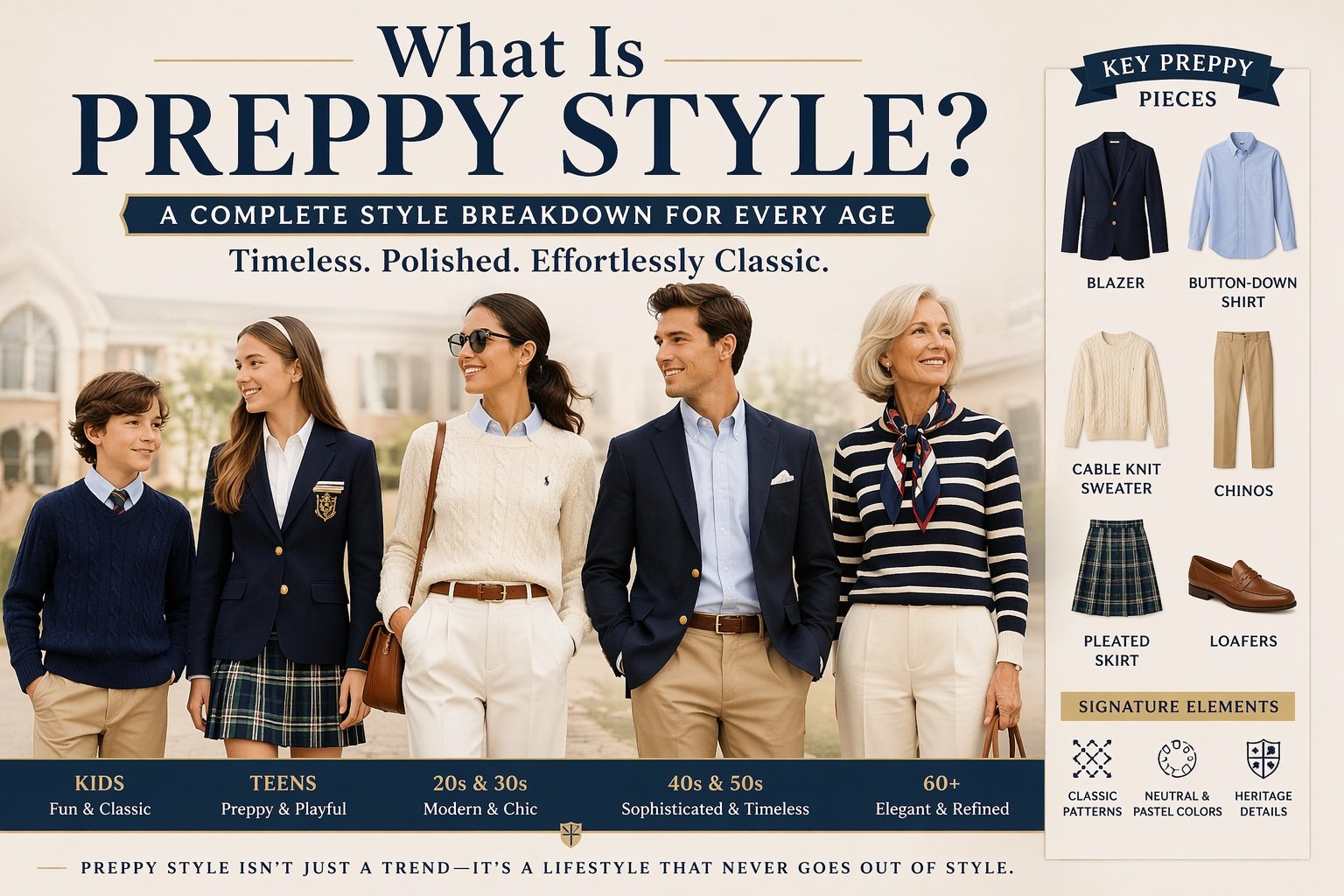
What Is Preppy Style? The Essential Style Guide for Every Age April 2026
There’s a certain type of person who walks into a room and looks effortlessly put-together not overdressed, not underdressed. Collar neat, shoes clean, posture confident. Chances are, they’re wearing something rooted in preppy fashion, even if neither of you would label it that way out loud. In this article you will learn what is preppy style? And we Commit you will be satisfied
How to Recognize Preppy Style the Moment You See It
Preppy style is a classic American fashion tradition rooted in the dress codes of preparatory schools and Ivy League universities along the East Coast. It combines polished, structured clothing with a relaxed, almost effortless attitude the visual shorthand for someone who grew up around tradition but doesn’t feel the need to announce it.
At its core, preppy fashion is about looking clean and intentional without appearing like you tried too hard. A navy blazer over a crisp oxford shirt. Chinos in tan or khaki. Loafers or boat shoes. Pastel colors in summer, neutral tones and tweed jackets come autumn. The pieces are classic, the combinations are deliberate, and the overall result reads as refined taste without being flashy.
What separates preppy from other polished aesthetics is its specific cultural DNA. This isn’t European tailoring or minimalist luxury it’s distinctly American, tied to campus life, athletic clubs, sailing, tennis, and the kind of casual confidence that comes from knowing the dress code before you walk in.
The Origins: Preparatory Schools, Ivy League Culture, and a Television Phenomenon
The term “preppy” comes from preparatory school the elite private secondary schools that fed students into Ivy League universities like Harvard, Yale, and Princeton. By the 1950s, a recognizable dress code had emerged among students at these institutions: button-down shirts, blazers, khaki trousers, and leather shoes. It wasn’t a fashion movement in the deliberate sense it was simply what those students wore, influenced by both British prep school tradition and American collegiate culture.
The style spread into mainstream consciousness gradually through the latter half of the 20th century. Designers like Ralph Lauren built entire brand identities around it, and Tommy Hilfiger brought it to a broader, more diverse audience through the 1990s. The look was practical, versatile, and carried an aspirational quality that made it appealing far beyond the East Coast elite.
Then came the 2000s and Gossip Girl. If you want to understand the modern pop-culture version of preppy aesthetic, the Upper East Side wardrobes of that show are a masterclass. Blazers as everyday wear, headbands, pleated skirts, cable knit sweaters layered with collared shirts it translated the Ivy League visual language into something dramatic and aspirational for a new generation. And it worked. The show is still directly referenced whenever neo-preppy fashion trends surface in discussions Like what is preppy style 2026.
The Patterns That Make Preppy Instantly Identifiable
No other aesthetic relies so heavily on specific textile patterns. Argyle, gingham checks, plaid patterns, striped designs these aren’t decorative afterthoughts in preppy dressing. They’re foundational.
Argyle (the diamond-grid pattern typically seen on sweaters and socks) is perhaps the most recognizable preppy motif. It traces back to Scottish Highland dress and was adopted by golfers and collegiate athletes in the early 20th century which explains why it feels both sporty and traditional at once.
Gingham checks are associated with warm-weather prep: button-down shirts, sundresses, and lightweight trousers in blue-and-white or green-and-white checks carry a fresh, clean energy that works particularly well in spring and summer contexts.
Plaid and tartan add weight and heritage to the look more common in autumn and winter contexts, often appearing in blazers, scarves, or skirts.
Stripes both Breton-style horizontal and classic vertical have been part of collegiate fashion since the early days, appearing on shirts, ties, and lightweight knitwear.
These patterns aren’t trendy in the seasonal sense. They recur because they’re baked into the heritage of the style itself.
The Defining Characteristics of Preppy Chic
What actually makes preppy chic different from simply dressing smartly? It comes down to a specific intersection of structure, heritage, and restraint. Smart casual style can encompass a lot of different aesthetics. Preppy is more specific it has a visual vocabulary, a set of approved patterns, and a consistent color palette that makes it immediately distinguishable.
The key characteristics:
- Structure without stiffness fitted but never constricting; tailored without looking like office wear
- Heritage textiles wool, cotton twill, madras, seersucker, and cable knit feature heavily
- Conservative color palette with deliberate pops navy blue outfits anchor the wardrobe; pastels and bright color combinations appear seasonally
- Layering as a technique a collared shirt under a sweater under a blazer is a quintessential preppy construction
- Sports-adjacent pieces the intersection of athletic and refined gives preppy its unique tension
What’s notable is the absence of anything edgy, subversive, or deliberately provocative. Preppy dressing is polished by nature. It signals belonging, tradition, and a kind of unhurried confidence the opposite of streetwear’s urgency.
For a deeper dive into how this aesthetic translates into modern outfit-building, Preppyglow offers some of the most well-curated and practical guidance available.
Preppy Wardrobe Essentials: The Pieces That Define the Look

Building a preppy wardrobe isn’t about buying everything at once. The beauty of this style is that it’s built on versatile, durable classics that earn their keep across seasons and decades. Here’s what actually matters:
The Shirt Situation: Button-Downs and the Oxford Cloth Standard
The button-down shirt specifically the oxford shirt is the single most important item in preppy dressing. The oxford cloth button-down (OCBD) was developed in the late 19th century in Scotland and adopted by American prepsters because it sat perfectly under a blazer yet looked equally at home on its own, slightly rumpled, on a Saturday afternoon.
A white or light blue oxford shirt can anchor almost any preppy outfit. Chambray works for a more casual register. Gingham adds pattern interest without being loud. The key rule: always keep the collar neat, whether buttoned or slightly open.
Beyond the oxford, a well-fitted dress shirt for more formal occasions and a few striped or checked button-downs round out this category effectively.
Polo Shirts and the Sporty College Aesthetic
The polo shirt occupies a unique position in preppy fashion it straddles the line between casual and smart, making it one of the most adaptable items in the wardrobe. Originally worn on tennis courts and golf courses, it became a campus staple because it looked put-together without requiring a full button-down commitment.
A classic polo in navy, white, or a muted pastel reads as a core preppy piece. Worn tucked with chinos, it leans formal. Untucked with shorts and boat shoes, it’s weekend-casual. Either way, it’s recognizably within the preppy dress code.
Layering Pieces: Blazers, Sweaters, and the Knit That Changed Everything
The navy blazer is arguably the single most versatile item in preppy fashion. It elevates whatever it’s worn with, bridges the gap between casual and formal, and works across essentially every season with appropriate layering underneath.
Sweaters particularly cable knit sweaters and argyle sweaters fill the mid-layer role in the cooler months. A classic preppy technique is wearing a crewneck or V-neck sweater over a collared shirt, allowing the collar (and sometimes a tie) to show above the neckline. This is sometimes called the “layered collar” look, and it’s one of the most immediately recognizable signals of traditional preppy aesthetic.
Tweed jackets and blazers with patch elbows add texture and a British prep school quality to autumn and winter outfits.
Bottoms: Chinos, Pleated Skirts, and the Trouser Hierarchy
Chinos in khaki, tan, navy, or olive are the trouser of choice in preppy wardrobes. They’re smarter than jeans but more relaxed than dress trousers exactly the kind of middle ground that defines the smart casual style the aesthetic occupies.
For women, pleated skirts (particularly A-line or wrap styles) in solid tones or subtle plaids are central to the feminine version of preppy dressing. Paired with a tucked blouse or a knit sweater, they deliver the polished look without any effort.
Shoes: The Case for Loafers and Boat Shoes
Footwear in preppy fashion is almost always flat, leather, and classic. Loafers particularly penny loafers and tassel loafers are the definitive preppy shoe. They’re smart enough for a blazer outfit, casual enough for weekend errands, and require minimal maintenance.
Boat shoes (originally designed for sailing) occupy a similar role, particularly in summer contexts. White leather sneakers work as a more contemporary concession within modern preppy outfits.
The consistent thread: no chunky soles, no overt athletic shoes, nothing too fashion-forward.
Preppy Style vs. Similar Aesthetics: Understanding the Differences
Preppy shares DNA with several related fashion aesthetics, but it’s distinct from each of them. Here’s a comparative breakdown:
| Style | Core Vibe | Key Difference from Preppy |
|---|---|---|
| Old Money Fashion | Understated, inherited wealth | Less color, more worn-in quality; no logos |
| Smart Casual | Polished but relaxed | Broader and more flexible; less heritage-specific |
| Ivy League Style | Campus-rooted, collegiate | Closest relative preppy is essentially Ivy League off-campus |
| British Prep School | Structured, formal, heritage | More formal; less color and pattern play |
| Coastal Grandmother | Relaxed, linen-forward | Softer, less structured; shares neutral palette |
| Dark Academia | Moody, intellectual | Overlapping pieces (tweed, Oxford shirts) but darker tones and contrasting intent |
The clearest distinction is cultural origin: preppy is specifically American East Coast, tied to a particular institutional culture. Old money fashion might share the quality sensibility, but it lacks the collegiate, athletic energy. Dark academia borrows preppy’s garments but recontextualizes them through an entirely different aesthetic lens.
Why Preppy Style Keeps Coming Back (And Why 2026 Is No Different)
Fashion cycles, but preppy fashion seems to operate on a different kind of return not a trend revival, but a periodic rediscovery. The reason is structural: the pieces genuinely work. A well-cut blazer, clean chinos, and loafers will look appropriate and put-together in almost any social context across generations. That’s not something most trend-driven aesthetics can claim.
The modern iteration sometimes called neo-preppy fashion or preppy street style adds some contemporary flexibility. Oversized blazers, mixed textures, bolder pattern clashing, and the occasional sneaker replace the rigid rules of traditional prep. Influencer preppy looks lean into bright color combinations and maximalist layering more than the restrained original.
What hasn’t changed is the underlying philosophy: look intentional, embrace quality over novelty, and let the clothes speak quietly rather than shout. In an era of fast fashion and constant trend churn, there’s something genuinely appealing about an aesthetic that resists obsolescence by design.
For anyone new to building this kind of wardrobe, a reliable resource like the preppy style guide at Preppyglow can make the entry point much less overwhelming particularly when it comes to navigating the difference between authentic preppy pieces and the trend-of-the-month approximations.
Practical Notes for Getting the Preppy Aesthetic Right
A few things that matter more than people realize:
Fit is everything. Preppy clothing is meant to be well-fitted not skinny-cut, not oversized (unless intentionally playing with the neo-preppy silhouette). Ill-fitting chinos or a boxy blazer undermine the entire look.
Quality over quantity. The heritage fashion philosophy behind preppy dressing assumes pieces last. A good oxford shirt worn and washed a hundred times looks better than a cheap one worn twice.
Restraint in accessories. A simple watch, a leather belt that matches your shoes, perhaps a simple scarf preppy accessorizing is minimal. The clothes do the work.
Grooming matters. More so than in almost any other casual aesthetic, preppy style assumes a degree of personal neatness. Clean shoes, pressed shirts, managed hair the “neat and clean outfit” principle extends to the person wearing it.
Don’t confuse preppy with formal. One of the most common mistakes is dressing too formally when attempting a preppy look. The distinguishing quality is relaxed polish, not dressed-up rigidity. The collar can be open. The blazer sleeves can be pushed up. The boat shoes can be worn without socks in summer. The ease is intentional.
FAQ: Your Most Important Questions About Preppy Style Answered
Is preppy style still relevant in 2026?
Absolutely and arguably more than it’s been in the last decade. The neo-preppy movement has brought the aesthetic into contemporary fashion conversations alongside Y2K and quiet luxury, and its core elements (clean tailoring, quality fabrics, classic patterns) have an enduring relevance that purely trend-driven styles don’t. Searches for “preppy style 2026” and “old money fashion” have continued to grow, driven by both social media aesthetics and a broader cultural turn toward timeless, investment-oriented dressing.
What shoes work best with preppy outfits?
Loafers are the gold standard penny loafers and tassel loafers are the most traditional choices and work across casual and semi-formal contexts. Boat shoes are ideal for summer and coastal settings. White leather sneakers have earned a place in modern preppy outfits, particularly for more casual combinations. Avoid heavily branded athletic shoes or chunky soles, which conflict with the refined simplicity of the aesthetic.
How do I dress preppy without looking overdressed?
The key is intentional casualness. Ditch the tie unless the occasion genuinely calls for it. Wear your oxford shirt with the sleeves rolled up. Choose chinos over dress trousers. Let the blazer be the dressiest element and keep everything else relaxed underneath. Fit is also crucial well-fitted casual pieces look effortlessly polished without the stiffness of formal dressing.
Can preppy style work for all ages?
Yes, and this is one of the aesthetic’s genuine strengths. The core pieces a blazer, well-fitted trousers, quality knitwear, clean leather shoes work for teenagers and retirees alike because they’re proportional and classic rather than trend-dependent. The specific combinations shift by age and context, but the foundational vocabulary translates universally.
What’s the difference between old money fashion and preppy style?
They share significant DNA but diverge in tone. Old money fashion is quieter muted colors, minimal logos, and a deliberate avoidance of anything that reads as trying. Preppy has more color (pastels, bright color combinations), more visible pattern (argyle, plaid, gingham), and a collegiate energy that old money fashion lacks. Old money is understated wealth signaling; preppy is institutional culture made wearable.
What are the core wardrobe pieces for a preppy aesthetic?
At minimum: a navy blazer, two or three oxford shirts (white, blue, gingham), well-fitted chinos in at least two neutral tones, a cable knit sweater, a polo shirt, loafers, and boat shoes. From there, argyle sweaters, pleated skirts, tweed jackets, and a broader range of pastel and pattern pieces expand the wardrobe without changing its character.
Is preppy fashion just for the elite?
Historically, it emerged from elite institutional culture but the style itself is accessible. Many of the core pieces are available at a wide range of price points, and the emphasis on quality-over-quantity means building the wardrobe gradually is a perfectly legitimate approach. The aesthetic signals refinement, but refinement isn’t synonymous with expense. A well-chosen thrift store blazer and a classic oxford shirt can deliver the same visual result as the most expensive versions of the same pieces
