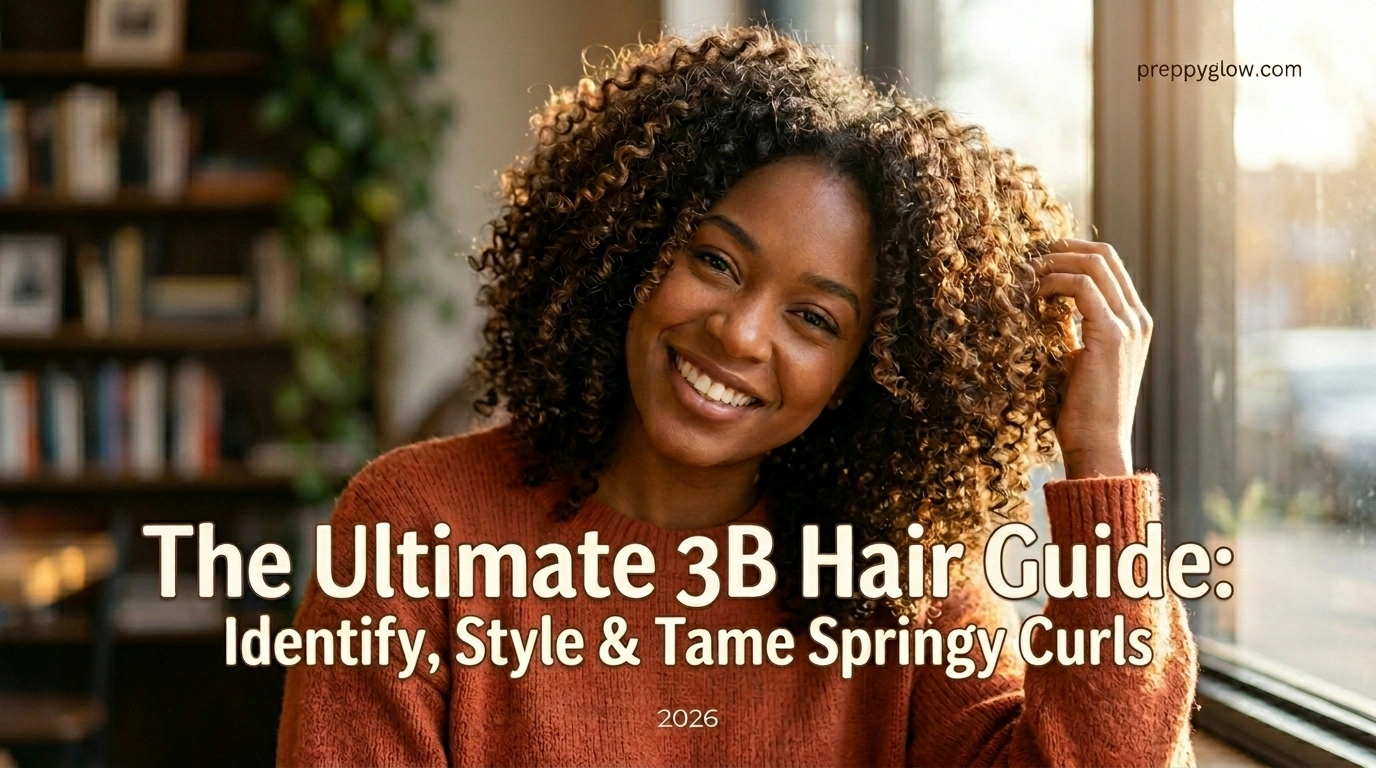
The Ultimate 3B Hair Guide: Identify, Style & Tame Springy Curls 2026
If your curls are bouncy, voluminous, and noticeably tighter than your friend’s loose waves — but they still frizz up by lunchtime no matter what you do — you’re probably dealing with 3b hair, and you’re fighting the wrong battle.
3b hair sits in the exact middle of the curly (Type 3) category: tighter and springier than 3A, but looser and bouncier than 3C. The curls are usually about the width of a marker, with real volume and movement, but they’re also some of the most dehydration-prone curls of any type.
In this guide, you’ll learn how to confirm you actually have 3b hair, the porosity science behind why it dries out so fast, and a complete wash-day-to-styling routine built specifically for springy, medium-shrinkage curls.
By the end, you’ll have a clear, repeatable system instead of trial-and-error guessing every time you step out of the shower.
What Is 3B Hair?
3b hair falls in the middle of Type 3 inside the Andre Walker curl-typing system, which ranges from straight (Type 1) through wavy (Type 2), curly (Type 3), to coily (Type 4). Within Type 3, 3B sits between the loose spirals of 3A and the tight corkscrews of 3C.
What Does 3B Hair Actually Look Like?
The defining trait of 3b hair is a tight, well-defined spiral that holds its shape even when wet — unlike 3A, which relaxes noticeably with water. Strand thickness is usually fine to medium, but the curls clump together densely, creating a look with serious volume and bounce.
Five real-world signs you’re likely dealing with 3b hair:
- Curls that hold their spiral shape right out of the shower, with minimal relaxing
- Ringlets roughly the width of a marker or highlighter pen
- Noticeable shrinkage — hair looks meaningfully shorter dry than it measures wet
- Curls that frizz quickly when touched, brushed, or exposed to humidity
- A defined halo of volume at the crown that 3A hair rarely produces
3B Hair on Men: What Changes?
Curl pattern is identical across genders, but cut length changes how 3b hair behaves. Very short fades can make the spiral look tighter than it is, since shrinkage is more visible with less length. Medium lengths let the true 3b pattern show clearly, which is why many barbers recommend at least an inch or two of length before judging curl type on men.
Men with 3b hair generally get the most predictable, even curl definition somewhere between half an inch and two inches of length — long enough for the spiral to fully form, short enough to stay low-maintenance day to day.
The Science Behind 3B Curls: Why They Frizz and Dry Out So Fast
Here’s the insight most product labels miss: 3b hair doesn’t need more product — it needs more consistent moisture. The tight spiral shape means the hair’s cuticle has more surface area exposed per inch of length than looser curl types, so water escapes the strand faster than it can be replaced.
This comes down to follicle shape again. 3b hair grows from a more curved, asymmetrical follicle than 3A, forcing a tighter coil as the strand emerges. The tighter the coil, the harder it is for natural scalp oil (sebum) to travel down the shaft and protect the ends, which is exactly why dryness and frizz are the two most common 3b complaints.

3B Hair Quick-Reference Profile
| Trait | Typical 3B Hair Detail |
| Curl diameter | Marker or Sharpie width |
| Shrinkage | Moderate — roughly 30–45% from wet to dry |
| Porosity | Often medium, frequently high at the ends |
| Density | Fine to medium strands, dense clumping |
| Frizz risk | High — the most frizz-prone of the three subtypes on average |
| Ideal wash frequency | 1–2 times per week, condition more often |
Curl-pattern ranges based on the Andre Walker hair-typing framework and consensus among curl-focused stylists. Individual hair varies.
The Float Test: Check Your 3B Porosity in 4 Minutes
Drop a clean, product-free strand into a glass of room-temperature water. If it floats, you’re low porosity. If it sinks slowly to the middle, you’re medium. If it drops straight to the bottom, you’re high porosity — the most common result for 3b hair, especially at the ends.
Ingredients That Help (and Hurt) 3B Hair
| Look For | Limit or Avoid |
| Shea butter and glycerin for sealed-in moisture | Sulfates, which strip oils your curls already lack |
| Rich leave-in conditioners with slip | Heavy waxes that cause buildup over multiple washes |
| Curl-defining gels with flexible hold | Alcohol-based products that accelerate dryness |
| Avocado or argan oil for sealing | Skipping conditioner on low-wash days |
Why 3B Hair Loses Definition Overnight
Friction is the hidden culprit behind morning frizz. Cotton pillowcases and regular cotton bonnets pull moisture directly out of the cuticle while you sleep, and the constant rubbing roughs up the curl’s outer layer.
Switching to a satin or silk pillowcase, combined with a loose overnight pineapple, solves the majority of “my curls looked great last night and terrible this morning” complaints reported by 3b hair clients.
3A vs 3B vs 3C Hair: Side-by-Side Comparison
3b hair is the type most often confused with both of its neighbors, since it shares some looseness with 3A and some tightness with 3C. Here’s exactly how all three compare.
| Feature | 3A Hair | 3B Hair | 3C Hair |
| Curl width | Sidewalk chalk / wine cork | Marker / Sharpie width | Pencil or straw width |
| Shrinkage | Low (10–20%) | Moderate (30–45%) | High (up to 50%+) |
| Wet behavior | Relaxes noticeably | Holds shape mostly | Holds shape fully |
| Frizz risk | Low to moderate | High | High, with knot risk |
| Best test | Curl loosens when wet | Curl bounces back even wet | Tight corkscrew, dense clumps |
The fastest way to separate 3b hair from 3A is the wet test: 3A visibly loosens when soaked, while 3b hair holds its spiral shape almost completely. The fastest way to separate 3b from 3C is curl width — if your curl is closer to a marker than a pencil, you’re 3B, not 3C.
Keep in mind that very few people have a single, uniform curl pattern across their entire head. It’s completely normal to have 3a-leaning curls at the temples and true 3b spirals at the crown — treat the dominant pattern as your guide for product shopping.
How Often Should You Actually Wash 3B Hair?
The short answer: one to two times a week, with conditioning in between. Washing 3b hair daily strips the limited natural oil it already struggles to retain, which directly causes the frizz most people are trying to fix.
1. Shampoo Sparingly
Use a sulfate-free formula once or twice a week, focused on the scalp rather than dragged through the full length of the curl.
2. Co-Wash on Off Days
A gentle, conditioner-only rinse two to three times a week keeps moisture topped up without over-cleansing the fragile mid-shaft and ends.
3. Always Detangle Wet
3b hair tangles easily because of its dense clumping. Detangle only with conditioner in the hair, working section by section from the ends up.
Stick to this rhythm for two to three weeks and most people notice a dramatic drop in frizz and breakage, even before changing a single product.
The Complete 3B Hair Care & Styling Routine
3b hair responds best to a layered, moisture-locking routine. Each step below builds on the last to trap hydration inside the curl before it has a chance to escape.
- Pre-poo before washing. Apply a light oil to dry hair 20–30 minutes before shampooing to create a protective barrier against over-cleansing.
- Shampoo the scalp only. Use a sulfate-free formula and let the lather rinse through the lengths naturally rather than scrubbing curls directly.
- Deep condition weekly. Leave a rich conditioner on for 15–20 minutes under a shower cap to restore moisture the tight coil structure loses fast.
- Detangle with conditioner in. Use a wide-tooth comb from ends to roots while hair is fully saturated and slippery.
- Apply the LOC method. Leave-in conditioner first, then a sealing oil, then a curl cream or gel — in that exact order, on soaking-wet hair.
- Diffuse on low heat with a heat protectant. 3b hair holds shape better with gentle, indirect heat than full air-drying, which can flatten the crown volume.
- Pineapple at night. Gather curls loosely on top of the head with a satin scrunchie to protect the shape and reduce morning frizz.

Common 3B Hair Problems (and How to Actually Fix Them)
- Frizz by midday: you’re skipping the oil-sealing step. Add a light oil after your leave-in to lock moisture in before styling.
- Curls look stringy or clumped together oddly: you’re using too much product at once. Apply less per section and distribute it more evenly through smaller pieces of hair.
- Hair feels dry within a day of washing: increase co-washing frequency and check that your shampoo is genuinely sulfate-free.
- Flat roots with frizzy ends: you’re applying product too heavily near the scalp. Start application from the ear-line down instead.
- Tangling overnight: switch to a satin or silk pillowcase and pineapple loosely instead of leaving curls completely loose.
- Volume disappears by evening: this is usually product fatigue, not a styling mistake. A light water-based refresher spray midday revives the curl without a full restyle.
Adjusting Your 3B Routine for Summer vs. Winter
- Summer: humidity is the enemy. Switch to a stronger-hold curl gel and rinse chlorine or saltwater out promptly to prevent moisture from being pulled out of the strand.
- Winter: indoor heating dries out 3b hair fast. Add a weekly hair mask and consider a silk-lined hat, since wool can rough up the cuticle and trigger static frizz.
Year-round, the core rule for 3b hair stays the same: layer moisture in deliberately, then seal it, rather than hoping one product does everything at once.
- Spring and fall transitions: watch how your hair reacts as humidity shifts week to week, and adjust gel hold or co-wash frequency gradually rather than overhauling your entire routine at once.
Is the Curl-Typing System Accurate for 3B Hair?
This comes up constantly in curly-hair communities: is the 2A-to-4C system real science, or just a shopping shortcut? The honest answer is both. It was never built as a precise medical classification — it’s a practical, visual tool for narrowing down a starting routine.
| Pros of Curl Typing | Cons of Curl Typing |
| Gives a fast, shared shopping vocabulary | Not a scientific or medical classification |
| Helps narrow a starting routine quickly | Most heads have two or three patterns at once |
| Used consistently across the haircare industry | Can encourage chasing an idealized “pure” type |
Use 3b hair as a useful starting point for product shopping, not a rigid label. If your curls are healthy, hydrated, and holding their shape, the exact letter matters far less than the results you’re seeing.
Best Hairstyles for 3B Hair
3b hair’s volume and bounce make it one of the most photogenic curl types, but its frizz tendency means some styles work better than others.
- Wash-and-go with diffusing: the classic option, and the best showcase for natural spiral definition when paired with a light diffuse instead of full air-drying.
- Twist-out: twisting damp, product-coated sections before bed adds extra hold and stretches shrinkage slightly for more visible length.
- Half-up topknot: keeps curls off the face during humid weather while still showing volume at the crown and sides.
- Braided protective styles: loose braids worn for a few days give 3b hair a break from daily manipulation, which reduces cumulative frizz and breakage.
Does 3B Hair Change Over Time?
Yes — curl pattern is far less fixed than most people assume. Hormonal shifts from puberty, pregnancy, or menopause can loosen or tighten a 3b pattern over months or years, sometimes dramatically.
Damage is the more common culprit, though. Repeated heat styling, chemical treatments, or harsh detangling can permanently loosen a 3b curl until it looks closer to 3A, even though the follicle itself never changed shape. If your curl pattern has shifted recently, check for split ends and breakage before assuming your hair type itself has changed.
Length plays a role too: longer 3b hair carries more weight, which stretches the spiral and can make identical hair look looser than it would at a shorter length.
About This Guide: Our 3B Hair Research & Methodology
This guide was written and reviewed by Maya Lawson, a certified curl specialist and trichology practitioner with 9 years of hands-on experience working with Type 3 hair clients across a wide range of porosity and density combinations.
PreppyGlow’s editorial process cross-references claims against the Andre Walker hair-typing framework, general dermatological consensus on porosity and follicle shape, and recurring patterns reported across curly-hair stylist communities. Recommendations are tested across multiple 3B porosity profiles before publication rather than written from a single hair type. This guide was last reviewed and updated for 2026.
Where this guide touches on hair science — porosity, shrinkage percentages, follicle behavior — we favor widely accepted, general consensus over single-study citations, since curl-pattern research remains a developing field without one universal scientific standard.
Our mission on PreppyGlow is simple: give curly-haired readers routines built for their exact curl pattern, not generic advice copied across every hair type.
People Also Ask About 3B Hair
Can 3B and 3C hair exist on the same head? Yes, very commonly. Many people have tighter 3C curls at the nape and looser 3B curls at the crown, which is completely normal and not a sign anything is wrong.
Why does my 3B hair look bigger some days than others? Humidity is the most common cause. High moisture in the air expands the cuticle and adds volume, while dry indoor air can cause the same curls to look smaller and tighter.
Is heat styling ever okay for 3B hair? Occasionally, with a heat protectant and low settings. Frequent heat styling is the fastest way to permanently loosen a 3b curl pattern over time.
What’s the difference between co-washing and regular washing? Co-washing uses conditioner only, cleansing gently without stripping oils. Regular shampooing removes more buildup but should be used less often on 3b hair.
Does 3B hair get tighter with shorter cuts? It can appear tighter since there’s less weight to stretch the curl open, but the underlying pattern itself doesn’t actually change with length.
Should 3B hair use protein treatments? Sparingly. Protein strengthens the strand, but overuse on already-fragile 3b curls can leave them feeling stiff and brittle, so alternate with moisture-focused masks.
Conclusion
3b hair earns its reputation as the bounciest, most voluminous curl type in the Type 3 family — but that same tight spiral structure is exactly why moisture and frizz are constant challenges. A consistent LOC-method routine, sparing wash frequency, and the right lightweight-but-rich product balance make all the difference.
Want the full breakdown of how 3b hair compares to its neighbors? Read our 3A vs 3B vs 3C Hair: The Complete Comparison, or explore our 3A Hair Guide and 3C Hair Guide to see the rest of the Type 3 curl family.
