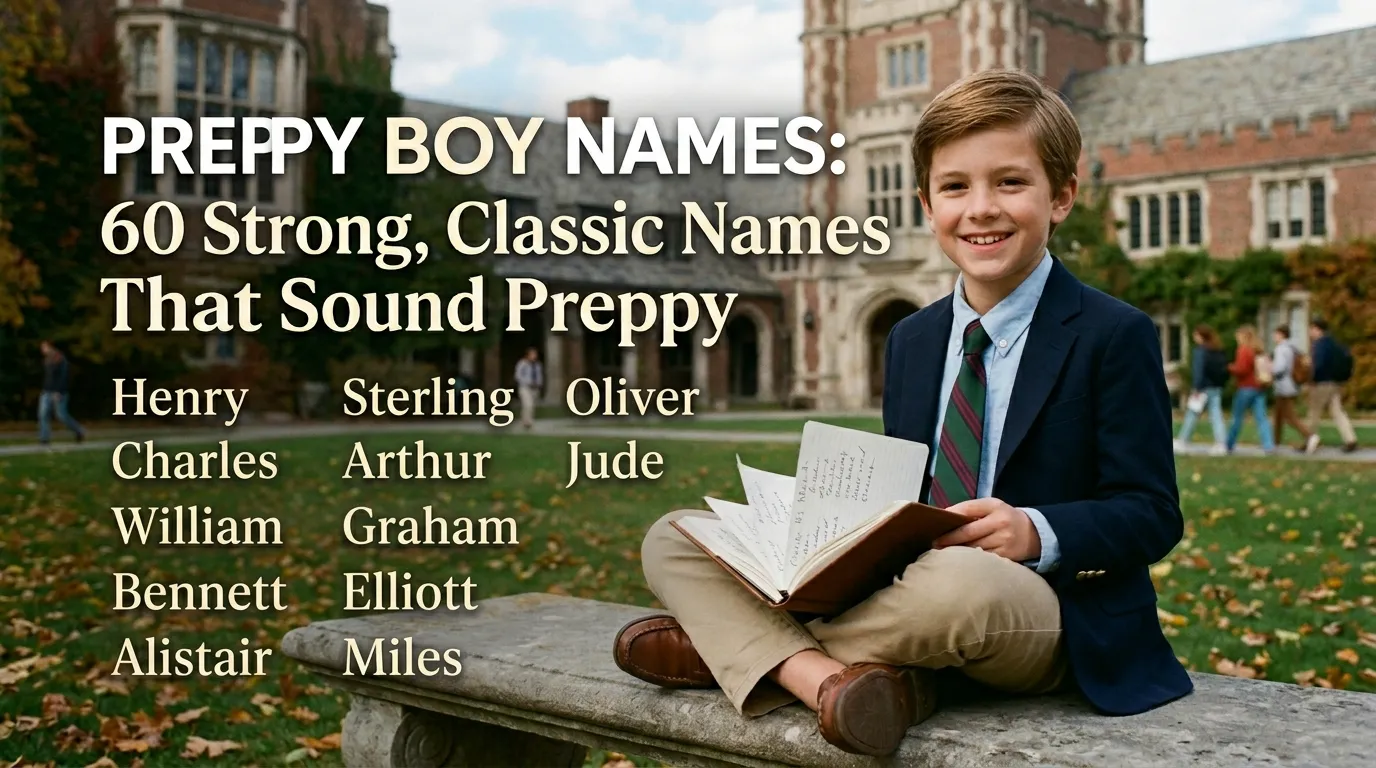
Preppy Boy Names: 60 Strong, Classic Names That Sound Preppy
There’s something unmistakably confident about a boy with a name like Hudson, Spencer, or Benjamin. These aren’t just names – they carry weight. They suggest a certain kind of upbringing, a leaning toward classic elegance, a quiet association with academic excellence and refined personality. That’s the essence of preppy boy names, and if you’re searching for one, you’re already thinking beyond trends.
Preppy names aren’t simply old-fashioned. They occupy a fascinating intersection between vintage lifestyle charm and modern sophistication. Whether you’re browsing preppy names for a boy or eventually a girl, you’ll notice they share the same DNA: polished without being stiff, traditional without being tired. If you’ve ever wondered why certain names just sound distinguished, this guide unpacks exactly that – with 60 name picks, cultural context, origin breakdowns, and everything a parent actually needs to make a confident choice.
What Makes a Name “Preppy”? Defining the Style Beyond the Stereotype
The word “preppy” originates from preparatory schools – the elite, often boarding schools in the northeastern United States that fed students into Ivy League universities like Harvard, Yale, and Princeton. These institutions shaped not just academic culture but also a broader aesthetic: tweed blazers, lacrosse fields, names that sounded like they belonged on a brass nameplate outside a library door.
Preppy culture is tied deeply to traditional naming style. Names common in these circles tended to be rooted in British names, Latin, or classical literature – names with gravitas, often passed down through generations. Think surnames used as first names (Preston, Carson, Hudson), or timeless classics borrowed from royalty and aristocracy (Edward, Hugo, Simon).
But here’s a nuance most name lists skip: preppy isn’t synonymous with stuffy. The best preppy names for boys feel alive – they have energy, they age well, and they work in a boardroom just as easily as on a college campus. That balance between high society associations and everyday wearability is what sets genuinely great preppy names apart from names that simply sound old.
The Cultural and Historical Roots of Preppy Baby Boy Names
From Ivy League Halls to Mainstream Naming Culture
The cultural DNA of preppy baby boy names stretches back centuries. Many popular choices trace their lineage to British aristocracy, where names like Edward, James, and Hugo were fixtures of the ruling class. These weren’t random selections – names in high society functioned almost like uniforms, signaling family heritage and social standing.
In 18th century music, literature, and political life, certain names accumulated reputations for intellectual distinction. Benjamin (Franklin), James (Madison), Simon (a name carrying both Biblical gravitas and literary polish) – these names were woven into the fabric of academia and civic life alike.
The American prep school tradition absorbed and codified this naming culture through the 19th and early 20th centuries. As families sent sons to Exeter, Andover, and Choate, they also passed down names that communicated belonging – to a lineage, an ethos, an expectation of academic excellence. Classic literature further reinforced the cycle, with characters named Nolan, Warren, Desmond, and Spencer populating the pages of novels that those very students were assigned to read.
The Old Money Effect: Why These Names Still Resonate
There’s a sociological phenomenon sometimes called the “old money names” effect – the observation that names associated with generational wealth and elite lifestyle carry lasting prestige. Unlike trendy names that spike and fade, timeless baby names from this tradition maintain quiet relevance across decades.
This isn’t elitism for its own sake. It’s that these names were selected over centuries by cultures that valued durability. A name like Callum (Scottish Gaelic, meaning “dove”) or Desmond (Irish, meaning “one from South Munster”) might sound quintessentially prep, but their roots are geographic and historical – not manufactured.
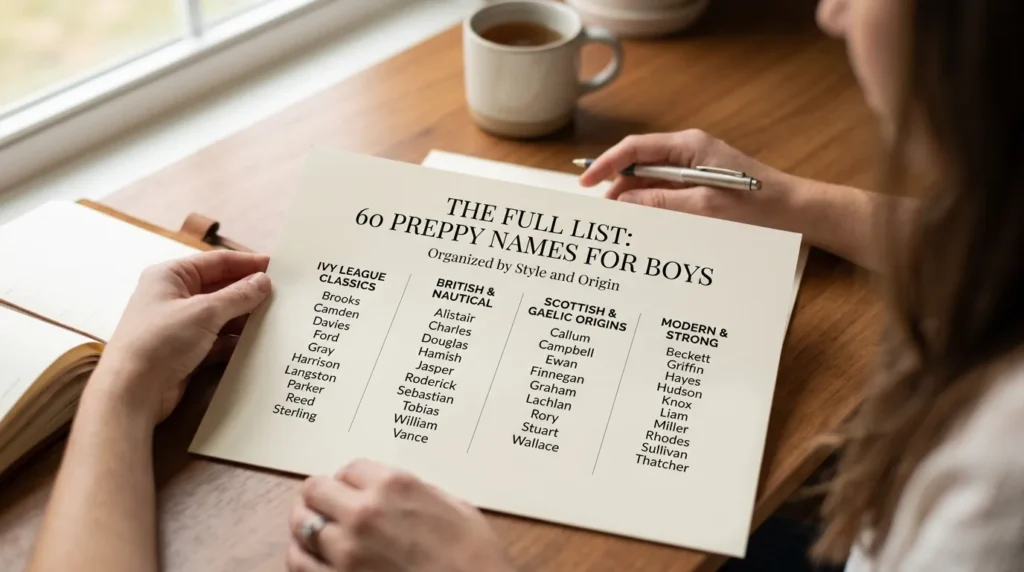
The Full List: 60 Preppy Names for Boys, Organized by Style and Origin
Classic Core: The Foundation of Preppy Naming
These are the anchors – names that have appeared on Ivy League rosters, in classic novels, and on family crests for generations. They represent the original spirit of traditional boy names done right.
- James – A perennial classic. Hebrew origin (“supplanter”), endlessly versatile, never truly out of style.
- Benjamin – Warm yet distinguished. Hebrew roots, strong enough to stand alone, “Ben” works as a natural nickname.
- Edward – Old English royalty. Stately, polished, a name that carries natural authority.
- Hugo – Latin/Germanic origin, meaning “mind” or “spirit.” Underused in the US, wildly popular in Europe – genuinely cool preppy names territory.
- Simon – Greek/Hebrew hybrid, meaning “one who hears.” Clean, confident, literary.
- Warren – Old French/English, meaning “park warden.” Uncommon enough to feel distinctive, familiar enough to feel grounded.
- Desmond – Irish origin with deep historical roots. Carries a sophisticated, almost cinematic quality.
- Lucas – Latin and Greek roots. A strong, slightly softer alternative to Luke, with the same timeless appeal.
- Levi – Hebrew, meaning “joined in harmony.” Feels modern but has ancient roots – a rare sweet spot.
- Nolan – Irish Gaelic, meaning “champion.” Athletic, sharp, one of the more elegant baby name ideas for boys who’ll grow into men of action.
Surname-Style Preppy Names for Boys: The Ivy League Aesthetic
One of the most recognizable hallmarks of Ivy League naming culture is the use of surnames – often family surnames – as first names. This convention signals heritage and elite naming tradition simultaneously.
- Hudson – English geographical surname turned powerhouse first name. Feels both classic and modern.
- Preston – Old English, “priest’s town.” Polished, confident, undeniably preppy.
- Spencer – Old English, meaning “steward” or “house administrator.” Has a natural, easy sophistication.
- Carson – Scottish/Irish surname. Friendly but refined – popular baby names that don’t overstay their welcome.
- Sutton – Old English, “south settlement.” Uncommon boy names with genuine prep school energy.
- Camden – Old English, “winding valley.” Feels fresh while nodding to British names tradition.
- Ashton – Old English, “ash tree town.” Familiar enough to feel accessible, distinctive enough to stand out.
- Beau – French origin, meaning “handsome.” Short, punchy, carries an effortless gentleman baby names quality.
- Damian – Greek/Latin, meaning “to tame.” Has old money names gravitas without being overly formal.
Refined and Polished: Names with European Flair
A genuinely comprehensive list of preppy names for boys has to acknowledge the global naming culture that informs the aesthetic. French baby boy names, British names, and Scandinavian boy names all contribute meaningfully to what “preppy” sounds like today.
- Rafael – Spanish/Hebrew origin. Sounds elevated, slightly European, fits the refined boy names category perfectly.
- Eduardo – Romance language variant of Edward. Warm and distinguished.
- Gael – Celtic origin, meaning “Gaelic speaker.” Short, strong, genuinely rare in American name pools.
- Hans – Scandinavian/German variant of John. Clean, global preppy names energy.
- Pedro – Portuguese/Spanish origin. Classic literature has long featured names of this stature.
- Idris – Welsh and Arabic roots, meaning “ardent lord.” One of the most intriguing names on this list – edgy yet elegant.
- Zahir – Arabic, meaning “bright” or “shining.” Cultured, distinctive, part of a growing recognition that refined personality isn’t culture-specific.
- Toru – Japanese origin. Quietly sophisticated – an example of global naming culture expanding what “preppy” means in the 21st century.
Unique Preppy Boy Names: Beyond the Obvious Picks
Parents who want something genuinely distinctive – not just the preppy classics they’ve seen on every list – will appreciate these unique preppy boy names. Each carries the right associations without being overexposed.
- Callum – Scottish Gaelic, “dove.” Has all the hallmarks of a polished baby name without the over-familiarity.
- Leighton – Old English, “herb garden.” Gender-neutral preppy names that skew traditionally masculine here.
- Rafferty – Irish surname-style, meaning “flood tide.” Uncommon, melodic, quietly cool.
- Theron – Greek, “hunter.” Has a vintage lifestyle feel with strong academic undertones.
- Emory – Germanic, “power.” Sounds like a university (because it is), which only adds to the academic inspired names appeal.
- Fletcher – Old English occupational name. Sharp, friendly, holds up in any decade.
- Aldous – Old German/English. Classic literature readers will recognize this from Aldous Huxley – high-brow and literary.
- Crispin – Latin, “curly-haired.” Medieval English saint’s name, deeply obscure, strangely charming.
- Stellan – Scandinavian, meaning “calm.” One of the more elegant Scandinavian boy names in circulation.
- Alistair – Scottish variant of Alexander. Unmistakably British, polished to a shine.
Modern Preppy Names: The 21st-Century Evolution
Preppy culture didn’t freeze in 1985. It evolved. Today’s best modern preppy names balance that old-school elegance with a contemporary ease that earlier generations of preppy names sometimes lacked.
- Beckett – Old English/Irish, “little stream.” Literary (Samuel Beckett), surname-style, effortlessly cool preppy names energy.
- Rowan – Scottish/Irish, “little redhead” or “rowan tree.” Fresh, natural, increasingly popular without being overused.
- Emmett – Germanic, “entire” or “universal.” Friendly and sharp – fits the cute baby boy names and sophisticated boy names categories simultaneously.
- Archer – Old English occupational name. Athletic associations, great sound, modern preppy names at their best.
- Bennett – Latin/French, variant of Benedict, meaning “blessed.” Feels literary and current in equal measure.
- Stellan – (see above) – worth noting its rise among trendy baby boy names in Nordic and American circles alike.
- Weston – Old English, “west settlement.” Has the surname-style prep school feel with a Western American edge.
- Griffin – Welsh, “strong lord.” Powerful, slightly edgy, one of the more interesting edgy boy names that still fits the preppy framework.
- Everett – Old English/German, “brave boar.” Sounds distinguished, feels human – a name that wears well.
- Beckett – (noted again for emphasis) consistently appearing on best preppy names lists for good reason.
Rare and Uncommon: For Parents Who Think Differently
If your instinct is to go off the beaten path entirely, these uncommon boy names carry preppy DNA without the exposure:
- Nikhil – Sanskrit, meaning “complete” or “whole.” Cultural baby names that transcend geography.
- Ravi – Sanskrit, “sun.” Short, strong, ancient.
- Hadley – Old English, “heather meadow.” Slightly gender-neutral, has classic literature associations (Hemingway’s first wife).
- Anselm – Germanic, “divine protection.” Medieval, aristocratic, genuinely rare.
- Peregrine – Latin, “traveler” or “pilgrim.” As uncommon as it gets – for parents who want a name with deep vintage lifestyle roots.
- Thaddeus – Aramaic/Greek. Biblical, literary, weighty in the best way.
Preppy Boy Names Comparison Table
| Name | Origin | Meaning | Style Category | Popularity Level |
|---|---|---|---|---|
| James | Hebrew | Supplanter | Classic Core | Very High |
| Benjamin | Hebrew | Son of the right hand | Classic Core | High |
| Hudson | English | Son of Hugh | Surname-Style | High |
| Spencer | Old English | Steward | Surname-Style | Medium |
| Hugo | Latin/Germanic | Mind, spirit | European Flair | Medium |
| Callum | Scottish Gaelic | Dove | Unique | Low–Medium |
| Beau | French | Handsome | Surname-Style | Medium |
| Sutton | Old English | South settlement | Unique | Low |
| Beckett | Old English/Irish | Little stream | Modern | Medium |
| Idris | Welsh/Arabic | Ardent lord | Global/Unique | Low |
| Stellan | Scandinavian | Calm | Modern/Scandinavian | Low |
| Preston | Old English | Priest’s town | Surname-Style | Medium |
| Rafael | Spanish/Hebrew | God has healed | European Flair | Medium |
| Desmond | Irish | From South Munster | Classic Core | Low–Medium |
| Everett | Old English/German | Brave boar | Modern | Medium |
Preppy vs. Posh vs. Vintage: Understanding the Differences
These three terms are often used interchangeably when people discuss sophisticated boy names, but they’re not the same thing – and the distinction matters when choosing a name.
Preppy names are specifically tied to the prep school and Ivy League tradition. They tend toward English, Latin, and Celtic origins, often have surname energy, and carry associations with academia and American East Coast culture. Examples: Hudson, Spencer, Preston.
Posh names lean more toward British aristocratic naming – think names that appear in Debrett’s Peerage. They’re often older, sometimes more archaic, and carry a distinctly transatlantic quality. Examples: Rupert, Barnaby, Cosimo.
Vintage names are simply older names having a revival – they may or may not carry elite associations. Their appeal is nostalgia and authenticity. Examples: Walter, Harold, Clifford.
The sweet spot for most parents is where preppy and vintage overlap: names like Warren, Levi, Desmond, and Nolan that feel genuinely classic without being costumy. And if you’re expecting a daughter too, many of the same principles apply to preppy girl names – names like Blair, Sloane, or Cordelia carry the same old-money elegance and classic refinement that define great preppy names across the board.
For a deeper dive into what the full preppy aesthetic looks like beyond naming, Preppyglow offers an excellent breakdown of preppy style, culture, and the lifestyle elements that make these names feel so at home in their world.
Choosing the Right Preppy Name: Practical Guidance
Does the Name Age Well?
The most important test for any name – preppy or otherwise – is how it ages. A name needs to work for a toddler, a teenager, a job applicant, and a 70-year-old. Names like James, Benjamin, and Edward pass this test effortlessly. Shorter, nickname-forward names like Beau or Gael do too, in different ways.
Consider Sound Pairing with Your Last Name
Preppy names often have strong consonant sounds – the “k” in Beckett, the “n” in Nolan, the hard stop in Preston. Make sure the name’s rhythm works with your surname. A one-syllable last name pairs beautifully with two- or three-syllable preppy choices like Benjamin, Everett, or Callum.
Nickname Viability
Many preppy baby boy names come with natural, friendly nicknames – and that flexibility matters:
- Benjamin → Ben
- Edward → Ed / Teddy
- Desmond → Dez
- Benjamin → Benji
- Callum → Cal
- Sutton → Sut (admittedly rare, but it works)
Names without obvious nicknames (Beau, Nolan, Gael) tend to be short enough that they don’t need them.
The “Will This Name Travel?” Test
Given that global naming culture increasingly shapes how names are received, it’s worth asking whether a name works across cultures and languages. Rafael, Hugo, Levi, and Lucas all travel exceptionally well – recognized across Europe, Latin America, and beyond without losing their polished character.
Lesser-Known Insights: What Most Preppy Name Lists Get Wrong
Most articles on this topic simply list names without explaining why they fit. A few things worth knowing:
Origin matters more than sound. A name can sound preppy purely because of phonetics, but the most enduring preppy names for boys are those with genuine historical substance. Aldous, Anselm, and Peregrine sound distinctive because they carry centuries of actual usage.
The surname trend has limits. Surname-style names are dominant right now, but they can age poorly in ways that classical names don’t. Hudson, Carson, and Camden are excellent now – but check their trajectories before assuming they’ll feel as fresh in 30 years.
Global names are increasingly part of the preppy conversation. Names like Idris, Zahir, Nikhil, and Ravi bring the same refined personality and cultural depth as any British or French baby boy name. Preppy culture at its best isn’t exclusionary – it’s about a commitment to quality, heritage, and timeless style.
Frequently Asked Questions About Preppy Boy Names
What exactly are preppy names for boys?
Preppy names for boys are typically classic, traditional, and often associated with Ivy League culture, prep school heritage, or old-money aesthetics. They tend to have strong historical roots – often British, Latin, French, or Celtic – and carry connotations of academic excellence, refinement, and timeless style. Names like James, Hudson, Spencer, and Benjamin are quintessential examples.
Are preppy names the same as old-fashioned names?
Not quite. Old-fashioned names are simply names that were popular in earlier decades (think Walter, Harold, or Clarence). Preppy names can be old-fashioned, but they specifically carry connotations of elite lifestyle and classic elegance. The key difference is that preppy names tend to feel current and polished even when they’re centuries old – they’ve been maintained in active, high-profile use rather than falling into disuse.
What are some unique preppy boy names that aren’t overused?
If you want unique preppy boy names that aren’t on every baby list, consider: Callum, Sutton, Aldous, Anselm, Rafferty, Crispin, Stellan, Leighton, Hadley, and Peregrine. These names carry all the hallmarks of preppy culture – classic roots, refined sound, historical weight – without the overexposure of more popular choices.
Can preppy names work for boys from diverse cultural backgrounds?
Absolutely. Preppy culture’s core values – classic elegance, academic inspiration, timeless style – transcend any single ethnicity or geography. Names like Rafael, Idris, Zahir, Nikhil, Ravi, and Toru bring the same refined personality to the table as any British or Ivy League name. In fact, culturally diverse preppy names often feel more distinctive and interesting than their Anglo counterparts.
What’s the difference between preppy names and Ivy League names?
Ivy League names are a subset of preppy names – specifically those with strong associations with Harvard, Yale, Princeton, and similar institutions. Think James, Benjamin, Edward, and Warren. Preppy names are the broader category, including surname-style names (Hudson, Preston, Carson), European imports (Hugo, Rafael, Stellan), and literary-inspired choices (Aldous, Crispin, Thaddeus). All Ivy League names are preppy, but not all preppy names are strictly Ivy League.
How do I know if a preppy name will age well?
Test it across life stages: does it work for a 5-year-old, a 16-year-old, and a 45-year-old professional? The best preppy baby boy names pass this test because they’re grounded in history rather than trend. Names like James, Desmond, Hugo, and Everett have been in use for centuries for a reason – they carry natural authority at every life stage without ever feeling inappropriate. Avoid names that sound exclusively youthful (like Beau or Gael, which are lovely but require a certain confidence to carry into middle age) unless you’re certain they suit your child’s likely personality.
A Note on Naming with Intention
Choosing a name is genuinely one of the first major decisions you’ll make for another person. The preppy naming tradition, at its best, isn’t about social climbing or exclusivity – it’s about reaching for something durable. Names like Levi, Callum, Warren, and Hugo have outlasted every trend they’ve lived through. That’s not luck. That’s the particular staying power of names rooted in culture, history, and genuine beauty of sound.
Whether you’re drawn to the Ivy League grandeur of Benjamin and Edward, the quiet cool of Sutton and Beau, the European sophistication of Hugo and Rafael, or the genuinely off-the-radar depth of Aldous and Peregrine – the preppy naming tradition gives you 60 strong reasons to feel confident in your choice.
For parents who want to go further – understanding how these names fit into a broader classic elegance lifestyle, from style to sensibility – Preppyglow is one of the better resources out there for understanding the full cultural context that makes these names feel so right.
