Preppy Party Trial: What It Is, How to Host & Everything You Need
When people search “preppy party trial” today, two very different worlds collide. One is the aesthetic universe of polo shirts, pastel blazers, and curated social gatherings rooted in East Coast prep culture. The other is a real, high-profile Connecticut murder trial that rocked the state and drew national attention through Court TV live trial coverage. This article covers both thoroughly, because understanding the full context of this phrase, from its cultural roots to its legal dimensions, is what separates a surface-level read from genuine insight.
What “Preppy Party” Really Means Before the Trial Changed Everything
Before May 2022, a “preppy party” evoked images of manicured lawns, boat shoes, varsity sweaters, and young people from well-off Connecticut suburbs socializing in the ways generations before them had. If you have ever explored what the aesthetic actually stands for, resources like Preppyglow lay out the cultural DNA clearly: it is a lifestyle built on tradition, tasteful presentation, and social confidence.
That image shattered publicly when the Shelton house party stabbing turned the phrase into something far darker in the public consciousness. A gathering at a private home in Shelton, Connecticut on May 14, 2022 ended with James McGrath dead, Ryan Heinz and Thomas Connery seriously wounded, and a teenager named Raul Valle facing the most serious criminal charges a Connecticut courtroom could bring.
Understanding the trial requires understanding both the setting and the people involved. This was not a random urban street fight. It was a party in a suburb, attended by teenagers, in a state where the preppy social culture is deeply woven into the community fabric.
The Night That Defined the Shelton Preppy Party Stabbing Case
What Happened on May 14, 2022
According to testimony and the police investigation that followed, the party at the Shelton residence involved underage drinking and a social scene typical of suburban Connecticut teens. Taylor Capela, a longtime friend of Jimmy McGrath, described the atmosphere of May 14, 2022 in detail during her testimony, placing the events in context for the jury. What began as a routine social gathering escalated into a violent party altercation that would end with a fatal stabbing.
James McGrath, the victim in Count 1 of the charges, died from his stab wounds. Ryan Heinz, named in Count 2, and Thomas Connery, the subject of Count 3, survived but sustained serious injuries. The prosecution argued that Raul Valle was responsible for all three stabbings.
Who Is Raul Valle
Raul Valle was a teenager at the time of the stabbing. The Connecticut stabbing victims and their families, as well as the broader community, watched as Valle became the central figure in what would grow into one of Connecticut’s most closely watched criminal justice cases in years. Court TV trial coverage brought the proceedings to a national audience, with people across the country following the Connecticut murder trial as it unfolded day by day.
Valle’s defense team argued self-defense claim throughout the trial, contending that Valle acted to protect himself and that the stabbing was not premeditated murder but a reaction to perceived threat.
Inside the Courtroom: The Connecticut Murder Trial Explained
The Charges Valle Faced
The Raul Valle trial centered on three distinct counts:
- Count 1 involved James McGrath, who did not survive. This was the murder charge that drew the most attention and ultimately led to jury deadlock on that specific count.
- Count 2 concerned Ryan Heinz, one of the surviving stabbing victims.
- Count 3 addressed Thomas Connery, whose brother Charlie Connery also played a significant role as a witness.
The attempted murder charges and assault charges tied to Heinz and Connery ran alongside the primary homicide count. The prosecution sought to establish that the stabbings were intentional, targeted acts of violence rather than a chaotic response to a party fight escalation.
The Witnesses Who Shaped the Case
The list of trial witness testimony was extensive. Each witness added a layer to the picture the jury had to piece together.
Charlie Connery, whose brother Tommy was among the surviving stabbing victims, personally witnessed the stabbing and described the incident during his testimony in vivid detail. His account was among the most emotionally resonant moments of the trial.
Taylor Capela, a close friend of McGrath, offered a picture of the party’s earlier hours and McGrath as a person, humanizing the victim for the jury.
Other eyewitness witness statements came from:
- Aidan King, who gave testimony about the events as he witnessed them
- Faison Teele, whose account contributed to the prosecution’s timeline
- Griffin Marcincyk, another attendee who provided perspective on the altercation
- Isabella Molnar, whose testimony addressed details of the gathering
- Emily Robinson, who spoke to the atmosphere and events of the night
- Tanner Chenowsky, whose account the defense also examined carefully
- Former Shelton Police Officer Lonnie Blackwell, whose testimony covered the law enforcement response and the early stages of the Shelton Police Department’s homicide investigation
Each of these witnesses faced cross-examination, and the defense used their statements to chip away at the prosecution’s narrative wherever inconsistencies appeared.
The Self-Defense Argument and Raul Valle’s Own Testimony
One of the most dramatic turns in the teen stabbing incident trial came when Raul Valle took the stand in his own defense. This is always a high-stakes decision in any criminal trial coverage scenario. The Raul Valle defense team calculated that hearing from Valle directly would humanize him and reinforce the self-defense claim.
Valle’s testimony described his state of mind that night, the threat he said he perceived, and why he believed his actions were necessary for his own survival. The prosecution worked to dismantle that account, pointing to the number of victims and the severity of the wounds as evidence that this was not a defensive act but an offensive assault.
Michael Egan, a figure connected to the legal proceedings, was also referenced in the context of the case’s broader details.
Day-by-Day Trial Coverage: How the Case Unfolded

Court TV’s live trial coverage meant that people following Connecticut courtroom news could track every development in near real-time. Here is a compressed look at how the major phases played out across the trial days:
| Trial Day | Key Development |
|---|---|
| Day 1 (6/17/25) | Opening statements; prosecution laid out the party stabbing case timeline |
| Day 2 (6/18/25) | Early witnesses; establishing the scene at the Shelton Connecticut crime location |
| Day 10 (7/3/25) | Key eyewitness testimony; defense cross-examinations intensify |
| Day 11 (7/7/25) | Raul Valle takes the stand in his own defense |
| Day 12 (7/8/25) | Closing arguments; jury sent to deliberate |
| Day 13 (7/9/25) | Jury deadlock on the murder charge; deliberations continue on remaining counts |
The jury deadlock on the murder charge related to James McGrath’s death was the headline moment. The jury asked to rehear Raul Valle’s testimony before delivering any verdicts, which Court TV broadcast and which legal analysts dissected at length. Murder charge deliberation in a case with this level of emotional weight and conflicting eyewitness accounts was always going to be complicated.
Preppy Party Culture vs. Party Violence: A Contrast Worth Making
Part of what made this case so arresting to the public was the collision of setting and outcome. Suburban Connecticut, preppy social gatherings, teens from established communities, these are not the environments most Americans associate with fatal party fight escalation. That dissonance drove much of the media and public interest.
If you spend time on Preppyglow exploring the actual preppy aesthetic, what stands out is how much the culture values order, presentation, and social grace. The Shelton preppy party stabbing represented a complete inversion of those values, which is part of why the case hit so hard within the community.
How to Actually Host a Preppy-Themed Party the Right Way

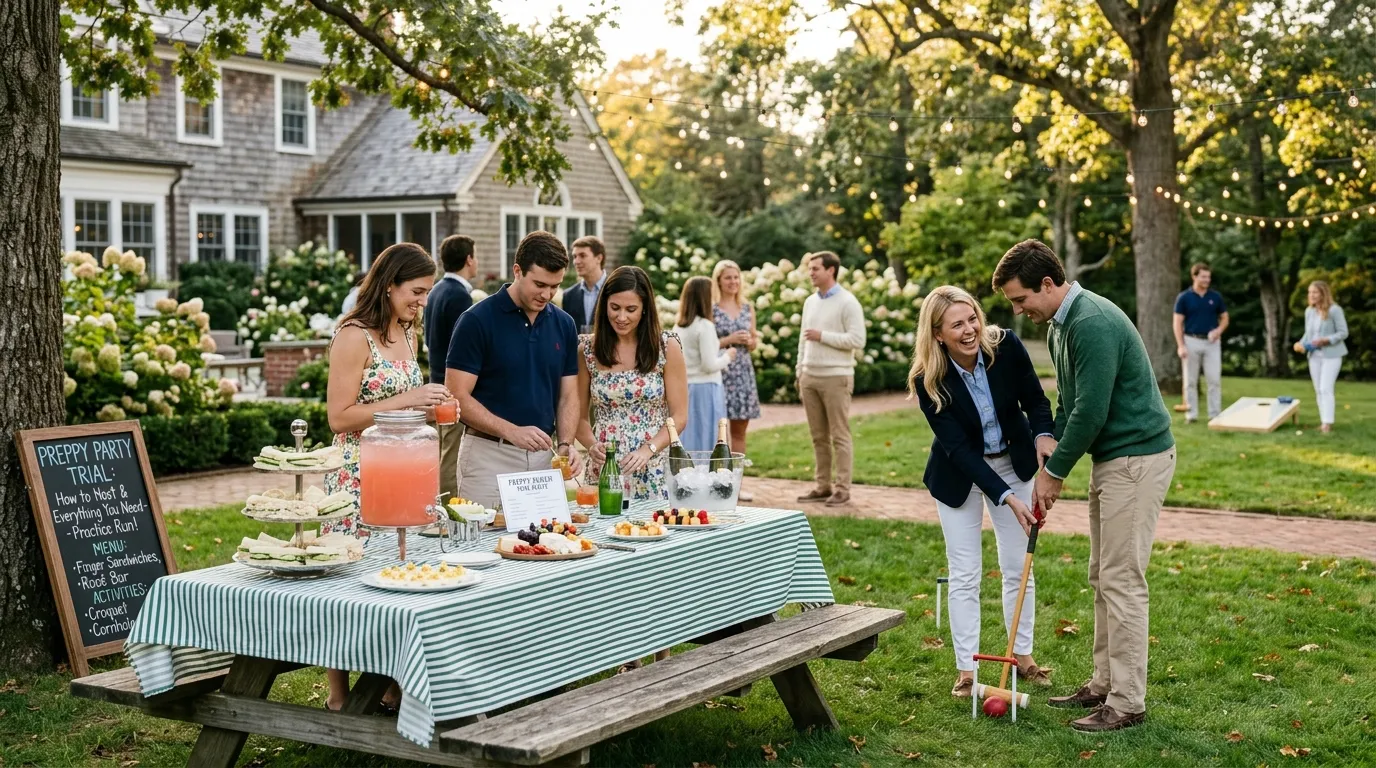
For those who arrived here looking for party-planning guidance rooted in preppy culture rather than court proceedings, here is what that actually looks like in practice.
The Core Elements of a Preppy Party Setup
A well-executed preppy party leans into a specific visual and social language:
- Color palette: Navy, hunter green, red, white, and pastel shades. Plaid and madras patterns work well for tablecloths and napkins.
- Dress code: Encourage guests to wear blazers, polos, headbands, and boat shoes. Part of the appeal is the collective costume.
- Venue: A backyard, a club-style indoor space, or a boathouse setting all fit. The point is that the space feels curated and intentional, not thrown together.
- Menu: Think upscale casual. Sliders, shrimp cocktail, deviled eggs, and seasonal baked goods. If you want to go full fall, something like a preppy kitchen pumpkin pie on the dessert table hits both the aesthetic and the season. For a spring or early summer gathering, a preppy kitchen apple pie works just as well and signals the wholesome, home-baked quality that fits the vibe.
- Music: Classic rock, pop standards, and yacht rock playlists fit the tone. Avoid anything that clashes with the curated atmosphere.
The “Trial” in Preppy Party Trial: Running a Practice or Preview Event
In event-planning circles, a “party trial” refers to a test run of your setup before the actual event. This is especially common for weddings, charity galas, and large gatherings where getting the details right matters. A preppy party trial in this sense would involve:
- Testing your tablescape and decor arrangement
- Running through your catering or food preparation timeline
- Inviting a small group to experience the ambiance and give feedback
- Checking that lighting, music levels, and flow between spaces all work together
This is genuinely useful practice. Anyone who has hosted a large event knows that surprises on the actual day are far more stressful than surprises during a low-stakes dry run.
Lesser-Known Insights About Preppy Culture and Teen Party Violence

Most coverage of the Shelton Connecticut crime either leaned into the suburban shock angle or the legal procedural side. Fewer outlets engaged with what the case actually reveals about teen social dynamics in affluent communities.
Research on teen violence case patterns consistently shows that access to alcohol, social hierarchies within peer groups, and the absence of adult supervision are the dominant risk factors. Underage drinking party settings create conditions where status anxiety and impulsivity intersect in dangerous ways, regardless of the socioeconomic background of the attendees.
The high-profile murder trial aspect also raised questions about how criminal justice case outcomes differ based on resources available to defendants. The Raul Valle defense was well-resourced and mounted a sophisticated legal strategy. The prosecution, drawing on Shelton Police Department investigations and extensive EMT testimony, worked to counter that strategy with physical evidence and witness accounts.
Whether Valle’s self-defense claim ultimately persuaded the jury, or whether the jury deadlock on the murder charge represented something closer to reasonable doubt rather than acceptance of the defense narrative, is a distinction that legal analysts debated extensively during and after the Court TV trial coverage.
Preppy Party Trial: Comparison of Key Perspectives
| Perspective | Prosecution View | Defense View |
|---|---|---|
| Nature of the event | Underage drinking party with foreseeable danger | Normal social gathering attended by Valle |
| Valle’s actions | Intentional, targeted fatal stabbing | Reactive self-defense under perceived threat |
| Victim characterization | Innocent party guests | Aggressors who threatened Valle |
| Witness credibility | Consistent and corroborated accounts | Biased or inconsistent testimony |
| Legal outcome sought | Murder conviction plus assault and attempted murder | Acquittal on all or most counts |
Frequently Asked Questions
What is the Preppy Party Trial?
The “Preppy Party Trial” refers to the Connecticut criminal trial of Raul Valle, who was charged with murder, attempted murder, and assault following the Shelton house party stabbing on May 14, 2022. The trial received extensive Court TV live trial coverage and drew significant public attention due to its suburban setting and the youth of those involved.
Who died in the Shelton preppy party stabbing?
James McGrath died as a result of the stabbings that occurred at the Shelton Connecticut party. Ryan Heinz and Thomas Connery were also stabbed and survived. Their cases formed Count 2 and Count 3 of the charges against Raul Valle.
What was Raul Valle’s defense in the Connecticut murder trial?
Raul Valle’s defense centered on a self-defense claim. His legal team argued that Valle perceived a genuine threat to his safety and that his actions were a defensive response rather than a premeditated attack. Valle testified in his own defense during Day 11 of the trial.
What happened during jury deliberation in the Raul Valle trial?
The jury deadlocked on the murder charge related to James McGrath’s death, which was the most serious count. During deliberations, the jury asked to rehear Valle’s testimony, a procedural step that Court TV covered closely. The jury deadlock on that count was a significant development in the case.
What does “preppy party trial” mean outside the criminal case context? In party planning, a “party trial” is a practice run or test event held before the main gathering. A preppy party trial in this sense means testing your decor, food, and ambiance in advance. The preppy aesthetic draws from East Coast collegiate culture, and executing it well often benefits from this kind of preparation.
What should I serve at a preppy-themed party? Classic American baked goods and appetizers fit the tone well. Seasonal items like a preppy kitchen pumpkin pie for fall events or a preppy kitchen apple pie for spring and summer gatherings work beautifully. Shrimp cocktail, cheese boards, and club-style finger foods all align with the aesthetic.
Where did the preppy party aesthetic originate? The preppy aesthetic grew out of Northeastern American private school and Ivy League university culture in the mid-20th century. It became codified and spread nationally through the 1980s, with strong roots in states like Connecticut, Massachusetts, and further south through preppy college South Carolina communities that blended the Southern and New England prep traditions into their own distinct version of the style.
