How to Write Thank-You Notes That Actually Impress
Most thank-you notes get read once and forgotten. A handful get folded up, tucked into a drawer, and kept for years. The difference almost never comes down to fancy stationery or perfect handwriting — it comes down to how the note is written. If you’ve ever stared at a blank card wondering what to say beyond “thanks so much,” this guide walks you through exactly how to write thank you notes that sound sincere, land well, and take you less than five minutes once you know the formula.
Whether you’re sending a wedding thank you note, a job interview thank you note, or a quick card for a hostess gift, the same core structure works. Below, you’ll find a repeatable formula, real wording examples, timing rules, and answers to the questions people ask most about thank you note etiquette.
Why Thank-You Notes Still Matter
Email and text made instant gratitude easy — and forgettable. A typed “Thanks!” disappears into a notification feed within seconds. A handwritten note, on the other hand, requires someone to buy a card, sit down, choose their words, and mail it. That effort is the message. It signals that the relationship — or the gift, or the interview — mattered enough to slow down for.
There’s also a practical career angle. Hiring managers regularly cite a well-written job interview thank you note as a tiebreaker between two similarly qualified candidates. It’s not that the note itself proves competence; it proves attentiveness, follow-through, and communication skill — three things every employer is quietly screening for anyway.
None of this means digital gratitude is wrong. A quick thank-you text after a casual coffee is perfectly appropriate. The key is matching the format to the moment, which is exactly what the next few sections cover.
Once you understand how to write thank-you notes with real intention behind them, they stop feeling like an obligation and start feeling like an easy, genuine habit.

The 4-Part Formula for a Memorable Thank-You Note
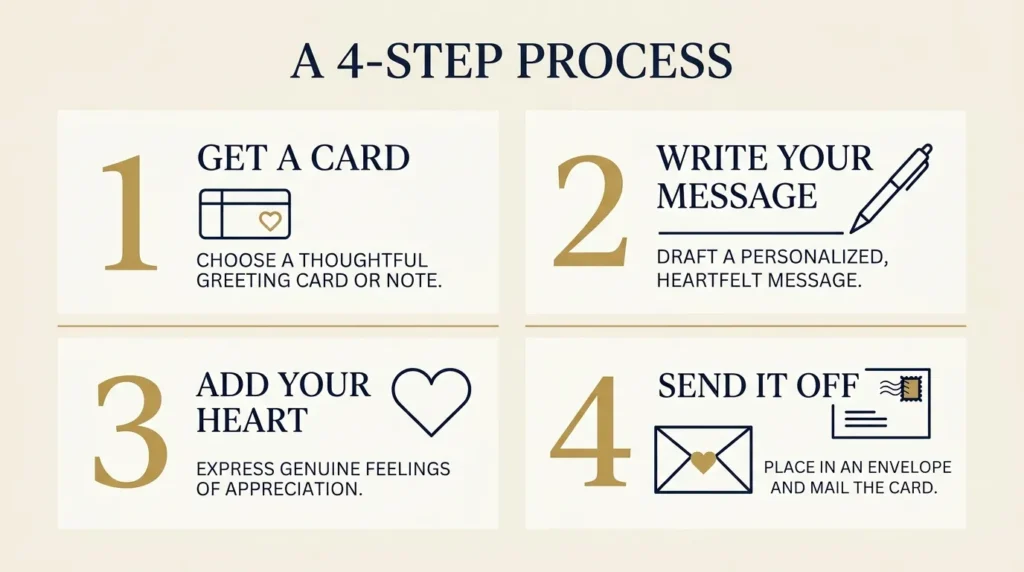
Every strong thank-you note — personal, professional, or somewhere in between — follows the same four-part skeleton. If you only remember one takeaway from this guide on how to write thank-you notes, make it this formula. Once you internalize this, you’ll never stare at a blank card again.
Part 1: The Greeting and Warm Opener
Use the recipient’s name, not just “Dear Friend” or “To Whom It May Concern.” A warm opener might reference something specific — the event, the timing, or how you’re feeling as you write.
Part 2: The Specific Detail
This is the part most people skip, and it’s the single biggest upgrade you can make. Instead of “thanks for the gift,” name it: “thank you for the hand-painted mug” or “thank you for taking the time to walk me through the marketing team’s workflow during my interview.” Specificity is what separates a personalized thank you note from a generic one.
Part 3: The Impact Statement
Explain what the gift, gesture, or conversation actually meant or how you’ll use it. “I’ve already put the mug on my desk” or “our conversation made me even more excited about the role” both do this well.
Part 4: The Closing Line
End with a forward-looking or warm closing line — something that points to the future of the relationship, not just the past gesture. “Hope to see you again soon” or “Looking forward to hearing from you” both work.
Comparison Table: The 4-Part Formula in Action
| Part | Generic Version | Improved Version |
|---|---|---|
| Greeting | “Dear Sir/Madam” | “Dear Priya,” |
| Specific Detail | “Thanks for the gift” | “Thank you for the blue ceramic vase” |
| Impact Statement | “I liked it” | “It’s already sitting on our dining table” |
| Closing Line | “Thanks again” | “Can’t wait to have you over to see it in person” |
Thank You Note Etiquette: What Most People Get Wrong
Thank you note etiquette isn’t complicated, but a few small missteps show up constantly — and most of them come down to not knowing how to write thank-you notes that feel personal rather than obligatory:
- Writing too generically. “Thanks for everything” says nothing. Name the thing.
- Mismatching tone. A business thank you card written like a casual text (or vice versa) feels off. Match formality to the relationship.
- Forgetting the sender’s perspective. Some people avoid gift descriptions because they worry it sounds like they’re “keeping score.” In reality, specificity reads as thoughtful, not transactional.
- Sending too late — or not at all. Timing matters more than people think, which we’ll cover next.
- Ignoring the medium. A wedding gift almost always warrants a handwritten card. A quick professional favor might be perfectly fine over email.
Formal vs. Informal Tone: How to Choose
A simple gut-check: if you’d use their first name and a casual sign-off in conversation, you can do the same in the note. If the relationship is more distant — a manager’s manager, a formal client, or an older relative you address respectfully — lean formal. When in doubt, formal is the safer default; you can always warm it up with a personal detail.
When to Send Thank You Cards (Gift, Interview, Wedding, Host)
Timing is one of the most searched parts of thank you note etiquette, and the rules vary slightly by occasion. Knowing how to write thank-you notes on the right schedule matters just as much as knowing what to say in them.
- After receiving a gift: Within 1–2 weeks is considered polite. For a wedding gift specifically, many etiquette guides extend this to a three-month window, though sooner is always better.
- After a job interview: Within 24 hours. This one is time-sensitive — hiring decisions can move fast, and a same-day or next-morning email thank-you note is standard practice.
- After a wedding: Ideally within three months of the event, though guests are often understanding given how much is happening during that period.
- After being a guest (hostess gift): Within a few days, while the visit is still fresh.
- After a business favor or referral: Within a week, and a handwritten note tends to stand out more than email in a professional context where most correspondence is digital.
Comparison Table: Thank-You Timing by Occasion
| Occasion | Ideal Timeframe | Recommended Format |
|---|---|---|
| Job interview | Within 24 hours | Email (handwritten as follow-up) |
| Wedding gift | Within 3 months | Handwritten card |
| Birthday/holiday gift | 1–2 weeks | Handwritten card |
| Hostess/dinner party | 2–3 days | Handwritten card or note |
| Business referral | Within a week | Handwritten or professional email |
Handwritten Note Guide: Paper, Pen, and Presentation
If you’re going the handwritten note route, a few small choices affect how the card feels in someone’s hands. This is where how to write thank-you notes by hand really comes down to presentation as much as wording.
Choosing Stationery and Envelopes
You don’t need monogrammed cardstock. A simple, good-quality card with a blank or subtly patterned interior works for almost any occasion. Save heavily illustrated or novelty cards for close friends and family.
Pen and Handwriting
A medium-tip pen (gel or fountain pens both work nicely) tends to look more polished than a thin ballpoint. If your handwriting is inconsistent, write a rough draft on scratch paper first, then transfer the final version onto the card.
Addressing and Mailing a Thank You Card
Write the recipient’s name and address in full, and don’t forget a postage stamp appropriate to the envelope’s weight and size (extra-thick cards sometimes require additional postage). Mailing sooner rather than perfecting the card for days is almost always the better trade-off.
Short Thank-You Note Examples You Can Copy
Sometimes you just need short thank you messages that don’t require overthinking. Here are ready-to-use thank you note examples across common situations, showing exactly how to write thank-you notes for five different everyday scenarios.
For a gift from a friend: “Sam — thank you so much for the record player, I’ve already broken it in with an entire Sunday of vinyl. You always know exactly what to get. Can’t wait to have you over to hear it.”
For a wedding gift: “Dear Aunt Carol, thank you so much for the beautiful set of glassware — it’s already found a home in our new kitchen cabinet. We’re so grateful you were there to celebrate with us, and we can’t wait to host our first dinner using them.”
For a job interview: “Hi Jordan, thank you for taking the time to speak with me about the account manager role yesterday. I especially appreciated hearing about the team’s approach to client onboarding — it’s exactly the kind of work I’m excited to contribute to. Looking forward to hearing about next steps.”
For a hostess gift: “Thank you for having us over Saturday — the dinner was wonderful, and the wine pairing was perfect. Hope to return the favor soon!”
For a business referral: “I wanted to say a proper thank you for referring Maria’s team to us last month. It’s meant a lot, and I won’t forget it — let me know if there’s ever anything I can do in return.”
Professional Thank-You Note Template
For a business thank you card or professional thank you note, a slightly more structured format works well. Here’s how to write thank-you notes that read as polished rather than stiff:
Dear [Name],
Thank you for [specific action — meeting with me, the introduction, the opportunity]. I especially valued [specific detail about the conversation or gesture].
[One sentence connecting it to next steps or ongoing relationship.]
Best regards, [Your name]
This template holds up whether you’re writing a job interview thank you note, following up after a client meeting, or sending a note to a mentor.

Common Mistakes That Make Notes Feel Generic
Even well-intentioned notes can fall flat. Watch for these patterns that quietly undo an otherwise solid understanding of how to write thank-you notes:
- Reusing the exact same wording for every recipient. It’s fine to reuse a structure, but swap in real specific details each time.
- Over-apologizing for a late note. One brief acknowledgment is enough — don’t spend three sentences apologizing for timing.
- Skipping the closing line. Notes that just stop after “thanks again” miss the chance to reinforce the relationship.
- Using clichés instead of real language. Phrases like “words cannot express” tend to read as filler rather than genuine gratitude.
- Forgetting to proofread the recipient’s name. A misspelled name undercuts an otherwise thoughtful note instantly.
Frequently Asked Questions
Here are quick answers to the questions people ask most often about how to write thank-you notes.
How long should a thank you note be?
Three to five sentences is plenty. Length isn’t what makes a note meaningful — specificity is.
Is it rude to send a thank you note by email instead of handwritten?
No, especially for job interviews or fast-moving professional situations where timing matters more than format. Handwritten notes are best reserved for gifts, weddings, and personal gestures.
Do you need to send a thank you note for every gift?
Generally yes, though small, in-person exchanges (like a birthday gift opened together) sometimes only need a verbal thank-you followed by a quick text or card if you want to go further.
What if I don’t know the recipient well?
Lean slightly formal, use their name correctly, and focus on one specific, genuine detail rather than trying to sound overly familiar.
Can I send a thank you note late?
Yes — a late note is almost always better than no note. A brief, honest acknowledgment (“I know this is coming later than I intended, but I’ve been thinking about your generosity since the wedding”) works better than skipping it altogether.
A Quick Note on Everyday Etiquette (PreppyGlow)
If thank-you notes are the kind of small, polished detail you enjoy getting right, you’ll probably like digging into the rest of everyday etiquette too — the kind PreppyGlow covers across table settings, hosting, correspondence, and personal style. It’s less about rigid rules and more about the small, considered touches that make ordinary moments feel a little more put-together, whether that’s the way you set a table or the way you close a letter.
Preppy Life Decoded: The Bigger Picture
Thank-you notes are really just one small piece of a much larger idea: that thoughtful, well-executed details are what make everyday life feel elevated. That’s the whole premise behind Preppy Life Decoded — a pillar approach to classic, considered living that covers everything from correspondence and hosting etiquette to table settings and personal presentation. If handwritten notes, proper stationery, and knowing exactly when to send a card appeal to you, Preppy Life Decoded is the broader framework this article sits inside — a guide to doing the small things with a little more intention, across every part of daily life.
Conclusion
Ultimately, how to write thank-you notes that people actually remember isn’t about having beautiful handwriting or a flair for words — it’s about naming something specific, saying what it meant, and getting it sent while the moment is still fresh. Use the 4-part formula, match your tone to the relationship, and don’t let a card sit on your desk for three weeks while you look for the “perfect” wording. A slightly imperfect note sent on time will always outperform a perfect one that never gets mailed.
