Preppy Fashion Style: What It Is, Who Wears It & How to Get the Look
There’s something quietly stubborn about preppy fashion. Decades of trend cycles have come and gone – grunge swallowed the ’90s, streetwear dominated the 2010s, and maximalism briefly had its moment – yet the polo shirt, the blazer, the loafer keep returning. Not as nostalgia pieces, but as genuine wardrobe anchors. The question isn’t whether preppy style survives. It’s worth asking why it refuses to leave – and what that says about who we are and how we dress.
What Preppy Fashion Actually Means (And What People Get Wrong)
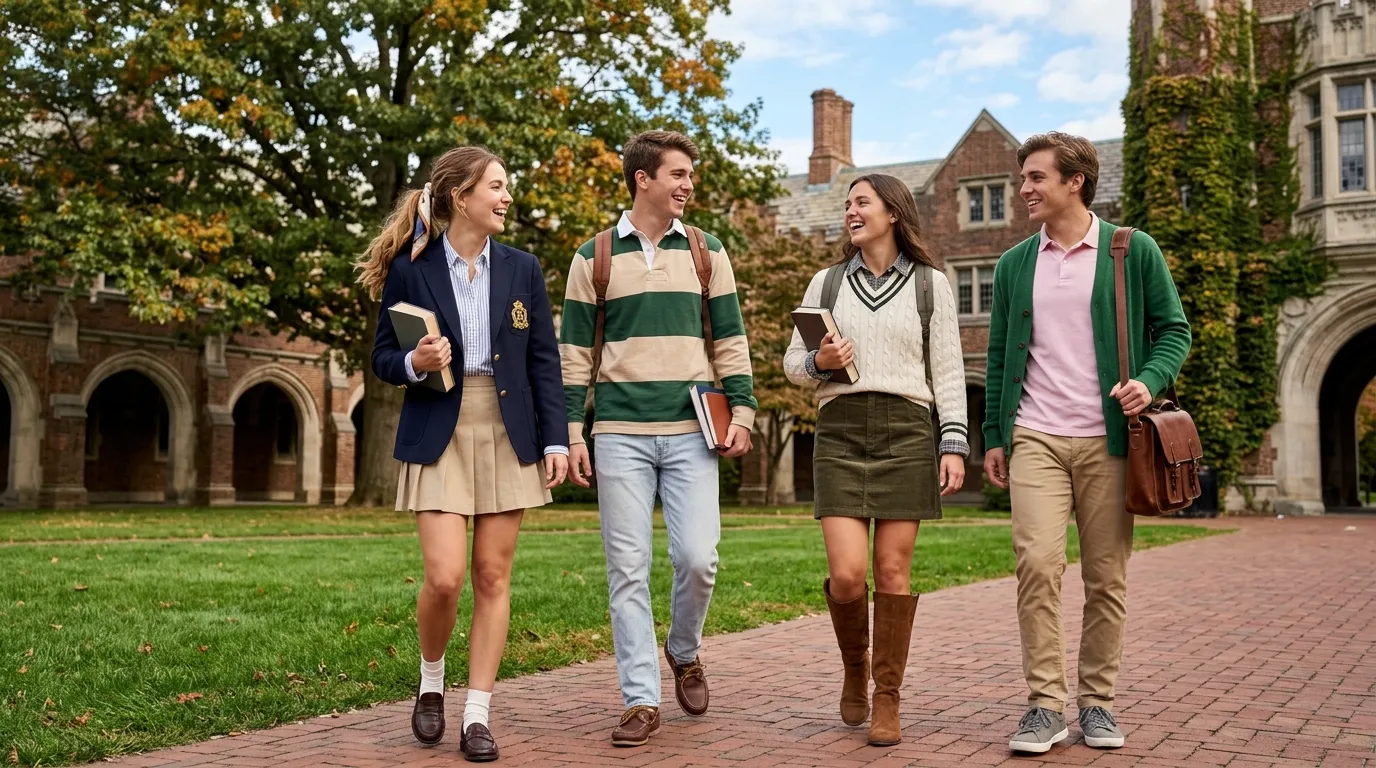
At its core, preppy fashion refers to a clothing aesthetic rooted in the dress codes of elite American preparatory schools and Ivy League universities. The word “preppy” is itself a derivative of “prep school” – those prestigious, often boarding institutions in the northeastern United States that historically educated the children of America’s upper classes.
But defining it only by its institutional origins undersells how far the style has traveled. Today, preppy clothing style blends classic American fashion sensibilities – structured, clean, and purposeful – with a kind of effortless polish that reads as both intelligent and approachable. It’s collegiate style with good posture.
What it is not: preppy is not the same as formal wear. It’s not a suit. It’s not black-tie. The genius of the aesthetic lies precisely in its comfortable middle ground – polished everyday style that communicates refinement without rigidity. A well-fitted cable-knit sweater over a button-down shirt, chinos with a neat break at the ankle, loafers worn without socks in summer – these are choices that say something without shouting it.
The Building Blocks of the Preppy Wardrobe
The individual pieces that define this aesthetic have remained surprisingly consistent over the decades:
- Polo shirts – the short-sleeved, collared knit shirt that became synonymous with leisure and sport, later elevated into everyday wear
- Blazers – typically in navy, camel, or houndstooth; worn with chinos rather than matching trousers
- Loafers – penny loafers especially, but also tassel and bit loafers; footwear that bridges casual and formal
- Cable-knit sweaters – chunky, textured, often in cream, navy, or forest green
- Button-down shirts – Oxford cloth, often with a button-down collar, worn tucked or half-tucked
- Chinos – cotton trousers in khaki, stone, or navy that replaced denim as the trouser of choice
- Pleated skirts – particularly in plaid or tartan, associated with the preppy schoolgirl aesthetic
- Varsity-style outerwear – letterman jackets, quilted vests, waxed cotton coats
None of these items are especially flashy in isolation. Together, they create a visual language of heritage fashion – clothing that signals history, taste, and a certain studied nonchalance.
The Origins of Preppy Style: Where It Actually Came From
How the Ivy League Shaped an Entire Aesthetic
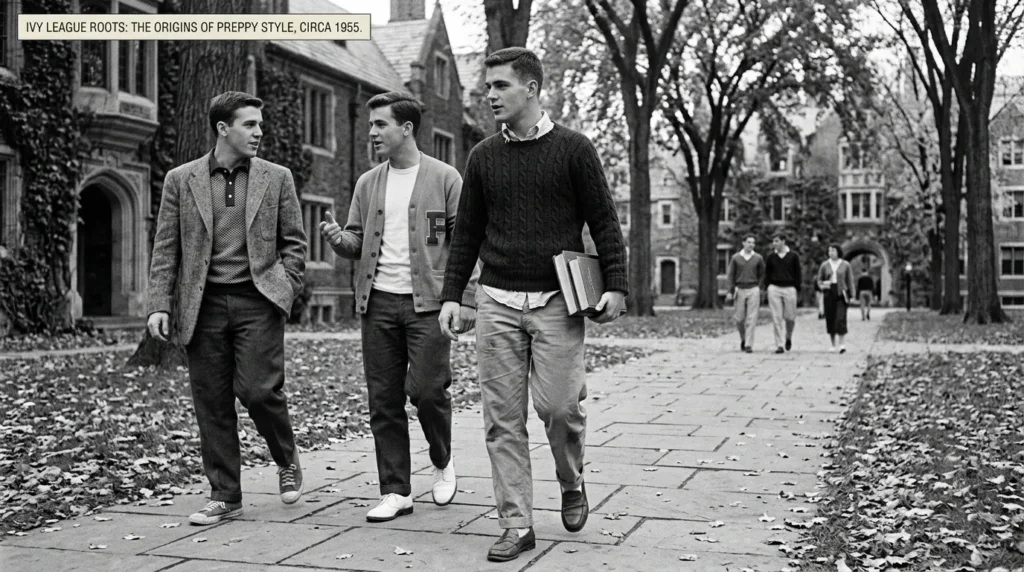
The story of preppy fashion begins, fittingly, in academia. In the early 20th century, students at Harvard, Yale, Princeton, and their peer institutions developed a distinctive mode of dress that reflected both their social position and their active lifestyles. Rowing, tennis, golf – the sports of the privileged classes – demanded clothing that was athletic but still respectable. The result was a practical elegance that has never really gone out of fashion.
Brooks Brothers, founded in 1818 in New York City, played a pivotal role in codifying this look. The brand introduced the button-down collar to American menswear after a company founder noticed British polo players fastening their collars to prevent them flapping during play. That single detail became one of the defining features of Ivy League fashion and, by extension, the entire preppy canon.
The influence wasn’t exclusively American. British roots run deep through this aesthetic – the tailored blazer originated in English universities and rowing clubs; the Shetland sweater came from Scottish fishing communities; the heritage of tweed, tartan, and structured outerwear is distinctly British in origin. East Coast fashion in the United States absorbed these influences naturally, given the cultural ties between New England’s elite institutions and their British counterparts.
Preppy Style in the Early 20th Century
Through the 1920s, ’30s, and ’40s, what we now call preppy was simply what well-educated Americans wore. It wasn’t a subculture or a trend – it was the default dress code for a specific social stratum. The clothing communicated membership in a world of country clubs, summer houses on Cape Cod or the Vineyard, and family names that preceded you into every room.
That exclusivity is important to understand. The old money aesthetic that underpins the preppy look is deliberate in its understatement. New money buys logos. Old money buys quality. The original preppy wardrobe contained nothing ostentatious – the signal was in the cut, the fabric, the quiet correctness of every detail.
How Preppy Fashion Evolved Across Decades
80s Preppy Fashion: When the Look Went Mainstream
The most significant turning point in preppy style evolution came in 1980, with the publication of The Official Preppy Handbook by Lisa Birnbach. Intended partly as satire, the book became a genuine style guide for millions of Americans who had no connection to prep schools or Ivy League campuses. Suddenly, the codes of elite fashion culture were publicly legible – and the aesthetic became democratized.
The ’80s preppy trend was colorful, confident, and unapologetically logo-heavy in ways the original aesthetic never was. Pastel polo shirts with popped collars, whale-embroidered belts, Sperry Top-Siders – the decade took the bones of the Ivy League look and amplified every detail to the point of caricature. It was both a celebration and a gentle mockery of the East Coast upper class.
This was also the decade that cemented Ralph Lauren as the defining designer of American preppy fashion. His Polo Ralph Lauren label had launched in the late ’60s with neckties and expanded into a full lifestyle vision – the country estate, the horses, the perfectly worn leather. Lauren, who grew up in the Bronx, understood the aspirational power of the aesthetic perhaps better than anyone born to it. His collections translated classic American fashion into a globally understood language of quality and tradition.
Tommy Hilfiger followed a similar trajectory, presenting bold, prep-inflected American sportswear that resonated with both traditional consumers and, unexpectedly, with hip-hop culture in the ’90s – one of fashion’s most fascinating crossover moments.
The Role of Designers and Brands in Shaping Preppy’s Modern Identity
J.Crew emerged in the 1980s as a catalog brand making Ivy League dressing accessible at mid-market prices. Where Ralph Lauren sold aspiration, J.Crew sold wearability. The brand’s editorial photography – sun-drenched, nautical, effortlessly stylish – defined the visual vocabulary of preppy for an entire generation of Americans.
Lacoste, the French brand founded by tennis champion René Lacoste, contributed the polo shirt’s sporting pedigree to the preppy canon. The crocodile logo became one of fashion’s earliest and most enduring status symbols – small enough to be discreet, recognizable enough to those who knew.
Preppy Fashion in Pop Culture: From Page to Screen
How Gossip Girl Reshaped the Preppy Aesthetic for a New Generation
If The Official Preppy Handbook defined preppy for the ’80s, then Gossip Girl did the same for the 2000s and early 2010s. The show, set among Manhattan’s fictional elite private school students, made Blair Waldorf one of the most influential style figures of her decade. Her headbands, plaid skirts, fitted blazers, and patent Mary Janes became a how-to guide for a generation of viewers.
What Gossip Girl did was update traditional preppy outfits with a sharper, more feminine edge – and embed them within a narrative of wealth, power, and ambition. It also made explicit what the aesthetic had always implied: that clothing is a performance of identity. Blair didn’t dress preppy because she went to Constance Billard. She dressed preppy because she understood, intuitively, that preppy style as a symbol of class and identity was a form of social armor.
Celebrity and Designer Influence on the Preppy Aesthetic
Beyond Gossip Girl, celebrity preppy style has been shaped by figures as varied as Princess Diana (whose collegiate knitwear and blazers became iconic), Olivia Palermo (whose East Coast sensibility translated to European fashion weeks), and more recently, a wave of TikTok creators exploring the old money aesthetic as both genuine fashion philosophy and social commentary.
On the runway, designers from Thom Browne to Miuccia Prada have revisited collegiate and varsity references repeatedly – deconstructing the blazer, reimagining the polo, playing with the tension between institutional tradition and individual subversion. Designer preppy collections have become a reliable fixture of the fashion calendar precisely because the aesthetic offers so much to work with.
Why Preppy Style Still Matters in 2026

The Shift from Elite to Mainstream – and Back Again
One of the more interesting dynamics in the history of preppy fashion is how it has oscillated between exclusivity and accessibility. The ’80s democratized it. The ’90s and early 2000s largely abandoned it in favor of minimalism and streetwear. Then social media, and particularly the viral spread of the old money aesthetic on platforms like Instagram and TikTok, brought it roaring back – but with a self-aware, sometimes ironic quality that the original never had.
The appeal of modern preppy outfits today is partly about what they signal in contrast to their surroundings. In a fashion landscape saturated with logomania, hypebeast sneaker culture, and disposable fast fashion, the quiet discipline of a well-cut blazer and a pair of loafers reads as a genuine alternative. It suggests permanence in a world of churn. For resources on building a cohesive wardrobe around these principles, Preppyglow is a useful starting point for understanding the aesthetic in its contemporary form.
Preppy Fashion as a Timeless Wardrobe Strategy
What makes the preppy fashion trends of 2026 and 2027 worth paying attention to is the growing recognition that preppy isn’t really a trend at all – it’s a wardrobe philosophy. Buy better, buy less, wear it longer. Choose classics over novelties. Invest in quality fabric and construction. These principles aren’t new; they’re the same ones that governed the classic wardrobe staples of the Ivy League in the 1950s. The fact that they feel radical today says more about the state of fashion than it does about preppy itself.
Preppy vs. Similar Aesthetics: Understanding the Differences
One reason preppy is sometimes misunderstood is how closely it resembles adjacent aesthetics. The table below clarifies the key distinctions:
| Aesthetic | Core Vibe | Key Pieces | Cultural Origin | Key Difference from Preppy |
|---|---|---|---|---|
| Preppy | Polished, collegiate, heritage | Blazer, polo, loafers, chinos | New England Ivy League | The original; institutional & structured |
| Old Money | Understated wealth, timeless | Linen, cashmere, quiet luxury | European & American elite | More European influence; less sporty |
| Coastal Grandmother | Relaxed, linen-heavy, seaside | Wide-leg trousers, woven bags | American East Coast | More relaxed; minimal structure |
| Smart Casual | Versatile, polished-relaxed | Chinos, loafers, knitwear | Office-adjacent | Less identity-driven; functional |
| Varsity / Collegiate | Sporty, youthful, team spirit | Letter jackets, hoodies, caps | American high school/college | More casual; logo and team-centric |
| British Heritage | Tailored, country, traditional | Tweed, brogues, wax jackets | English countryside | More formal; less sport-derived |
The distinctions matter because dressing “preppy” is about more than picking the right pieces – it’s about the particular combination of collegiate style, athletic heritage, and institutional polish that defines the aesthetic. A cashmere turtleneck alone doesn’t make an outfit preppy. Context and combination are everything.
Preppy Style Men and Women: How to Build a Modern Wardrobe
Building a genuine modern preppy wardrobe doesn’t require spending a fortune. It requires selectivity. Preppy style for men centers on a short list of well-chosen pieces that work together without much effort. Here’s what actually matters:
Invest first in:
- A well-fitted navy blazer (wool or wool-blend; single-breasted; two or three buttons)
- Two or three Oxford cloth button-down shirts in white, blue, and pink
- A pair of chinos in khaki and navy
- Classic penny loafers or tassel loafers in tan or burgundy
- A crew-neck cable-knit sweater in cream or navy
Add over time:
- A polo shirt in a solid, muted color (avoid loud graphics or oversized logos)
For a preppy guy, the outfit formula is simpler than it looks: start with the blazer-chinos-loafer combination, then build outward. Preppy guy fashion is less about following rules and more about understanding why those pieces work together – structure, proportion, and a restrained palette do most of the heavy lifting.
- Pleated or A-line skirts in plaid or solid muted tones
- A quilted vest or field jacket for layering
- Boat shoes for warmer months
The rules that matter:
- Fit above everything. The preppy aesthetic falls apart with poor fit.
- Restrained color palette – navy, white, khaki, forest green, burgundy, camel.
- Minimal visible branding. Preppy is about quality, not advertisement.
- Mix textures thoughtfully – a cable knit over a poplin shirt, a wool blazer over a cotton polo.
For anyone new to the aesthetic, exploring a dedicated preppy style guide can help translate these principles into actual outfit decisions – Preppyglow covers this in depth, with a practical focus on putting looks together for everyday wear.
Lesser-Known Insights About Preppy Fashion
Most coverage of preppy style focuses on its elite origins and its mainstream revival. What gets less attention:
Preppy has always been countercultural in context. In the 1980s, wearing a blazer and loafers was an act of defiance against disco excess. In the mid-2000s, preppy was a quiet rebellion against the dominance of streetwear. The aesthetic has a habit of becoming subversive precisely because it’s unfashionable – and then cycling back to cool.
The gender dynamics of preppy have always been fluid. The women who attended women’s colleges in the Ivy League orbit – Wellesley, Smith, Vassar – developed their own version of the aesthetic that borrowed heavily from menswear. Blazers, Oxford shirts, flat shoes – what we now think of as “tomboy preppy” was, in many ways, the original version.
Preppy fashion was genuinely multicultural before it was marketed that way. Hip-hop’s embrace of Ralph Lauren and Tommy Hilfiger in the ’90s wasn’t an external influence on the aesthetic – it was a reimagining from within, creating something entirely new that fed back into mainstream fashion.
Frequently Asked Questions About Preppy Fashion
What is preppy fashion, exactly?
Preppy fashion is a clothing style that originated in the dress codes of American preparatory schools and Ivy League universities. It centers on clean, structured, heritage-driven pieces – blazers, polo shirts, button-down shirts, chinos, loafers, and cable-knit sweaters – worn in a polished but relaxed way. The aesthetic values quality, fit, and restraint over novelty or visible branding.
What is the difference between preppy style and the old money aesthetic?
They share DNA but diverge in emphasis. Preppy style has a distinctly American, sport-inflected quality – it comes from campus life, sailing, and tennis. The old money aesthetic is broader and more European in influence, leaning toward quiet luxury in neutral tones with minimal athletic references. Preppy can be colorful; old money rarely is.
How do I dress preppy without looking costume-y or dated?
The key is proportion and restraint. Modern preppy outfits avoid the cartoonish ’80s excess – no popped collars, no whale emblems on everything. Focus on well-fitting basics, a muted color palette, and mixing casual and structured pieces. A navy blazer with jeans and loafers is undeniably preppy without reading as a costume.
Is preppy fashion still relevant in 2026?
Yes – arguably more so than it’s been in twenty years. The resurgence of the old money aesthetic, growing fatigue with fast fashion, and a broader cultural interest in quality and permanence have all contributed to a genuine preppy revival. Modern designers continue to draw on collegiate and Ivy League references in runway collections, and the core wardrobe pieces remain as wearable as ever.
What’s the easiest way to start dressing preppy?
Start with a navy blazer and a pair of well-fitting chinos. Add an Oxford shirt and a pair of loafers. From that foundation, almost any addition – a cable-knit sweater, a polo shirt, a plaid scarf – will feel coherent. Preppy is one of the easiest aesthetics to build incrementally because its components are versatile and work well with one another.
Is preppy fashion only for certain body types or demographics?
Not at all. The aesthetic’s emphasis on fit means it can be adapted to any body type – the principles of proportion and structure apply regardless. Demographically, preppy style has traveled far from its New England elite origins; it is now a genuinely global aesthetic with communities across Europe, Asia, and beyond. What matters is the sensibility, not the zip code.
