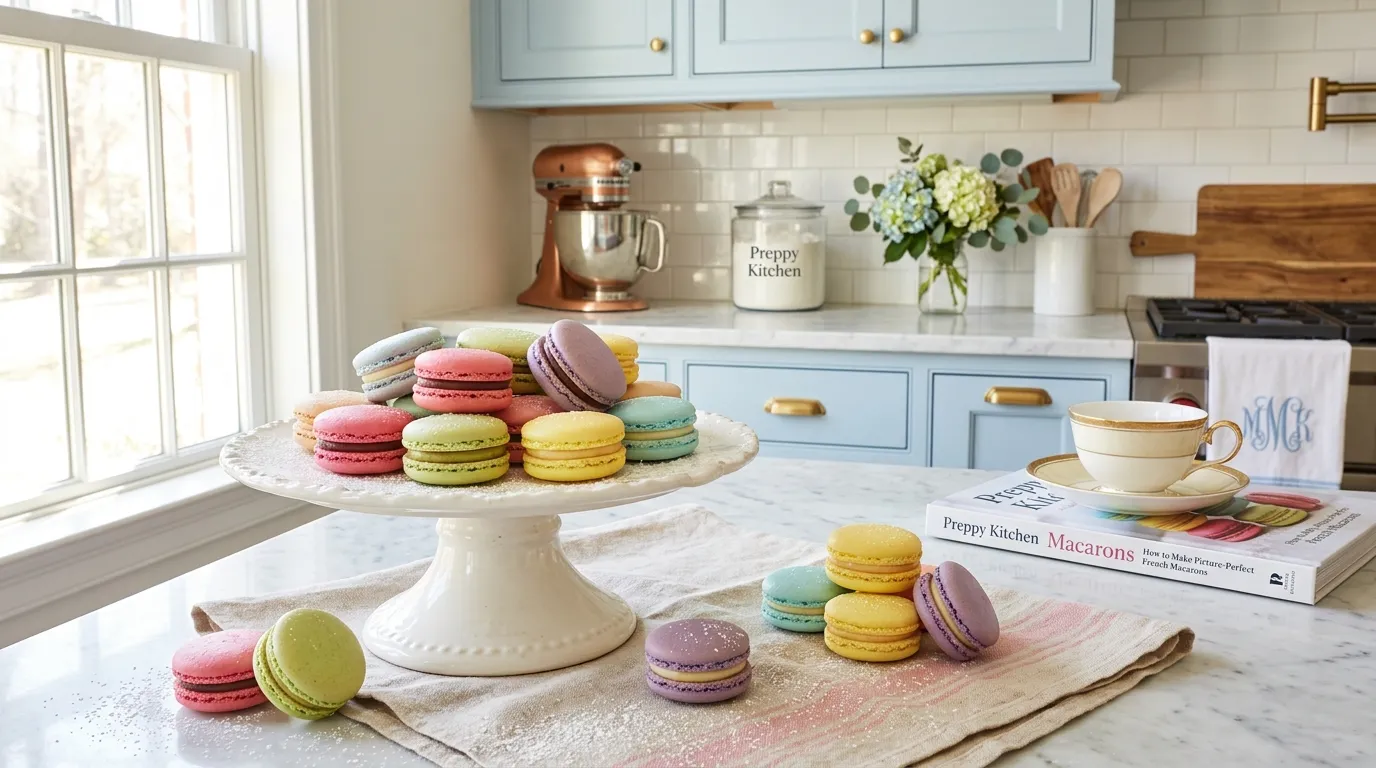
Preppy Macarons: How to Make Picture-Perfect French Macarons
There is something almost intimidating about a perfectly stacked box of French macarons. Those smooth, glossy shells with their delicate “feet,” sandwiched around a cloud of filling they look like they belong behind a glass case in a Parisian patisserie, not in your home kitchen. Yet that is exactly what the Preppy Kitchen approach to macarons challenges: the idea that these elegant desserts are beyond the reach of a determined home baker.
“Preppy macarons” refers to the style of classic French macarons popularized through approachable, detail-rich baking tutorials that break down an otherwise technical pastry into achievable steps. The aesthetic leans clean, colorful, and bakery-worthy pastel macarons lined up in careful rows, each one consistent in size, smooth on top, and ruffled at the base with that signature macaron foot. This guide is built around the same philosophy: thorough, honest, and practical, so you can actually produce perfect macarons at home.
What Actually Goes Into a French Macaron
Before touching a mixing bowl, it helps to understand exactly what a macaron is and why each component behaves the way it does. A French macaron is a sandwich cookie built from two meringue-based shells made primarily with almond flour and egg whites, filled with anything from French buttercream to chocolate ganache.
This is not to be confused with a macaroon the coconut-based American cookie that shares a similar name but almost nothing else. The French macaron traces its refined form to early 20th-century Paris, when the renowned Ladurée tearoom began selling the sandwich version that has since become a global icon of French pastry culture. Before that, macaron shells existed as individual almond meringue cookies without filling, dating back centuries in Italian and French culinary history.
What makes the macaron technically demanding is that its structure depends on a precise balance between almond flour, powdered sugar, egg whites, and granulated sugar and how those ingredients are treated at every stage of the process.
Essential Equipment Before You Start
Getting the right tools in place before you begin is not optional with macarons. This is one of those recipes where improvising your equipment often leads directly to cracked tops, lopsided shells, or hollow centers.
Here is what you genuinely need:
- Kitchen scale — Volume measurements are not reliable for macaron batter. Use grams.
- Stand mixer or hand mixer — You need to whip egg whites to stiff peaks, which takes sustained power.
- Sifter or fine mesh strainer — Almond flour must be sifted; any coarse lumps will show on the shell surface.
- Silicone baking mats or parchment paper — These provide the right amount of grip and heat distribution for the shells.
- Piping bags and a round tip (about 1/2 inch) — Consistent sizing is what separates rustic from bakery style macarons.
- Oven thermometer — Most ovens run hot or cold. Even a 10-degree variation can crack your shells or leave them underbaked.
- Rubber spatula — For the macaronage (folding) stage, which requires feel more than speed.
Many macaron troubleshooting problems trace back to skipping the oven thermometer. It is one of the most valuable purchases you can make for this recipe.
The Full Ingredient Breakdown
For the Macaron Shells
Getting the ratios right for almond flour macarons is non-negotiable. These amounts typically yield about 30 to 36 filled sandwich cookies.
| Ingredient | Amount | Purpose |
|---|---|---|
| Almond Flour (blanched, fine) | 200g | Structure and flavor base |
| Powdered Sugar | 200g | Sweetness and smooth shell texture |
| Egg Whites (aged, room temperature) | 150g | Meringue base |
| Granulated Sugar | 150g | Stabilizes the meringue |
| Vanilla Extract | 1 tsp | Flavor depth |
| Food Coloring (gel preferred) | As needed | Color without adding liquid |
A note on egg whites: Many experienced bakers age their egg whites by separating them 24 to 48 hours ahead and leaving them uncovered in the refrigerator. This evaporates some moisture and produces a stiffer, more stable meringue. It is not mandatory, but it does make a real difference, particularly in humid environments.
On food coloring: Always use gel or powder-based food coloring. Liquid food coloring adds water to the batter, which throws off the consistency and can prevent the shells from forming properly.
For the French Buttercream Filling
French buttercream differs from its American counterpart in one significant way: it uses a cooked sugar syrup poured into egg yolks to build a custard base, then butter is whipped in. The result is richer, silkier, and less sweet than standard buttercream frosting, which makes it an ideal companion to the slightly sweet, chewy macaron shells.
| Ingredient | Amount |
|---|---|
| Egg Yolks | 4 large |
| Granulated Sugar | 120g |
| Water | 40ml |
| Unsalted Butter (softened) | 250g |
| Vanilla Extract | 1 tsp |
For chocolate macarons, add 2 to 3 tablespoons of high-quality cocoa powder to the buttercream, or swap the vanilla filling entirely for a dark chocolate ganache which is simply melted chocolate combined with warm heavy cream and chilled to a pipeable consistency.
For raspberry macarons, fold fresh raspberry puree (strained of seeds) into the finished buttercream, or use a raspberry jam layer between two buttercream borders to prevent the filling from making the shells soggy.
How to Make French Macarons: Step by Step

Making a perfect French macaron recipe requires attention at each stage. None of the individual steps are especially complicated, but the order and technique matter considerably.
Step 1: Prepare Your Almond and Sugar Mixture
Combine the almond flour and powdered sugar in a bowl and sift them together through a fine mesh strainer. Discard any coarse pieces that remain in the strainer. This is called the “tant pour tant” in French baking, meaning equal parts almond and sugar. Sifting is not decorative it directly determines how smooth your macaron shells will be.
Step 2: Build a Stable Meringue
In a completely clean, grease-free bowl, begin whipping your room-temperature egg whites at medium speed. As they become foamy, gradually add the granulated sugar in a thin, steady stream. Increase speed to medium-high and continue until the meringue holds stiff, glossy peaks. At this point, add your vanilla extract and gel food coloring, and whip just until combined.
The meringue stage is where many batches go wrong. Under-whipped whites produce flat shells. Over-whipped whites become dry and cause cracking. The sweet spot is a meringue that forms a firm peak but still has a slight gloss.
Step 3: Macaronage The Fold That Makes or Breaks Everything
Add all of the sifted almond-sugar mixture to the meringue at once. Using a wide rubber spatula, fold and press the batter against the side of the bowl in a deliberate motion. You are intentionally deflating some of the air this is correct.
The batter is ready when it flows off the spatula in a thick, continuous ribbon and the ribbon disappears back into the bowl within about 10 seconds. If it falls in chunks, keep folding. If it flows like water, you have gone too far and the batter cannot be recovered. This stage is called macaronage, and it is genuinely something you develop a feel for over a few batches. The smooth macaron batter at this stage should look like slowly flowing lava thick but fluid.
Step 4: Pipe and Rest
Transfer the batter to a piping bag fitted with a round tip. Pipe uniform circles onto your prepared baking sheets, holding the bag straight up and down, directly above the sheet. Aim for circles about 1.5 inches in diameter.
Once piped, firmly tap the baking sheet against the counter three to four times to release any air bubbles. Pop any visible bubbles with a toothpick. Then let the shells rest at room temperature until they form a dry skin you should be able to lightly touch one without any batter sticking to your finger. This typically takes 30 to 60 minutes depending on humidity.
This resting step is what creates the signature macaron foot. As the shell bakes, steam needs somewhere to escape, and if the top is sealed by a dry skin, the steam pushes outward and upward from the base forming that ruffled edge.
Step 5: Bake Low and Steady
Preheat your oven to 150°C (300°F) and verify this with an oven thermometer. Bake the shells for 14 to 16 minutes on the center rack. They should not brown. When done, the shells will release cleanly from the parchment or silicone mat once cooled. If they stick, they need another minute or two.
Let the shells cool completely on the baking sheet before attempting to remove or fill them.
Step 6: Make the French Buttercream and Fill
For the French buttercream, heat the granulated sugar and water in a small saucepan until it reaches 118°C (244°F). Meanwhile, whip the egg yolks in a mixer until pale and thick. With the mixer running, pour the hot syrup down the side of the bowl in a slow, thin stream. Continue whipping until the bowl feels cool to the touch, then add the softened butter piece by piece. Whip until smooth, light, and creamy. Add vanilla extract and adjust flavor as desired.
Match your shells by size and pipe a generous mound of filling onto the flat side of one shell. Press its partner gently on top to sandwich them together. The filling should reach just to the edge.
Pro Tips for Consistently Better Results
These are the kinds of observations that rarely make it into a basic easy macaron recipe but matter enormously once you start troubleshooting.
- Humidity is your enemy. On rainy or particularly muggy days, macarons absorb moisture from the air and struggle to form a proper skin. If you live somewhere humid, keep the air conditioning running while you bake.
- Age your egg whites whenever possible. The chemistry behind this is simple: older egg whites have less moisture and create a more stable meringue, which translates to better structure in the shell.
- Weigh everything. This cannot be overstated. A tablespoon of almond flour varies wildly depending on how it is scooped. A scale is the only reliable tool.
- Rotate your baking sheets. Ovens have hot spots. Rotating halfway through baking helps all the shells bake evenly.
- Let filled macarons mature. This is a lesser-known fact about parisian macarons: they actually taste better after 24 hours in the refrigerator. The filling softens the shell slightly, producing that characteristic chewy, slightly crispy texture that makes a properly made macaron so distinctive. Freshly filled macarons can taste dry by comparison.
The same kind of careful, methodical preparation that goes into classic baked goods like preppy kitchen sugar cookies or preppy kitchen carrot cake applies here, but with even less margin for error. Macarons reward patience.
French Macarons vs. Similar Confections
It is worth clarifying where macarons sit among other related baked goods, since the terminology frequently causes confusion.
| Item | Base | Texture | Filling |
|---|---|---|---|
| French Macaron | Almond flour + meringue | Crispy outside, chewy inside | Buttercream, ganache, jam |
| American Macaroon | Shredded coconut | Dense, moist | None (sometimes chocolate-dipped) |
| Meringue Cookie | Egg whites + sugar | Crisp and airy | None |
| Amaretti | Almond paste | Firm and slightly chewy | None |
| Dacquoise | Almond or hazelnut meringue | Crisp outer layer | Typically buttercream |
The macaron is uniquely defined by its gluten-free dessert status, the sandwich construction, and that foot along the shell base. It is the only item in this group where the filling is as important to the identity of the cookie as the shell itself.
Macaron Flavors Worth Exploring

Once you have mastered the base technique, the variety of macaron filling ideas available to you is genuinely exciting. The shells themselves can carry virtually any flavor through the addition of extracts, freeze-dried fruit powders, or cocoa.
Beyond classic vanilla macarons, consider:
- Chocolate macarons with dark chocolate ganache filling intense, rich, and deeply satisfying.
- Raspberry macarons with raspberry buttercream or jam the tartness balances the sweetness of the shells beautifully.
- Lemon macarons with lemon curd filling bright and refreshing, particularly popular in spring.
- Pistachio macarons with pistachio paste buttercream a flavor rooted in French pastry tradition.
- Coffee macarons with espresso buttercream a crowd-pleasing combination with real depth.
For anyone exploring the broader world of French-inspired baking and the kind of refined, polished aesthetic that defines these colorful macarons, the Preppyglow style guide is worth a look it captures a similar sensibility around presentation, color, and attention to detail that translates beautifully from wardrobe to kitchen.
The same care that goes into assembling a perfectly frosted preppy kitchen cheesecake those neat layers, the clean garnish, the deliberate presentation applies directly to how you approach plating and presenting macarons.
Storing Macarons the Right Way
How to Keep Macarons Fresh
Filled macarons should be stored in an airtight container in the refrigerator. They keep well for up to five days. Because the shells are hygroscopic (they absorb moisture from the environment), leaving them uncovered at room temperature will cause them to become sticky and lose their texture.
Before serving refrigerated macarons, let them sit at room temperature for 15 to 20 minutes. The shells firm back up as they cool after filling, and a brief rest at room temp brings the texture back to its best.
Unfilled shells can be stored at room temperature in an airtight container for two to three days, or frozen (see below).
Can You Freeze Macarons?
Yes, and this is one of the most practical things about this sweet French dessert both filled and unfilled macarons freeze well. Unfilled shells freeze for up to three months in a single layer, then stacked once frozen solid. Filled macarons freeze for up to two months.
To thaw, transfer to the refrigerator overnight and bring to room temperature before serving. Avoid thawing at room temperature directly from frozen, as the condensation can damage the shells.
Macaron Troubleshooting: What Went Wrong
Why Did My Macaron Shells Crack?
Cracked shells are almost always caused by one of three things: oven temperature too high, shells that were not given enough time to form a skin before baking, or batter that was under-mixed during macaronage. Check your oven temperature with a thermometer, extend the resting time (especially in humid weather), and make sure your batter passes the ribbon test before piping.
Why Are My Macarons Hollow Inside?
Hollow macarons where there is a gap between the shell top and the interior usually indicate that the meringue was over-whipped or that the batter was under-mixed. Hollow shells look intact from the outside but feel light when pressed. The fix is to whip the meringue to stiff (not dry) peaks and ensure the macaronage stage reaches the right ribbon consistency. Some hollow-ness can also result from oven temperature being too high, causing the outside to set before the inside has fully baked through.
Why Do My Macarons Have No Feet?
Missing feet almost always mean the shells did not develop a proper skin during resting, or the oven temperature is too low. Feet form because steam escapes from the base rather than the top, which only happens when the surface of the shell is sealed and the heat is sufficient to generate that upward push.
Frequently Asked Questions
What is the difference between French, Italian, and Swiss meringue methods for macarons?
The French method uses uncooked egg whites whipped with granulated sugar the simplest approach and the one outlined in this guide. The Italian method cooks the sugar into a syrup before adding it to the whites, producing a more stable meringue that is slightly more forgiving in humid conditions. The Swiss method heats the whites and sugar together over a double boiler before whipping. All three can produce excellent shells, but the French method is the best starting point for home bakers learning the process.
Can I make macarons without a stand mixer?
Yes, a hand mixer works fine. The key requirement is that you can sustain medium to high speed for several minutes while whipping the egg whites. Stand mixers are more consistent, but they are not a requirement.
Why does almond flour matter so much in this recipe?
Almond flour is what makes this a gluten-free dessert there is no wheat flour in the shells whatsoever. Beyond dietary considerations, almond flour provides the fat and protein structure that gives macaron shells their characteristic texture: crisp on the outside, chewy within. Using anything other than finely ground blanched almond flour (not almond meal, which includes the skin) will affect the texture and appearance of the shells.
Why do macarons need to rest before baking?
The resting period allows the surface of the piped batter to dry and form a thin skin. This is what directs steam toward the base of the shell during baking, creating the foot. Without it, the steam escapes through the top, cracking the shell and preventing foot formation.
How do I get evenly sized macaron shells?
The most reliable method is to print or draw a template of uniform circles (about 1.5 inches in diameter) and place it under your parchment paper as a guide. Remove it before baking. Alternatively, silicone macaron mats with pre-formed guides are widely available and take the guesswork out of sizing entirely. Consistent piping pressure and technique held vertically, released cleanly also makes a significant difference.
Can I use liquid food coloring in macarons?
It is strongly advised against. Liquid food coloring introduces extra moisture into the batter, which can destabilize the meringue and affect the shell texture. Gel food coloring achieves vibrant, saturated color with a minimal amount of product and no additional liquid. Powder-based coloring is also a reliable option.
How long do I need to mature macarons before serving?
The standard recommendation is 24 hours in the refrigerator after filling. During this time, the filling softens the inner surface of the shell, melding the two elements together and producing the slightly chewy interior that defines a well-made macaron. Eating them immediately after assembly is not wrong, but the texture and flavor integration are noticeably better after resting.
