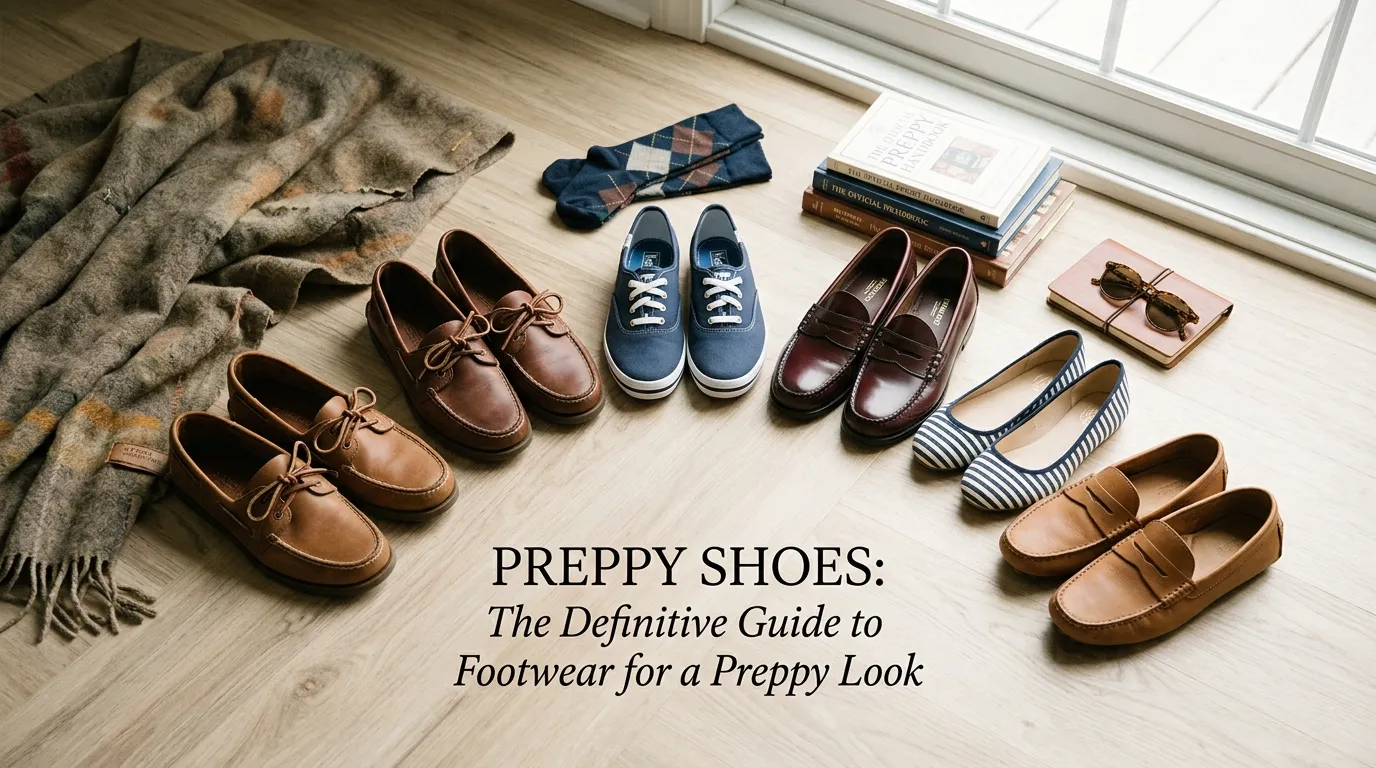
Preppy Shoes: The Definitive Guide to Footwear for a Preppy Look
There’s a quiet confidence that comes with pulling on the right pair of shoes. You don’t have to announce your style to the room when your footwear does it for you cleanly, deliberately, and without a single extra word. In the world of preppy fashion, that’s exactly the role shoes play. They aren’t accessories. They’re the foundation.
If you’ve ever wondered why certain shoes feel perpetually relevant while trends around them rise and collapse, the answer lies in the preppy philosophy itself. Preppy shoes were never designed for fashion weeks, editorial spreads, or viral moments. They were designed for boats, campus quads, cobblestone streets, and summer afternoons on the water. That utilitarian origin is precisely what gives them staying power.
This is the guide that connects all the dots the history, the shoe types, the brands, the styling logic, the seasonal breakdowns, and the real-world answers to the questions people actually ask. Whether you’re building your first preppy wardrobe or refining one you’ve maintained for years, by the end of this guide, you’ll understand not just what preppy shoes are, but why they matter and how to wear them in a way that feels genuinely effortless.
What Are Preppy Shoes, Really?
Quick Summary: Preppy shoes are rooted in classic American Ivy League and East Coast heritage culture. They prioritize clean silhouettes, quality materials, and real-world versatility over trend-driven design. Think boat shoes, loafers, espadrilles, ballet flats, and Jack Rogers sandals all built for genuine life, not the runway.
At their core, preppy shoes are footwear styles born from the classic American preppy aesthetic a fashion sensibility that took root on the campuses of Ivy League universities, boarding schools along the Eastern Seaboard, and summer resorts across New England in the early-to-mid twentieth century. The word “preppy” comes from “preparatory school,” and the aesthetic it describes has always been one of understated refinement, functional elegance, and an almost stubborn resistance to fleeting trends.
In footwear terms, that translates to a fairly well-defined set of silhouettes: boat shoes, loafers, espadrilles, ballet flats, wedges, and flat sandals. The materials lean toward leather, suede, canvas, and jute natural, breathable, and durable. The color palette runs heavily on navy and white combinations, pastel hues, and crisp neutrals with strategic pops of color.
What separates preppy footwear from aesthetics that might look superficially similar is its dual commitment to function and form. These shoes aren’t bought to be displayed. They’re worn in the real world on docks, walking along the waterfront, strolling across campus, or navigating the cobblestones of a coastal town. They’re supposed to move through life gracefully, not sit behind glass being admired.
Much like the preppy shirts and preppy clothes they pair with, preppy shoes derive their authority not from exclusivity or conspicuous expense, but from quality, simplicity, and the kind of design intelligence that doesn’t announce itself. That quiet authority is the entire point.
The Origins of Preppy Style Shoes: A Brief History

Quick Summary: Preppy footwear didn’t come from fashion houses it grew organically from the lifestyle of East Coast American culture. Boat shoes, penny loafers, and Jack Rogers sandals all have specific, rooted histories that explain why they’ve endured for decades as timeless style staples.
The preppy aesthetic wasn’t engineered in a design studio. It evolved organically from the habits, hobbies, and social customs of a specific corner of American life one that spent summers in Maine or Cape Cod, sailed on weekends, attended garden parties in Connecticut, and sent its children to boarding schools where the dress code carried serious weight.
The boat shoe sits at the absolute center of this history. In 1935, a Connecticut sailor named Paul Sperry was struggling with how to stay on his feet on wet boat decks. Watching his cocker spaniel navigate an icy surface with ease, he studied the natural siping pattern on the dog’s paws and used it to design a non-slip rubber sole. The resulting shoe the Sperry Top-Sider became the defining footwear of nautical-inspired style and was quickly absorbed into the Ivy League fashion ecosystem, where it has remained ever since.
By the 1950s and early 1960s, the penny loafer had cemented its place in the classic American style canon. Derived from Norwegian farmers’ moccasins and adapted for American collegiate culture, the loafer communicated a particular kind of polish that felt accessible rather than stuffy. It said, essentially: I care about how I look, but not in a way that requires your notice.
Jack Rogers sandals arrived in the early 1960s and transformed women’s preppy footwear. The Navajo sandal, in particular, became synonymous with East Coast summer culture partly because of its extraordinary craftsmanship and partly because Jackie Kennedy was frequently photographed wearing them. When a sitting First Lady endorses a shoe style, it tends to stick around.
The 1980s codified everything. Ralph Lauren’s brand expanded the reach of the preppy aesthetic from regional subculture to global aspiration. Heritage brands leaned into the New England narrative. The preppy handbook both the literal bestselling book and the cultural blueprint it represented made the aesthetic legible and desirable to audiences far beyond the original in-group.
Understanding this history is critical to understanding preppy footwear today: these shoes have never been trend-driven. They are utility-driven. And utility, unlike trend, doesn’t expire.
The Essential Preppy Shoe Styles: A Complete Breakdown

Quick Summary: The preppy shoe wardrobe is built on a small number of highly versatile silhouettes boat shoes, loafers, espadrilles, ballet flats, wedges, sandals, and flip flops. Each occupies a distinct role in the wardrobe and pairs naturally with the broader preppy aesthetic. Knowing which shoe fits which occasion is the real skill.
Boat Shoes: The Definitive Nautical Footwear
No conversation about preppy shoes can begin anywhere other than the boat shoe. Born from function specifically, the need for sailors to stay upright on wet, slippery decks the boat shoe’s leather upper, siped rubber sole, and moccasin-style construction made it both practical and unexpectedly elegant.
Sperry Top-Sider remains the benchmark brand. Their name has become so synonymous with the style that “Sperrys” functions as a generic descriptor the way “Kleenex” does for tissue. But the broader category includes options from Sebago, L.L. Bean, and dozens of brands in every price range.
Boat shoes work equally well with chinos, shorts, or sundresses. They occupy the sweet spot between casual and smart-casual without requiring any deliberate effort. The key styling rule: wear them without socks, or with ultra-low no-show socks. Heavy athletic socks completely undermine the aesthetic this is one of the most common mistakes made by people new to preppy footwear, and it’s entirely avoidable.
One thing worth noting from real-world experience: a pair of well-worn boat shoes is worth more than a pair of brand-new ones in the preppy universe. The patina that builds on leather over time the subtle creasing, the slight scuff on the toe signals authenticity. These are shoes meant to be lived in.
Loafers: The Quiet Authority of Preppy Footwear
Loafers occupy a slightly more elevated position in the preppy hierarchy than boat shoes not dramatically dressier, but possessing a different kind of authority. Suede loafers and leather penny loafers move seamlessly from classroom to dinner table to weekend gathering without needing any adjustment.
The penny loafer, specifically, carries genuine historical weight. The small slot across the leather band designed originally to hold a coin for emergency phone calls became a cultural signifier of New England collegiate culture. Today it’s simply a design detail, but one with clear aesthetic meaning.
The driving loafer, with its distinctive rubber pebble sole, reads more casual. The bit loafer, decorated with metal horsebit hardware, edges toward dressed up. Both belong firmly in the preppy footwear canon. The choice between them depends less on occasion and more on personal preference within the spectrum of classic American style.
Loafers work under tailored trousers, slim-fit jeans, midi skirts, and structured shorts. They don’t work especially well at the beach or on the water that territory belongs to boat shoes and sandals. Knowing when to deploy each style is part of the preppy approach to dressing.
Espadrilles: The Effortlessly Seasonal Pick
Espadrilles are one of those rare shoe styles that communicate an entire season in a single silhouette. The jute rope sole, the canvas or leather upper, the ease with which they slip on everything about the espadrille says warm weather, outdoor settings, and relaxed social occasions.
Kate Spade espadrilles have brought particular playfulness to the style printed uppers, bow details, graphic patterns that fit naturally within the summer preppy outfits palette. Other brands offer more understated takes: solid navy or white canvas with a clean jute sole, the kind of shoe that disappears into an outfit in the best possible way.
Espadrilles are genuinely comfortable preppy shoes, which is part of their appeal. They pair beautifully with linen trousers, midi skirts, wide-leg shorts, and any number of preppy dresses. They’re also available in wedge versions which brings us neatly to the next essential style.
Wedges: Elevated Without Being Overdressed
In the preppy wardrobe, the wedge occupies a specific and useful niche: it adds height and a degree of formality without crossing into the territory of stilettos or overtly dressy heels. For a fashion sensibility that prizes appropriateness above almost everything else, the wedge’s ability to feel put-together without feeling overdressed is genuinely valuable.
Lilly Pulitzer wedges represent this category at its most expressive bold prints, vibrant colors, that signature “more is more if more is done right” philosophy. But more understated wedge options from Lacoste, Cole Haan, and various heritage brands offer the same silhouette in a quieter register.
Espadrille-style wedges, which combine the jute sole of an espadrille with the elevated platform of a wedge, are particularly well-suited to the preppy summer wardrobe. They’re comfortable enough for a full afternoon, polished enough for a summer dinner, and casual enough to pair with a sundress without looking like you’re trying too hard.
Ballet Flats: The Everyday Workhorse
Ballet flats are the unsung heroes of the preppy shoe wardrobe the pieces that get worn the most and photographed the least. Clean, low-profile, and compatible with virtually everything, a quality pair of leather ballet flats in a neutral color is one of the most genuinely useful things a person can own.
Lacoste flats bring the brand’s signature sporty refinement to the silhouette. Sam Edelman offers accessible options at reasonable price points. Repetto provides a more European take on the same concept. Whatever the source, the key qualities are consistent: quality leather construction, a clean toe, and a sole with enough substance to last.
Patterned or pastel ballet flats particularly in floral, stripe, or gingham prints are very much at home within the preppy aesthetic and work especially well with solid-colored clothing. One of the classic preppy styling principles applies here directly: let either the shoe or the outfit carry the pattern, but not both simultaneously.
Flip Flops: The Relaxed End of the Spectrum
Vineyard Vines flip flops represent the most casual tier of preppy footwear but casual, within this aesthetic, doesn’t mean careless or cheap. Preppy flip flops are better constructed, better padded, and more deliberately designed than generic beach footwear. They’re also more contextually specific: they belong at the beach, on the boat, by the pool, and at resort settings. They do not function as everyday street shoes within the preppy framework.
This is an important distinction that many people miss when approaching the preppy aesthetic from the outside. Every shoe in this wardrobe has a context, and part of what makes the overall look work is the accuracy of those contextual choices. Flip flops at the marina? Perfect. Flip flops at a garden party? A different conversation entirely.
Jack Rogers Navajo Sandals: A Perennial Classic
Jack Rogers sandals deserve their own paragraph in any discussion of women’s preppy footwear because their cultural status is simply in a different category than most other shoes. The Navajo sandal with its handcrafted leather construction, woven multi-strap design, and metallic hardware has been part of the preppy wardrobe since Jackie Kennedy made it famous in the early 1960s, and it hasn’t changed appreciably since.
That continuity of design is its own form of credibility. A shoe that doesn’t need to evolve because its original form was essentially correct is a different kind of shoe than one that reinvents itself every season to stay relevant. Jack Rogers belongs firmly in the category of timeless fashion staples, and its place in the preppy canon is secure.
Best Preppy Shoes for Summer: Seasonal Styling That Works

Quick Summary: Summer is preppy footwear’s strongest season. Build your warm-weather shoe wardrobe around a core of boat shoes, Jack Rogers sandals, espadrilles, and quality flip flops, matched carefully to the time of day and occasion type.
Summer is when the preppy aesthetic fully exhales. The combination of warm weather, outdoor settings, and relaxed social occasions creates the perfect conditions for nautical-inspired footwear, canvas summer shoes, and the entire range of sandal styles to come into their own.
Here’s a practical framework for building a functional summer preppy shoe wardrobe:
Morning and casual daytime: Boat shoes or leather ballet flats handle most everyday situations running errands, casual lunches, morning walks along the waterfront. These are the shoes you can put on without thinking and know they’ll be right.
Beach and waterfront settings: Vineyard Vines flip flops or Jack Rogers sandals are the natural choices. Both are appropriate, comfortable, and visually at home in nautical and coastal settings. The key is choosing based on what the day involves: if you’re staying relatively clean and dressed, sandals; if you’re in and out of water, flip flops.
Late afternoon and outdoor social occasions: Espadrilles and wedges occupy this territory perfectly. They’re comfortable enough to handle a full afternoon but polished enough for an outdoor dinner or garden party. Kate Spade espadrilles in a print or solid work particularly well here.
All-day versatility: When you genuinely don’t know what the day will bring, leather ballet flats are your best friend. They’re appropriate in more settings than any other single shoe in the preppy wardrobe.
The broader principle: read the setting, then choose the shoe. Preppy style has always been as much about appropriateness as aesthetics probably more.
How Preppy Shoes Pair with Preppy Shirts and Preppy Dresses
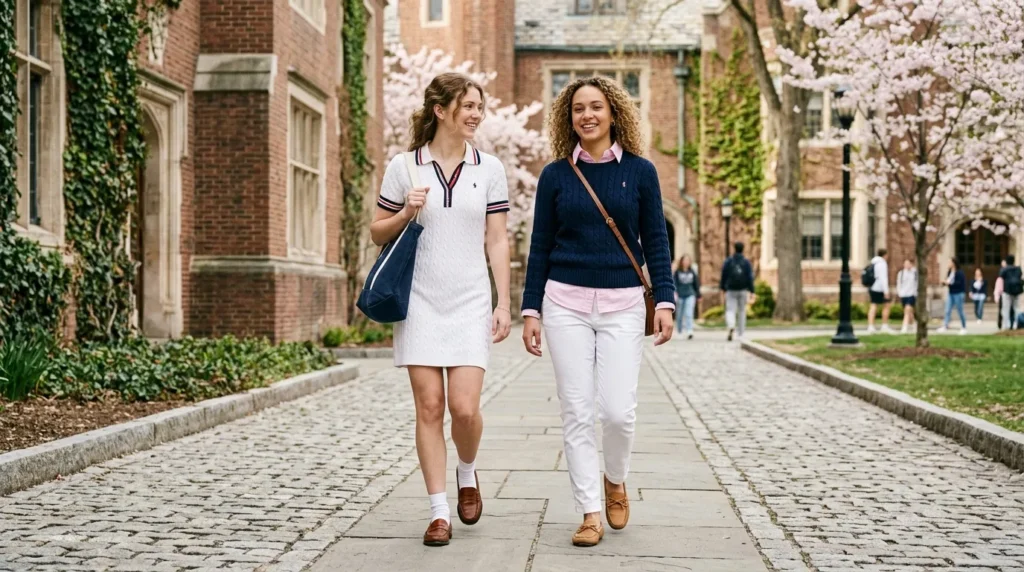
Quick Summary: Preppy shoes are designed to complement, not compete. Pair boat shoes and loafers with preppy shirts for smart-casual looks; choose sandals, flats, or wedges under preppy dresses based on the occasion’s formality level. Keep colors and formality registers in sync throughout the outfit.
Shoes don’t exist in isolation they complete an outfit, and understanding how preppy footwear interacts with the rest of the classic American wardrobe is where this aesthetic really comes to life.
Pairing with preppy shirts: Oxford cloth button-downs, polo shirts, linen tops, and striped jerseys all pair naturally with the boat shoe. There’s a reason this combination has existed for decades: the clean lines of a quality Oxford shirt and the simple construction of a Sperry Top-Sider belong to the same design logic. Loafers push the formality level slightly higher — pair them under a polo tucked into tailored chinos and the result is the classic preppy smart-casual look executed perfectly.
Pairing with preppy dresses: The key variable here is occasion formality. A casual sundress in a floral or stripe print calls for Jack Rogers sandals, flat espadrilles, or a quality flip flop in a beach setting. A more structured shift dress benefits from a low wedge or leather ballet flat. A flowing midi dress at a resort setting pairs beautifully with either a strappy flat sandal or an espadrille wedge.
The underlying rule across all combinations: match formality levels, and let either the dress/shirt or the shoe carry the visual interest not both simultaneously. When both elements are in the same color family and at the same formality register, the outfit achieves that effortless coherence that is the hallmark of genuinely good preppy dressing.
Popular Preppy Shoe Brands: Who Defines the Category
Quick Summary: The preppy shoe landscape is defined by a core group of heritage and lifestyle brands Sperry Top-Sider, Jack Rogers, Lilly Pulitzer, Lacoste, Kate Spade, and Vineyard Vines each with a distinct identity and signature style. Understanding what each brand represents helps you build a more intentional wardrobe.
| Brand | Signature Style | Key Material | Best For |
|---|---|---|---|
| Sperry Top-Sider | Boat shoes | Leather, canvas | Nautical casual, everyday wear |
| Jack Rogers | Navajo sandals | Handcrafted leather | Summer, resort, casual dress |
| Lilly Pulitzer | Wedges, sandals | Canvas, leather | Bold prints, warm-weather events |
| Lacoste | Flats, sneakers | Leather, canvas | Daily wear, smart casual |
| Kate Spade | Espadrilles, flats | Canvas, leather | Playful polish, seasonal styling |
| Vineyard Vines | Flip flops, boat shoes | Rubber, leather | Beach, resort, weekend casual |
Each of these popular preppy brands carries a distinct identity within the broader ecosystem of Ivy League fashion and classic American style. Sperry Top-Sider is the foundation no brand is more central to what preppy footwear means. Jack Rogers occupies a uniquely feminine and artisanal space within that tradition. Lilly Pulitzer represents preppy at its most joyfully colorful. Lacoste brings a more understated, European-inflected version of the same sensibility. Kate Spade adds playfulness and graphic wit. Vineyard Vines anchors the most casual tier with an unmistakably New England spirit.
For a deeper understanding of how these brands fit into the full scope of preppy fashion, Preppy Glow offers comprehensive style guides that place footwear in the context of complete preppy outfit building a useful reference for anyone building or refining their wardrobe.
Preppy Shoes vs. Similar Footwear Aesthetics: What Sets Them Apart
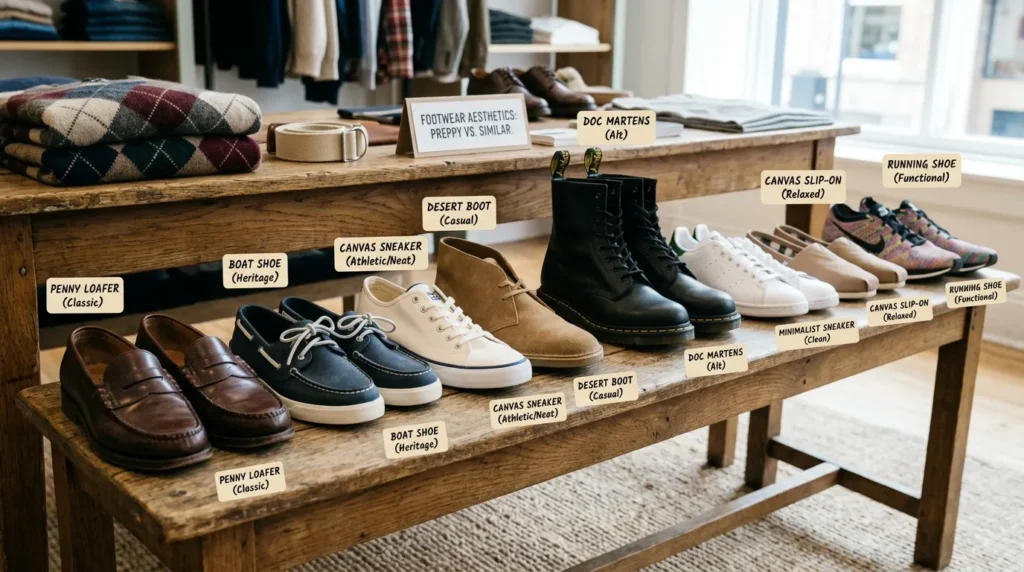
Quick Summary: Preppy shoes share surface-level similarities with old money, coastal grandmother, classic Americana, and athleisure aesthetics but each differs meaningfully in color palette, formality level, and cultural origin. Understanding these distinctions sharpens your ability to dress with genuine intentionality.
The preppy aesthetic doesn’t exist in a vacuum. It sits alongside and overlaps with several related footwear sensibilities, and drawing clear lines between them is genuinely useful for anyone trying to dress with intention rather than approximation.
Preppy vs. Old Money: This is the most commonly confused comparison. Both aesthetics prize quality, understatement, and classic silhouettes. The difference lies in color and silhouette range. Old money footwear favors quiet, traditional colors dark brown, black, burgundy and skews toward more formal silhouettes like oxfords and monk straps. Preppy embraces a much wider color range, including pastels and bold accents, and assigns much greater importance to casual styles like boat shoes and flat sandals. Old money is also typically brand-neutral to the point of austerity; preppy is more comfortable with visible branding.
Preppy vs. Coastal Grandmother: These two aesthetics share meaningful overlap both favor linen, comfortable silhouettes, and a palette rooted in coastal settings. The key difference is crispness. Coastal grandmother leans toward overtly relaxed, flowing pieces. Preppy footwear maintains structure and polish even in its most casual expressions.
Preppy vs. Classic Americana: Classic Americana is broader, encompassing workwear traditions, Western influences, and heritage brands with rural origins. Preppy is a specific subset of this larger category one with a distinctly East Coast, academic, and nautical flavor. The shared values are durability and quality; the cultural contexts diverge significantly.
Preppy vs. Athleisure: These are genuinely opposite ends of a spectrum. Athleisure prioritizes performance function above all else. Preppy footwear prioritizes appearance and occasion-appropriateness, with comfort as a genuine but secondary consideration. Common mistake: assuming any comfortable, casual shoe fits the preppy aesthetic. It doesn’t.
How to Style Preppy Shoes: Practical Guidance That Actually Works
Quick Summary: Great preppy shoe styling comes down to three principles match formality levels throughout the outfit, let the shoe anchor rather than drive the color story, and invest in quality that improves with age. Avoid athletic socks with boat shoes, mixing formality registers carelessly, and trying to make beach shoes work in non-beach contexts.
Knowing which shoes are preppy is only the beginning. Knowing how to style them is the actual skill.
Match formality levels within the outfit. This is the most important rule and the most frequently broken one. Boat shoes belong with shorts and casual separates, not with blazers and dress trousers. Loafers belong with chinos or structured skirts, not with athletic shorts. Wedges belong under dresses and dressy separates, not under oversized hoodies. When formality levels within an outfit are mismatched, the whole look loses coherence even if each individual piece is excellent.
Let the shoes anchor the color story. Preppy footwear in classic neutrals navy, tan, white, cognac works as a stabilizing element within an outfit. This means you can wear a bold Lilly Pulitzer print or a richly striped Oxford without the shoes competing for visual attention. When shoes are the anchor, clothing can be the statement and that balance is where the best preppy looks live.
Quality ages better than trend, always. This is the defining principle of the entire preppy philosophy. A pair of Sperry Top-Siders maintained with regular conditioning and cedar shoe trees will look more authentic and more interesting at year five than a fast-fashion equivalent does on day one. The patina on well-maintained leather preppy shoes is part of the aesthetic. Invest accordingly.
Get the sock situation right. In warmer months, sockless or no-show socks are the preppy default. In cooler weather, a thin dress sock in a complementary tone not contrasting keeps the look clean. The single most common beginner mistake in preppy footwear is wearing athletic socks with boat shoes or loafers. It’s not a small error; it changes the entire register of the outfit.
Lesser-Known Insights About Preppy Footwear Trends
Quick Summary: Preppy footwear operates by rules that run counter to mainstream fashion logic. Wear signals authenticity more than newness. Color blocking predates the trend. Comfort was always built into the design brief. Understanding these counterintuitive truths makes you a more sophisticated wearer.
Most style guides stay on the surface. Here are a few deeper observations about how preppy footwear actually works insights that don’t usually appear in basic style roundups.
Wear signals authenticity not newness. In conventional fashion contexts, newer typically means better. In the preppy world, a slightly worn, well-maintained pair of boat shoes communicates something that a brand-new pair simply can’t: the suggestion that these shoes have been part of your life for a long time, that they came with summers on the water and years of quiet, consistent good taste. This isn’t just aesthetic philosophy; it’s practical. Buy quality, maintain it carefully, and let time do the rest.
Color blocking in preppy footwear predates the trend by decades. Before color blocking became a concept on the runway, preppy footwear was doing it naturally two-tone saddle shoes, navy and white espadrilles, contrasting trim on loafers. The preppy approach to color has never been accidental or trend-driven; it’s a codified part of the aesthetic language that happens to periodically get rediscovered by the wider fashion world.
Comfort was always part of the original design brief. There’s a persistent misconception that stylish footwear must sacrifice comfort. Preppy shoes refute this entirely. Boat shoes were designed for physical activity on moving vessels. Loafers were built for long days on campus. Jack Rogers sandals were made for real summers heat, walking, hours outdoors. Comfortable preppy shoes aren’t a modern concession to practicality; comfort was baked into the original design logic from the beginning.
The preppy shoe aesthetic is more democratic than it appears. From the outside, preppy style can seem exclusive it has Ivy League and old money associations that can feel like a barrier. But the actual footwear canon is built on styles that were designed for active, outdoor use by working fishermen, sailors, and students. The real preppy shoe tradition is fundamentally egalitarian: if you care about quality and dressing appropriately for the occasion, you’re already doing it right.
Affordable Preppy Footwear: Getting the Look Without the Luxury Price Tag
Quick Summary: Preppy shoes don’t have to be expensive. The aesthetic’s emphasis on simple, classic silhouettes means that mid-range brands can execute the look effectively. Prioritize silhouette and material over brand, shop end-of-season for classic styles, and invest heavily in care and maintenance to extend the life of what you buy.
The preppy aesthetic’s association with heritage brands and Ivy League culture can make it seem inherently expensive. In reality, building a functional preppy shoe wardrobe at a modest budget is entirely achievable partly because the aesthetic itself works against unnecessary complexity and excess.
Prioritize silhouette and material over brand recognition. A clean leather ballet flat from a mid-range brand achieves exactly the same aesthetic result as one from a luxury label. What matters is construction quality a solid last, quality leather, and a sole that won’t give out within a season. The label inside the shoe is invisible when you’re wearing it.
Shop end-of-season and classic colorways. Unlike trend-driven fashion, preppy footwear doesn’t change appreciably year to year. Last season’s navy boat shoes are this season’s navy boat shoes, which means end-of-season sales are a genuine opportunity rather than a compromise. Avoid limited-edition colorways or novelty prints at full price; they’ll be on sale within three months.
Build around core colors first. Navy, tan, white, and cognac before pastels or patterns. Core colors are more versatile, more available at multiple price points, and more likely to work across your entire wardrobe rather than with a single outfit.
Invest seriously in care. This is where the real value-for-money calculation lives. A $70 pair of leather shoes maintained with regular conditioning, cedar shoe trees, and proper waterproofing will outlast a neglected $200 pair by years. The preppy approach to footwear has always been buy well, then maintain which means the initial purchase price is only part of the cost equation.
Trendy summer shoes for women come and go. Preppy footwear is designed, literally and philosophically, to stay. That durability makes the investment whatever its size a more defensible decision than it might initially appear.
What Shoes Do Preppy People Actually Wear? A Realistic Picture
Quick Summary: Real preppy wardrobes are simpler than style guides suggest. On most days, preppy wearers choose from a small rotation of trusted styles boat shoes, loafers, sandals, and ballet flats matched intuitively to the day’s setting. The effortlessness is real, but it comes from having built a wardrobe where most things naturally work together.
Style guides can drift toward the aspirational. Here’s a more realistic picture of what preppy footwear looks like in practice.
On a typical casual summer day, the choice is probably boat shoes or flat sandals with shorts and a polo or linen shirt. The decision takes about four seconds and involves no deliberation because the wardrobe is built so that most pieces naturally work together.
For a slightly more social occasion a garden party, an outdoor lunch with friends, a Saturday afternoon dinner loafers or espadrilles with chinos or a midi skirt. Again, the choice is fast because the options are clear and the wardrobe has been curated with this kind of occasion in mind.
At a beach or resort setting: flip flops or Jack Rogers sandals, without question. The setting determines the shoe without much deliberation.
For a smart-casual evening: wedges or leather ballet flats, depending on whether the outfit calls for height or simplicity.
The common thread across all of these is an intuitive matching of shoe to setting that doesn’t require much conscious effort. That’s the actual goal of the preppy approach to dressing: not to look like you worked hard at it, but to look like looking good is simply how you move through the world. That effortlessness is achievable but it’s built, not accidental. It comes from making thoughtful choices consistently until those choices become instinct.
People Also Ask: Frequently Asked Questions About Preppy Shoes
What are the most iconic preppy shoes for women?
The most iconic women’s preppy shoes are Jack Rogers Navajo sandals, Sperry Top-Siders, Lilly Pulitzer wedges, leather ballet flats, and espadrilles. These five styles have appeared consistently within preppy fashion for decades and remain the core of any well-built preppy footwear wardrobe. Each one balances practicality with clean polish across a wide range of occasions and settings.
Are boat shoes still considered preppy in 2026?
Absolutely and unambiguously. Boat shoes remain the single most recognizable symbol of nautical-inspired footwear and the preppy look overall. They’ve been part of Ivy League fashion since the 1930s and show no signs of fading. If anything, they’ve become more broadly appealing as the preppy aesthetic has expanded beyond its class-specific origins and entered mainstream style culture. The Sperry Top-Sider in particular remains as relevant as it has ever been.
What materials are most common in preppy footwear?
Leather preppy shoes are the most traditional and most frequently encountered material. Both full-grain leather and suede appear across loafers, boat shoes, and ballet flats. Canvas summer shoes are equally central particularly in espadrilles and casual flats. Jute, used for espadrille soles, and high-quality rubber, used for boat shoe outsoles, are also signature materials within the category. The unifying emphasis is on natural, breathable materials with quality construction and genuine durability.
How do I build a starter preppy shoe wardrobe on a budget?
Start with three genuinely versatile pieces: a pair of boat shoes in leather or canvas, a simple ballet flat or loafer in a neutral color such as tan, navy, or cognac, and a quality sandal either a strappy flat or a flip flop appropriate to your lifestyle. These three categories cover the vast majority of casual and smart-casual occasions within the preppy framework. Add espadrilles or a low wedge once the core is established. Focus on construction quality over brand, because the silhouette matters more than the label on the inside.
What’s the difference between preppy shoes and old money shoes?
The distinction is real and worth understanding. Both aesthetics favor quality and classic silhouettes, but old money footwear leans toward darker, more subdued color palettes burgundy, dark brown, black and more formal silhouettes like oxfords, derbies, and monk straps. Preppy footwear embraces a broader color range including pastels and bright accents, and assigns far greater importance to casual styles: boat shoes, sandals, and espadrilles play a central role that they simply don’t in old money dressing. Preppy is also more comfortable with visible brand identity; old money is typically brand-neutral.
Can men wear preppy shoes too?
Definitely. The preppy shoe canon boat shoes, penny loafers, suede driving loafers, espadrilles, and flip flops translates naturally to men’s wardrobes. Sperry Top-Siders, leather loafers, and boat shoes are as central to men’s preppy dressing as they are to women’s. The styling principles are largely identical: match formality levels, anchor the color story with the shoe, invest in quality, and let wear add character over time.
Final Thoughts: Why Preppy Shoes Endure
There are fashion categories built entirely on novelty shoes that exist to catch your eye in a store window and disappear from relevance within a season. Preppy shoes are the opposite of this.
They endure because they were never built for the moment. They were built for the long haul for the kind of life that moves through real settings and real seasons and real occasions, and needs footwear that can keep up without drawing unnecessary attention to itself. That’s a genuinely unusual thing in a fashion landscape driven by constant newness.
The best preppy shoes are the ones that look better at the end of a summer than they did at the beginning of it. The ones that pair with more things than you expected and look right in more places than you planned. The ones that require no explanation and offer no apology.
That’s the standard. It’s not a complicated one but it takes a certain kind of intentionality to meet it consistently. This guide has given you everything you need to do exactly that.
For more comprehensive style guides covering the full range of preppy fashion from footwear to dresses, shirts, accessories, and beyond visit Preppy Glow, your complete resource for classic American preppy style.
